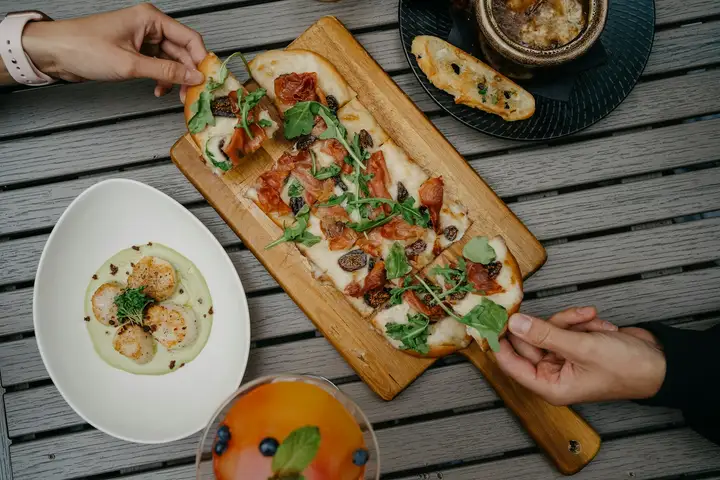
Look up a Roman style pizza recipe and you get two answers that cannot both be right. One says to roll a 60% hydration dough paper-thin. Another says to press an 82% dough into a sheet pan. Both are real Roman pizza, because the name covers at least three different things, and nearly every page describes only one of them. Pick the wrong one and you will wonder why your pizza looks nothing like the photo.
Roman style pizza is two main pizzas under one name: pizza tonda romana, a thin, rolled, crunchy round at about 55 to 60% hydration, and pizza al taglio, an airy pan pizza at 75 to 85%, cut and sold by weight. Unlike Neapolitan pizza, it has no official definition.
Who this is for: home bakers who want a crisp pizza without a 900°F oven, anyone confused by Roman recipes that contradict each other, and people who ate a slice in Rome and want to know which dough it came from.
TL;DR
- “Roman” is a family, not a recipe. Gabriele Bonci splits it into three: pizza al taglio (in teglia), pizza del fornaro (bakery pizza), and pizza tonda.
- The round (tonda): about 55 to 60% hydration, oil in the dough, 150 to 180 g balls, rolled thin, no raised rim, topped to the edge.
- The pan (teglia, sold al taglio): 75 to 85% hydration in practice, a long cold ferment, 15 to 30 mm thick, airy crumb, crisp base.
- Published recipes span 60% to 82% hydration, all labeled Roman. The table below converts eight of them to baker’s percent.
- Both styles suit a home oven far better than Neapolitan does. Dissapore calls the pan version the best pizza to make at home.
- Our teglia formula: 430 g bread flour, 335 g water (78%), 13 g oil, 10 g salt, 1.5 g instant yeast, 24 hours cold, one half-sheet pan.
- Our tonda formula: 420 g flour, 245 g water (58%), 17 g oil, 10 g salt, 1 g instant yeast, four balls of about 173 g.
- The most common failure on the pan style is pulling it out pale. Bake until the underside is properly brown.
What is Roman style pizza? The three styles behind the name
Roman style pizza is a family of pizzas from Rome, not one recipe. Unlike Neapolitan pizza, which holds EU protected status and UNESCO recognition, Roman pizza has no officially agreed definition.
The clearest map comes from Gabriele Bonci, the baker behind Rome’s Pizzarium. Quoted by Sky TG24, he divides Roman pizza into three types: pizza in teglia or al taglio, sold by weight; pizza del fornaro, found in the city’s bakeries; and pizza tonda, thin and crisp and served on a plate. Tony Gemignani’s Pizza Today column lists even more sub-categories and notes they can be thick or thin.
Pizza tonda romana: thin, rolled, crunchy
This is the round pizza you sit down to at a Roman pizzeria. Its signature is scrocchiarella, a Roman dialect word for crunch. Bonci describes it as thin with no cornicione, made from 150 to 180 g balls and very often a preferment (biga or poolish).
The style guide from Italian food site Dissapore puts the hydration at about 55% and credits the crisp edge to oil in the dough. The traditional tool is a rolling pin. One Palermo pizzeria rolls its tonda to about 1.5 mm, roughly 1/16 inch, and tops it right to the edge.
A 2018 document, the Manifesto della Nuova Pizza Romana, describes it as a low, crunchy pizza, topped to the edge, about 30 cm across, with no flour on the rim or base.
Pizza al taglio (pizza in teglia): tall, airy, sold by weight
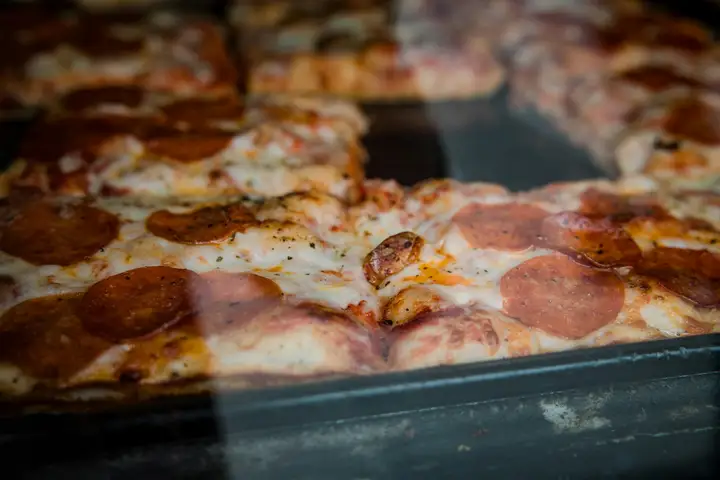
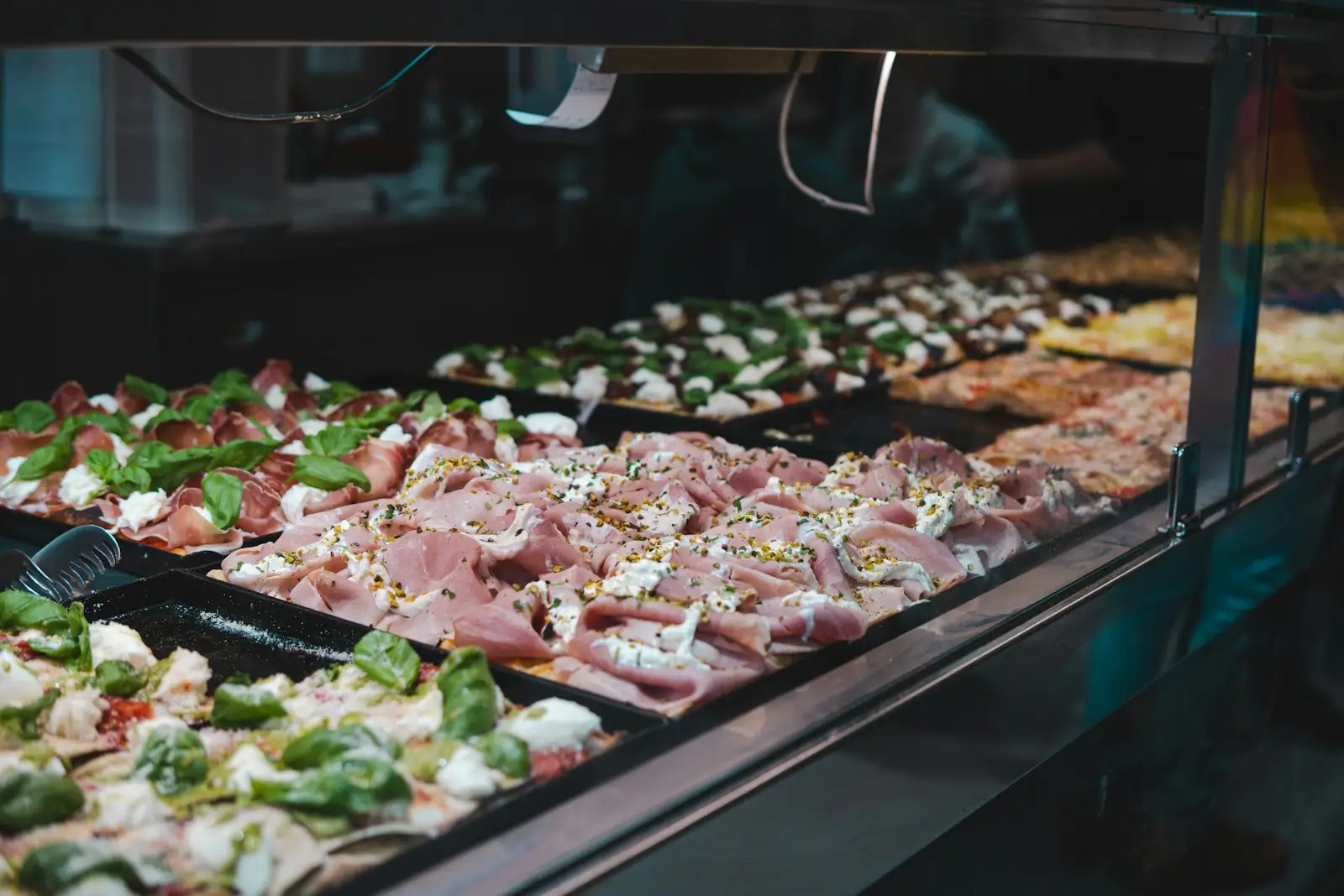
Al taglio means “by the cut.” In teglia means “in the pan.” They describe the same kind of pizza from two angles: how it is sold and how it is baked. You point, a slab gets cut with scissors, and it is weighed.
The Italian group Confraternita della Pizza has proposed a standard for it, quoted by Sky TG24: baked in a pan normally 60 x 40 cm, 15 to 30 mm thick and even across the surface, with no raised rim, a dry and delicate underside, and a wide, open crumb. Dissapore puts the dough at 75 to 90% hydration with 24 to 72 hours at 4°C (39°F).
Pizza del fornaro: the bakery bianca and rossa
These are the plain sheets sold in Rome’s bakeries. Bonci describes them as thin and crisp, traditionally baked in the bread oven, in a handful of classic forms: bianca, rossa, and bianca filled with mortadella. Pizza bianca is dough, olive oil, and salt, not the cream-sauced white pizza Americans know; our white pizza sauce guide sorts out that confusion.
Pizza alla pala, and where pinsa fits
Pizza alla pala is baked directly on the oven floor from a long wooden peel, stretching about a meter. Dissapore describes a thinner, slightly sweet dough with generous oil or lard and hydration up to 80%. Italy’s official tourism site treats teglia and pala as the same family of dough: spread it in a pan and you get teglia, bake it on the stone and you get pala.
Pinsa is a separate product with its own flour blend, created and trademarked in 2001. It gets sold as ancient Roman food, and it is not.
Roman style pizza by the numbers
Here are the styles side by side, using Italian reference figures rather than any single recipe.
| Tonda | Teglia / al taglio | Pala | |
|---|---|---|---|
| Shape | Round, about 30 cm (12 in) | Rectangle, pan normally 60 x 40 cm (24 x 16 in) | Long oval, about 1 m |
| Hydration | About 55 to 60% | 75 to 90%, though one Dissapore writer caps it at 85% | Up to 80% |
| Thickness | Very thin, about 1.5 mm at one pizzeria | 15 to 30 mm | Relatively thin |
| Fat in dough | Oil | Varies by recipe | Generous oil, lard, or both |
| Baked | On the oven floor, 360 to 400°C (680 to 750°F), under 2 minutes | In a pan, about 12 to 15 minutes | On the oven floor, from a long peel |
| Sold | Whole, on a plate | By the cut and weight | By the cut and weight |
What published Roman pizza recipes actually use
Published recipes run from 60% to 82% hydration, and each one simply says “Roman.” We converted eight of them to baker’s percent, where flour is 100% and everything else is a percentage of flour weight.
| Recipe | Style | Hydration | Salt | Oil in dough | Ferment |
|---|---|---|---|---|---|
| Vincenzo’s Plate | Round | 60% | 2.0% | About 5 to 7% | 16 to 24 h cold |
| Ooni bianca | Sheet pan | 67% | 4.0% | None (pan and top only) | 12 h+ cold |
| Gozney, Daniele Uditi | Rolled round | 70% | 3.5% | 5.0% | 12 h cold, then 4 to 6 h |
| Dissapore home teglia | Teglia | 75% | 2.0% | None | 24 h cold, then 4 to 6 h |
| Vincenzo’s Plate pala | Pala, with biga | 77% | 1.9% | 2.2% | Biga, then final dough |
| Adam Witt | Al taglio | 80% | 2.1% | 4.0% | 24 h cold |
| Bake-Street | Teglia | 80 to 81.5% | 2.2% | None | 24 h cold, then 4 to 5 h |
| America’s Test Kitchen | Al taglio | 82% | Not given in the article | 2 tbsp in the dough | 16 to 24 h cold |
Three things stand out. Hydration mostly tracks style: traditional rounds sit at the low end, pans and pala at the high end. That is why experts seem to contradict each other: Gemignani sees “higher hydration” in Roman dough while discussing pan-heavy styles, and Dissapore says the round runs about 55%. Both are right.
Uditi’s 70% round breaks the pattern, and it reflects a real shift. Gambero Rosso reports that the tonda is spreading well beyond Rome, and at least one of the new pizzerias it profiles is working with high hydration. As Giancarlo Casa of La Gatta Mangiona told Sky TG24, Rome has no single style the way Naples does, but at least four different ways of working.
Salt varies too, from 1.9% to 4%. That is a wider range than the style’s reputation for light salting suggests, so treat any one number as a choice, not a rule.
Roman style pizza vs Neapolitan
The round Roman pizza is thin and crunchy; Neapolitan is soft, with a tall, puffy rim. Bonci’s own comparison gives the clearest numbers.
| Roman tonda | Neapolitan | |
|---|---|---|
| Ball weight | 150 to 180 g | About 250 g |
| Oven | 360 to 400°C (680 to 750°F) | About 480°C (900°F) |
| Rim | None, or barely there | Tall cornicione |
| Hydration | 55 to 60% | 58 to 65% |
| Oil in dough | Yes | No |
| Shaping | Traditionally a rolling pin, today also by hand | By hand only |
| Texture | Crisp, dry snap | Soft, tender, foldable |
The ball weights and temperatures are Bonci’s, and the hydration ranges are from Dissapore’s comparison. The practical difference for you is heat. Neapolitan dough needs a very hot oven to set its soft crust in about a minute. The tonda wants a longer, drier bake, so it tolerates a lower temperature and suits a steel in a home oven.
Roman pizza vs Sicilian and Detroit
Roman pan pizza is wetter and airier than either American pan style. All three are rectangles, and that is where the resemblance ends.
| Roman teglia | Sicilian | Detroit | |
|---|---|---|---|
| Hydration | 75 to 85% | 65 to 70% | 65 to 70% |
| Crumb | Very open, large holes | Open but bready | Soft, focaccia-like |
| Base | Thin, crisp, dry | Oil-fried | Oil-fried, cheese edge |
| Toppings | Often added after the bake | Baked on | Cheese to the edge, sauce on top |
The proposed teglia standard calls for an underside that is dry and not greasy. That is the opposite of the fried bottom you want on Sicilian or Detroit, so oil a Roman pan enough to release the dough without leaving it swimming.
Where Roman pizza comes from
Roman pizza as we know it is a 20th-century food. In TASTE, Sara Jenkins recounts being told by chef Stefano Callegari that ancient Romans ate off cracker-like bread, then records his admission that the real story starts in the postwar years. Treat any ancient Rome origin story with suspicion.
The round started as a sideline in neighborhood trattorie and spread across the city in the 1970s, according to Bonci. The pan style grew up in rosticcerie. Many credit bakers from Terni who moved to Rome, and it became mass street food in the late 1970s and 1980s.
The high-hydration version came later. Dissapore traces it to the 1990s and Angelo Iezzi, and credits Bonci with making it explode in the new millennium. One practical motive, per Dissapore’s home recipe, was keeping pizza good on the counter for hours and bringing it back to life on reheating.
How to make pizza in teglia at home
This is the Roman pizza to start with, because it needs no special oven and very little skill with shaping. The formula below is built from the published recipes above, sitting between Dissapore’s beginner-friendly 75% and America’s Test Kitchen’s 82%. It is a starting point drawn from those sources, not a claim of our own test bakes.
House formula, one 18 x 13 inch half-sheet pan:
| Ingredient | Weight | Baker’s % |
|---|---|---|
| Bread flour | 430 g | 100% |
| Water | 335 g | 78% |
| Extra-virgin olive oil | 13 g (about 1 tbsp) | 3% |
| Fine sea salt | 10 g | 2.3% |
| Instant yeast | 1.5 g (about 1/2 tsp) | 0.35% |
That makes about 790 g of dough, or roughly 3.4 g per square inch. Use that figure to scale for another pan. Dissapore’s home recipe works out slightly thinner, at about 3.2 g per square inch.
Flour matters here. A dough this wet needs strength. Use bread flour, such as King Arthur’s at 12.7% protein. Dissapore warns that weak flour will not hold 75% water through a 24-hour rest.
- Mix. Stir the flour, yeast, and 310 g of the water in a large bowl until no dry flour remains. Cover and rest 20 minutes. Add the salt, the remaining 25 g of water, and the oil. Squeeze the dough through your fingers until everything is absorbed.
- Fold. Wet your hands, lift one edge, and fold it to the center. Work around the bowl. Cover, rest 20 minutes, and repeat twice more. America’s Test Kitchen found that folds built more gluten in its wet dough than 10 minutes in a stand mixer.
- Ferment cold. Leave the dough covered at room temperature for 1 hour, then refrigerate for 24 hours.
- Shape and proof. Turn the cold dough onto an oiled surface and fold it into a loose rectangle. Set it in an oiled container or pan, cover, and proof 3 to 4 hours at room temperature, until puffy and jiggly.
- Preheat. Set a rack in the lowest position, with a steel or stone on it if you own one. Heat the oven to 500°F (260°C), or its maximum if lower, for at least 45 minutes. Published recipes land close to this: Adam Witt uses 500°F, Bake-Street 509°F, and Dissapore 480 to 520°F. Heat from below is what crisps the base: ATK moved its pan to the lowest rack, and Dissapore puts it directly on the oven floor.
- Press into the pan. Turn the dough onto a surface dusted with semolina. Keep your hands open and press with your fingertips, edges first, then the center. Dissapore’s warning: closing your hand and pushing air to the rim, the way you would for a round pizza, destroys the crumb. Lift it into an oiled half-sheet pan and ease it to the corners. There is no rim.
- Bake in stages. Spread a thin veil of crushed tomato and bake on the lowest rack for 10 to 12 minutes, until the underside is browned. Add more tomato and bake 3 to 5 minutes. Add the mozzarella for the final 2 minutes, so it melts but stays white. Move the pan up a rack if the top needs color.
- Cool on a rack. Slide it out of the pan onto a wire rack. On a flat surface, steam ruins the crust. Add fresh toppings, then cut it with scissors, which is how it is done in Rome.
If the dough fights you, drop the water to 323 g (75%) next time. Once you are comfortable, go up to 345 g (80%). Above that the gains shrink: Dissapore’s writer rarely finds it useful to exceed 80%.
To reheat, Dissapore suggests a few minutes at 200°C (about 400°F). The pan style was designed for this. Our oven reheating guide has more detail.
How to make pizza tonda romana at home
This one rewards a good baking surface. The formula sits within the Italian 55 to 60% range, with a little less oil than Vincenzo’s Plate and Uditi use (4% against their 5% or more). Like the teglia formula, it is drawn from published sources and is not a claim of our own test bakes.
House formula, four 12-inch pizzas:
| Ingredient | Weight | Baker’s % |
|---|---|---|
| 00 or all-purpose flour | 420 g | 100% |
| Cold water | 245 g | 58% |
| Extra-virgin olive oil | 17 g (about 1 1/4 tbsp) | 4% |
| Fine sea salt | 10 g | 2.4% |
| Instant yeast | 1 g (about 1/3 tsp) | 0.24% |
That makes about 693 g, or four balls of about 173 g, right inside Bonci’s 150 to 180 g range. Vincenzo’s Plate recommends 00 flour and says all-purpose works too; our Neapolitan flour guide explains what 00 means.
- Mix. Combine the flour, salt, and yeast. Add the water, then the oil, and mix until smooth, about 8 to 10 minutes by hand or 5 in a stand mixer. At 58% this dough is firm and easy to handle.
- Rest and chill. Rest 30 minutes at room temperature, then refrigerate for 16 to 24 hours, the window Vincenzo’s Plate uses.
- Ball. Divide into four pieces of about 173 g, shape into tight balls, and rest 1 hour at room temperature.
- Preheat. Heat a pizza steel or stone at your oven’s maximum for at least 45 minutes.
- Roll. Dust the counter lightly and roll a ball into a 12-inch round, as thin and even as you can get it, keeping the edge as thin as the center. This is the opposite of our stretching guide, which protects the rim. Here you are deliberately pressing the gas out. Brush off excess flour, since the Manifesto calls for none on the rim or base.
- Top lightly. Spread sauce to the edge, and go easy. A thin pizza cannot carry wet toppings.
- Bake. Vincenzo’s Plate bakes the sauced base first for 2 to 3 minutes on a stone at 250°C (480°F), until it sets and colors underneath, then adds cheese for 1 to 2 minutes more. Keep going until the whole base is crisp, not just the edge.
In a portable oven, turn it down. Bonci’s range is 360 to 400°C (680 to 750°F), Uditi uses about 400°C (750°F), and Vincenzo’s Plate uses 320 to 350°C (610 to 660°F). All of that is well below the 850 to 950°F you would use for Neapolitan; see our pizza oven temperature guide. Ooni does the same for its pan bianca: heat the stone to 752°F, then drop the flame to its lowest setting before the pizza goes in.
Roman pizza toppings
Roman toppings are simple, and the pan style often gets them after the bake. Gemignani says he typically sees more white pizzas than sauced ones in this style, with many ingredients added after baking.
- Pan classics: rossa (just tomato), bianca (oil and salt), potato and rosemary, and mortadella. Jenkins singles out the “improbably delicious” potato and rosemary.
- After the bake: cured meats, fresh cheeses, and greens. America’s Test Kitchen finished one version with arugula, fresh mozzarella, and Parmesan.
- Round classics: margherita, and tomato and mozzarella with anchovies.
Bonci’s rule of thumb, reported by Food Republic, is two or three toppings that work together. “Anything more would be too much,” he said.
A naming trap: the anchovy pie swaps names depending on where you stand. In Rome, a pizza napoletana is tomato, mozzarella, and anchovies, while GialloZafferano’s “Roman pizza” is built on the same ingredients. So a pizza “romana” on a menu may be a topping, not a style. Our anchovies on pizza guide covers how to use them well.
What to skip
- Hydration bragging. Dissapore dismisses claims of 100% to 140% as web hype. Its writer never exceeds 85% for teglia and rarely finds it useful above 80%.
- A 60 x 40 cm pan. It is the professional standard, and about 24 x 16 inches will not fit most home ovens. A half-sheet pan is fine.
- Pulling the pan pizza early. Dissapore’s most exasperated warning is about pale pizzas from bakers afraid of burning them. A teglia bakes for 12 to 15 minutes at professional temperatures. It is very hard to burn, so bake until the base is brown.
- A stand mixer for very wet dough. America’s Test Kitchen found folds did better, and they cost you nothing.
- A thick rim on a tonda. Bonci notes the round is also shaped by hand today, so a rolling pin is not mandatory, but a rim is the wrong goal. The dough should be even from center to edge.
- Wet toppings early. On the pan, add fresh mozzarella in the last 2 minutes. On the round, keep everything light.
- Running a portable oven flat out. That is a Neapolitan habit. A burnt top on a raw crumb is what it gets you here.
- Using one style’s rules on the other. A 58% dough wants a rolling pin; a 78% dough wants your fingertips. If your dough is giving you trouble either way, our troubleshooting guide can help you find out why.
- Ancient Rome stories and digestibility claims. The first is myth, and the second is rarely backed by anything you can check.
Roman style pizza FAQ
What makes a Roman-style pizza?
It depends which Roman pizza you mean, because there is no official definition. Pizza tonda romana is thin, rolled, and crunchy, with oil in a dough of about 55 to 60 percent hydration, no raised rim, and toppings to the edge. Pizza al taglio is baked in a pan from a 75 to 85 percent hydration dough, with an airy crumb and a crisp base, then cut and sold by weight.
What’s the difference between Roman pizza and Neapolitan pizza?
The round Roman pizza is thin and crunchy with no cornicione; Neapolitan is soft and tall-rimmed. Gabriele Bonci puts the Roman ball at 150 to 180 grams, baked at 360 to 400C, and the Neapolitan ball at about 250 grams, baked at about 480C. Roman dough usually contains oil and has traditionally been rolled with a pin; Neapolitan dough is stretched by hand only.
Is Roman pizza thick or thin?
Both, because the name covers different pizzas. Pizza tonda romana is very thin, with one Italian pizzeria rolling it to about 1.5 mm. Pizza al taglio is thicker: the Confraternita della Pizza’s proposed standard calls for 15 to 30 mm, with an open, airy crumb.
What’s the difference between Sicilian pizza and Roman pizza?
The pan-style Roman pizza is wetter and airier. Pizza al taglio runs about 75 to 85 percent hydration and has an open crumb with a thin, crisp base. American Sicilian runs about 65 to 70 percent, with a thicker, softer, bread-like crumb and a bottom fried in oil. Roman pan pizza is often finished with toppings after the bake, while Sicilian is usually baked fully topped.
How do you make Roman-style pizza crust crispy?
For the round, roll the dough very thin, include oil in the dough, keep the toppings light, and bake on a fully preheated steel or stone. For the pan style, bake on the lowest rack until the underside is properly browned, add wet toppings late, and cool the pizza on a wire rack so steam does not soften the base.
Do you need a pizza oven for Roman pizza?
No. Pizza al taglio is baked in a pan, and Dissapore calls it the best pizza to make at home, using an ordinary oven at its maximum setting. The thin round also works on a preheated steel or stone. If you do use a portable oven, run it cooler than you would for Neapolitan.
Is pizza al taglio the same as focaccia?
No, though they are close relatives. America’s Test Kitchen compares al taglio’s bubbly crumb to good focaccia. The difference is in the treatment: al taglio is pressed to an even thickness with a thin, crisp base and works as a platform for toppings, sold by the cut. Focaccia is usually dimpled, softer, and eaten as bread.
Related reading
- Pinsa, the other “Roman” flatbread, and what is true about it
- Sicilian pizza dough recipe, the American-Italian pan cousin
- Pizza oven temperature, by style and by oven
- Tavern style pizza, another thin, crisp pizza built for a home oven
Pick the pizza first, then the dough
Most Roman pizza failures start with the wrong recipe for the pizza in your head. If you want a thin, crackling round, you want 55 to 60% water, oil, and a rolling pin. If you want a tall, airy slab, you want 75 to 80% water, folds, a day in the fridge, and the nerve to leave it in the oven until the bottom is brown. Both work in the oven you already own, which is more than Naples can promise.