Ask most people to name Chicago’s pizza and they will say deep dish. Ask a Chicagoan what they actually order on a Tuesday and the answer is tavern style pizza: a thin, crispy, cracker-crust pizza cut into little squares. Deep dish is the famous one, the one tourists line up for. Tavern-style is the one the city actually eats, in neighborhood joints and corner bars, week in and week out. This is what it is, why it is built the way it is, how it differs from every other thin crust (including its square-cut Missouri cousin, St. Louis style), and how to make a proper one at home.
TL;DR
- Tavern-style pizza is Chicago’s everyday thin pizza: a low-hydration, rolled-thin, rigid cracker crust, cut into squares (the “party cut”), not wedges.
- It is the opposite of deep dish. Deep dish is tall and casserole-like; tavern-style is flat and crisp. Locals eat far more tavern-style than deep dish.
- The crust is a cracker by design. Low hydration (around 50%), a little oil, rolled thin, and docked, so it bakes stiff and snaps instead of folding.
- Cheese and toppings go to the very edge. No bare rim. The classic Chicago topping is Italian sausage and giardiniera; pepperoni is just as common.
- The square cut is functional: it is bar food, easy to grab one-handed with a drink, more crispy corners, easy to share.
- It is not New York thin (which is chewy and foldable) and not the New Jersey bar pie (a thin char-edged round, a cousin from a different region).
- Bake it hot (around 500F) on a stone, steel, or screen until it is deeply crisp.
What is tavern style pizza (and why it is not deep dish)
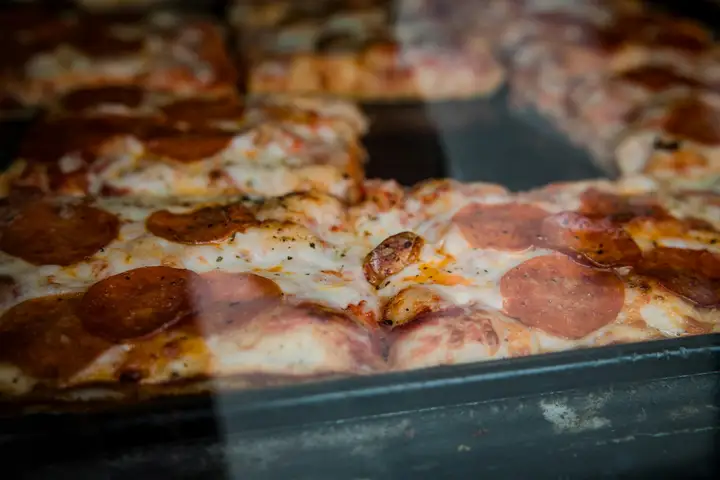
Tavern-style pizza, also called Chicago thin crust, is a thin, crisp, flat pizza on a stiff cracker-like crust, topped edge to edge and cut into small squares. Per the definition on Wikipedia’s tavern-style pizza page, it is the thin-crust style associated with Chicago and the greater Midwest, distinct from the deep-dish style that made the city famous.
That distinction is the whole point, because the most common belief about Chicago pizza is exactly backwards. Deep dish, the tall, buttery, casserole-style pie baked in a deep pan, is Chicago’s export and its tourist draw. But it is not what most Chicagoans eat most of the time. The everyday pizza, the one from the neighborhood spot and the corner tavern, is thin-crust tavern-style. If you grew up in Chicago, “pizza” means a thin square-cut pie, and deep dish is the thing you get when out-of-town relatives visit.
The cracker-thin crust
The defining feature is the crust: thin, flat, and rigid enough to snap. It does not puff, it does not fold, and it has no airy cornicione (the big bubbled rim of a Neapolitan or New York pie). It is closer to a savory cracker than to bread, and that is deliberate. The texture comes from a low-hydration dough rolled thin and baked until crisp, which we get into below.
The square (party) cut
Tavern-style is cut into small squares, usually two inches or so, in a grid. This is the “party cut” or “tavern cut,” as opposed to the wedge or “pie cut” you get with New York and most other styles. It is not a gimmick. A rigid cracker crust does not fold, so squares are simply easier to pick up and eat with one hand, which matters when the other hand is holding a beer. The grid also produces more crispy edge and corner pieces, and small squares are easy to share around a table. Form following function, bar-pizza edition.
Tavern vs deep dish vs New York thin vs the New Jersey bar pie
Thin, crispy pizza gets called a lot of things, so here is where tavern-style sits:
- Tavern-style (Chicago): low-hydration, rolled-thin, rigid cracker crust, square cut. Crunchy and flat.
- Deep dish (Chicago): the opposite. A tall pie baked in a deep, buttery pan, cheese on the bottom, chunky sauce on top, eaten with a fork. See how different a Chicago pan pizza can get in our Detroit-style pizza recipe, which is the other great Midwestern pan style (airy, with a crisp frico edge), and is itself nothing like tavern-style.
- New York thin: also thin, but higher-hydration and fermented, so it is pliable, chewy, and foldable, and cut into big triangular slices. Built to fold, not to snap. See our New York-style pizza crust.
- New Jersey bar pie: a close cousin and a common point of confusion. The famous Serious Eats “crispy bar-style pizza” recipe by Kenji Lopez-Alt is the New Jersey bar pie (Star Tavern in Orange, NJ), a small, thin, char-edged round. It is delicious and related, but it is a New Jersey tradition, not Chicago tavern-style. If you searched “tavern pizza” and landed on a New Jersey recipe, that is why it looked a little different.
Where tavern-style pizza comes from
Tavern-style is named for exactly what it sounds like: the bars and taverns that served it. In mid-century Chicago, neighborhood taverns put out thin, square-cut pizza as cheap, salty bar food, the kind of thing that pairs with a beer and keeps people ordering another round. A thin cracker crust was inexpensive to make, and cutting it into small squares meant a bar could feed a crowd while patrons grabbed a piece without setting down their drink.
That bar-food origin is why the format is the way it is, and it stuck. Thin, square-cut pizza became the default neighborhood pizza across Chicago and much of the Midwest, the everyday pie from corner spots and Italian-American joints. Deep dish, commonly credited to Pizzeria Uno in 1943, came later and became the city’s famous symbol, but it never displaced thin crust as the local everyday choice. Pizza writers who have dug into the style agree on this; Andrew Janjigian’s deep look at Chicago tavern-style makes the case that the square-cut thin crust, not deep dish, is the true Chicago vernacular pizza.
The dough: why it bakes into a cracker (the chemistry)
The cracker texture is not an accident of baking; it is engineered into the dough. Three choices do the work.
Low hydration. A tavern-style dough runs around 50% hydration (50 grams of water per 100 grams of flour), sometimes lower. That is dramatically drier than a Neapolitan dough at 60 to 65% or a wet ciabatta-like dough at 75%+. Less water means less gluten development and far less gas retention, so the dough cannot puff. It bakes dense and stiff instead of airy and chewy. The low hydration is the single biggest reason tavern-style snaps. It is the same principle behind a no-yeast cracker-style crust, just with a little yeast and a long rest for flavor.
A little fat. Tavern-style doughs include some oil, and traditionally many Chicago shops used shortening or lard. The fat coats flour proteins, shortens the gluten strands, and promotes a tender-but-crisp, shortbread-like snap rather than a tough chew. It is what separates a pleasant cracker from a hard biscuit.
Rolled, not stretched, then docked. Because the dough is stiff and you want it flat and even, you roll tavern-style dough with a pin rather than stretching it by hand. Then you dock it (prick it all over with a fork or a docking tool) so it does not bubble up in the oven. A puffed bubble is the enemy of a flat cracker. Many recipes also rest the dough cold for a day or more, which relaxes the stiff gluten so it rolls thin without fighting back, and develops a little flavor in a dough that otherwise ferments very little.
On flour: all-purpose is the workhorse here, because its moderate protein gives tenderness and a clean snap. Bread flour makes the crust tougher and chewier, which is the wrong direction for a cracker. A small amount of semolina or fine cornmeal (swapped in for some of the flour, or just dusted on the peel) adds a sandy, extra-crisp bite that many Chicago shops favor. This is the opposite end of the flour spectrum from a high-protein, long-ferment dough; if you want the chewy, open style instead, that is a job for 00 or bread flour and a wet dough.
Chicago tavern style pizza recipe
This makes two roughly 12-inch thin crusts. The dough is happiest with a cold rest, so start it a day ahead if you can.
The dough
- 300g all-purpose flour (or 250g all-purpose plus 50g semolina for extra crunch)
- 150g water, room temperature (50% hydration, deliberately low)
- 25g (about 2 tablespoons) neutral oil, or melted shortening for tradition
- 1 teaspoon (3g) instant yeast
- 1 teaspoon sugar
- 1 teaspoon (6g) fine salt
- Mix to a stiff dough. Combine everything and mix until it forms a firm, slightly shaggy ball. This dough is much drier than you may be used to; that is correct. Knead 3 to 4 minutes until smooth and tight.
- Cold rest (recommended). Wrap and refrigerate 24 to 72 hours. This relaxes the gluten so it rolls thin, and adds the only real flavor development this low-ferment dough gets. Short on time? Rest it covered at room temperature for 1 to 2 hours; it will still work, with slightly less flavor.
- Roll very thin. Divide in two. On a floured counter, roll each piece with a pin to about 1/8 inch (3mm) or thinner, into a 12-inch round. Roll, do not stretch; you want it flat and even, not hand-shaped.
- Dock it. Prick the entire surface all over with a fork. This keeps it from bubbling into a balloon.
The sauce
Keep it thin and cooked, not raw and wet. A simple version: simmer one 14-ounce can of crushed tomatoes with 1 minced garlic clove, 1 teaspoon dried oregano, 1/2 teaspoon sugar, and salt for 15 minutes until thickened. Spread a thin layer; a thick crust of sauce will steam the cracker soft. For more on building a sauce, see our pizza sauce recipe.
Toppings: sausage, giardiniera, cheese to the edge
The cardinal rule of tavern-style is cheese to the very edge, no bare rim. Use low-moisture mozzarella, spread right out to the perimeter so every square has cheese and the edges crisp into lacy brown. Some Chicago shops blend in a little sharper cheese (a touch of cheddar or brick) for color and tang, but mozzarella alone is the standard. Keep the load light overall: a thin crust cannot carry a heavy pile without going soggy, so go easier than you would on a thicker pie.
The classic Chicago topping is Italian sausage, pinched into small raw nuggets and scattered over the cheese so they cook and render right on the pizza, fennel and all. The other signature is giardiniera, and it is worth knowing because it is the topping that makes a tavern pizza taste like Chicago. Giardiniera is a relish of pickled vegetables (typically celery, carrots, cauliflower, peppers, and sport peppers) packed in oil, sold mild or hot. Its bright, vinegary, spicy bite cuts the richness of cheese and sausage. Add it in the last few minutes if you want it to soften and meld, or after the bake if you want it sharp and crunchy. Pepperoni is equally traditional and, because it is dry, an easy first topping that will not weigh the crust down.
Rolling, docking, and baking
- Preheat hard, and pick your surface. Get a stone or steel up to temperature at 500F for at least 45 minutes. Baking on a pizza steel gives the fastest heat transfer and the crispest bottom; a stone is a close second. A perforated pizza screen is the third option and the one many Chicago shops actually use: the holes let the bottom dry and crisp evenly, and a thin, rigid tavern crust slides on and off a screen without the launching skill a bare stone demands. If you are new to thin crust, a screen is the forgiving choice.
- Build on the screen or a peel. Sauce thin, cheese to the edge, toppings light.
- Bake hot and fast at 500F for 10 to 12 minutes, until the cheese is browning and the bottom is deeply crisp and rigid. Lift an edge; it should be stiff and golden, not pale or floppy.
- Cut into squares. Let it set for a minute, then cut in a grid with a rocker knife or a wheel. Two-inch squares is the standard.
Troubleshooting
- Soggy, not crisp: too much sauce, too many toppings, or the baking surface was not hot enough. Use a thin layer of sauce, keep toppings light, and fully preheat the stone or steel at 500F.
- It puffed into bubbles: you skipped docking, or did not dock thoroughly. Prick the entire surface before baking, edges included.
- Pale and floppy: underbaked, or the oven ran cool. Tavern-style needs to bake until the bottom is rigid and deep golden. Give it the full time on a fully preheated surface, and check by lifting an edge.
- Hard as a board: rolled too thick and then overbaked, or not enough fat in the dough. Roll thinner, do not skimp on the oil that gives the crust its short snap, and pull it as soon as the bottom is crisp.
- The dough fought back when rolling: the gluten was tight. A cold rest of a day or more relaxes it. Rolling same day, let the dough rest 15 minutes whenever it resists, then continue.
- Uneven thickness: that is hand-stretching, not rolling. Use a pin and aim for an even 1/8 inch across the whole round.
What to skip
- Do not use a high-hydration dough. This is the most common mistake. A wet, chewy dough makes a New York or Neapolitan pie, not a cracker. Tavern-style is defined by being dry, around 50% hydration.
- Do not stretch it by hand or leave it thick. Roll it thin with a pin. Hand-stretching leaves it uneven and too thick to crisp.
- Do not skip docking. An undocked tavern crust balloons into bubbles instead of staying flat.
- Do not leave a bare crust rim. Cheese goes to the edge. A bare puffed rim is a New York move; on tavern-style it just bakes into a hard, naked border.
- Do not drown it in sauce or pile on toppings. A thin cracker steams soft under a heavy, wet load. Thin sauce, light toppings.
- Do not bake it low and slow. It needs high heat to crisp before it dries out. 500F on a hot surface.
- Do not confuse it with deep dish, or call the New Jersey bar pie “Chicago tavern.” They are different pizzas from different places.
Where tavern-style fits in the pizza map
Tavern-style pizza is the corrective to the biggest myth in American pizza: that Chicago means deep dish. The city’s real everyday pizza is this thin, crisp, square-cut cracker, and once you understand it, the rest of the Chicago and Midwestern map makes sense. Deep dish is the special-occasion pan pie. Detroit-style is the airy, frico-edged pan pizza from up the road. Tavern-style is the unfussy thin one you eat at the bar with a beer, cut into squares so everybody gets a crispy corner.
Make it once and the appeal is obvious: it is fast, it is genuinely crispy in a way a chewy crust never is, and it is a different pleasure from a foldable New York slice or a leoparded Neapolitan pie. Roll it thin, dock it, cheese it to the edge, bake it hard, and cut it into squares. That is Chicago, the real one.
FAQ
What is the difference between tavern pizza and regular pizza?
Tavern-style pizza is Chicago's thin, crispy, rigid cracker-crust pizza, cut into small squares (the 'party cut' or 'tavern cut') rather than wedges. Its dough is low-hydration and rolled thin, so it bakes stiff and snaps rather than folding. 'Regular' pizza usually means a softer, chewier, foldable crust like New York style, made from a wetter, fermented dough and cut into triangular slices.
Is tavern style pizza the same as deep dish?
No, they are opposites, and this is the biggest misconception about Chicago pizza. Deep dish is a tall, buttery, casserole-like pie baked in a deep pan, with cheese on the bottom and chunky sauce on top. Tavern-style is thin, crispy, and flat. Despite deep dish being Chicago's famous export, tavern-style thin crust is the pizza Chicagoans actually eat most of the time. It is the everyday neighborhood and bar pizza.
Why is tavern style pizza cut into squares?
The square or 'party cut' suits the pizza and the setting. A thin, rigid cracker crust does not fold, so squares are easier to grab and eat with one hand while holding a drink, which is the point of bar pizza. Squares also mean more crispy edge and corner pieces to go around, and small pieces are easy to share across a table. It is practical, not arbitrary.
What is on a Chicago tavern style pizza?
A thin layer of cooked tomato sauce, low-moisture mozzarella spread all the way to the edge (no bare crust rim), and toppings. The classic Chicago combination is Italian sausage and giardiniera (pickled vegetables), though pepperoni is just as common. Because the crust is thin and crisp, toppings are kept light so they do not weigh it down or make it soggy.
What is the difference between tavern style and New York thin crust?
Both are thin, but they are made differently and eat differently. New York crust is higher-hydration and fermented, so it is pliable, chewy, and foldable, and it is cut into large triangular slices. Tavern-style is low-hydration and rolled thin, so it bakes into a rigid, snappy cracker, and it is cut into squares. New York is built to fold; tavern-style is built to crunch.