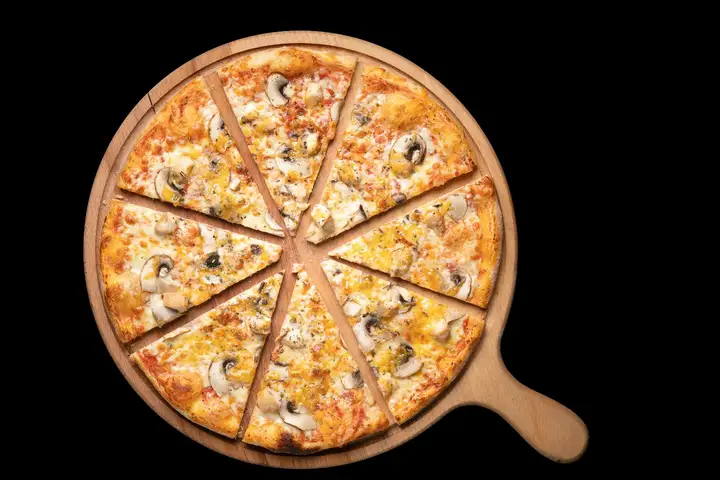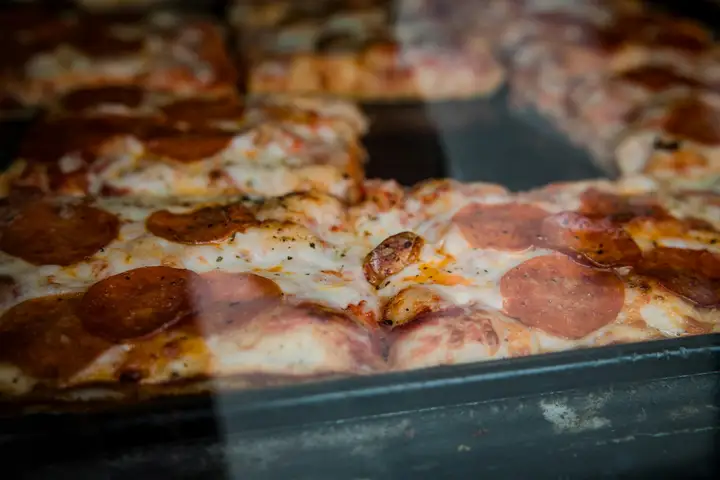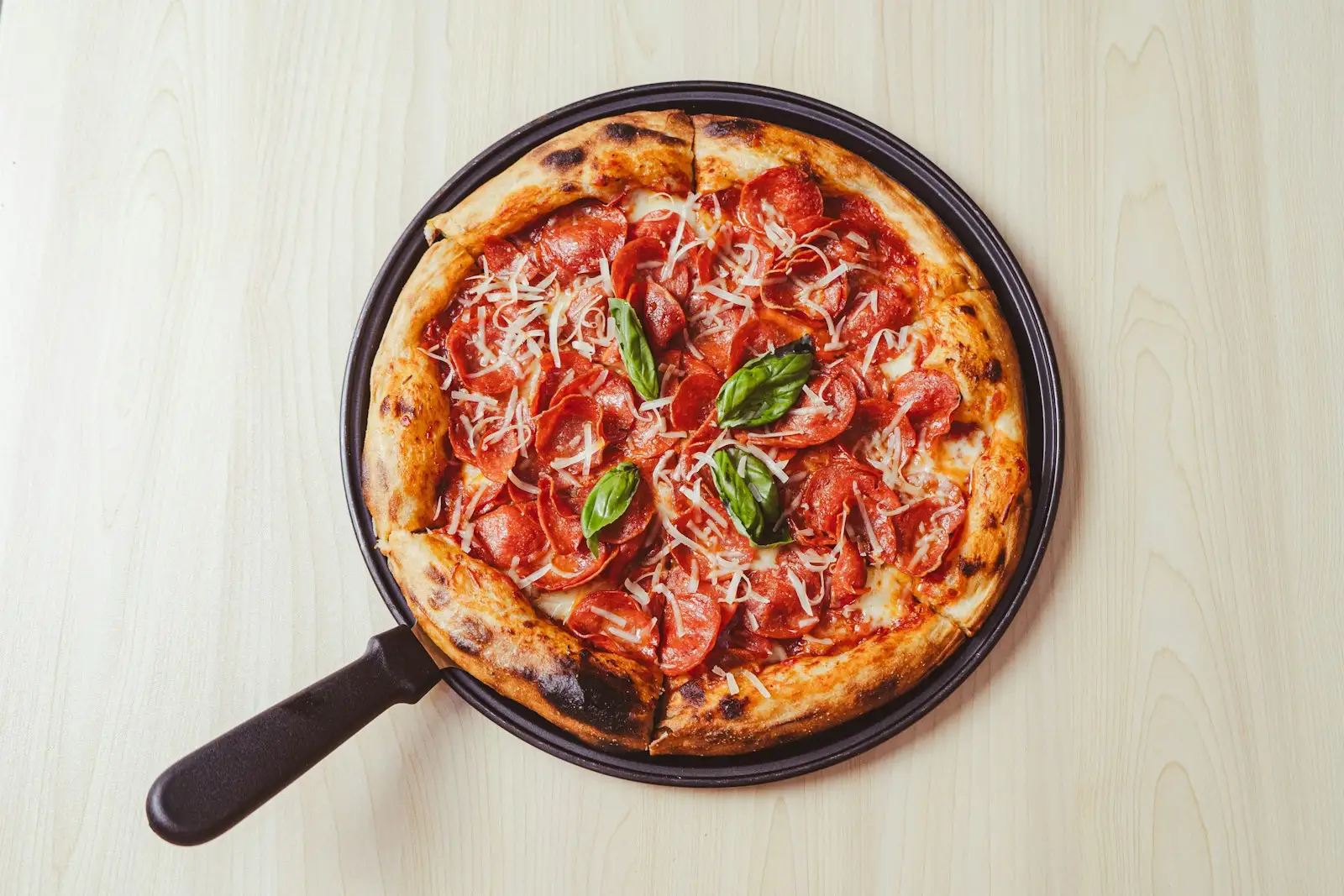
Sicilian pizza is the rectangular pan pizza that confuses every home cook the first time they make it. It is not New York. It is not Detroit. It is not focaccia, and it is not pinsa, the oval Roman flatbread it gets mistaken for at a glance. The real Sicilian (sfincione) comes from Palermo with anchovies and breadcrumbs; the American Sicilian (the square slice from any Italian-American pizzeria) swapped the toppings for mozzarella and tomato sauce. Both share the same dough: high-hydration, long-fermented, baked in an olive-oiled rectangular pan until the bottom is golden and the crumb is open. Here is that dough recipe, built at 65 percent hydration with a 24-hour cold ferment, plus the distinctions between Sicilian and every other rectangular pan pizza on the menu.
TL;DR
- Sicilian pizza dough recipe at a glance: 500g bread flour, 325g water (65 percent hydration), 10g salt, 2g instant yeast, 25g olive oil. Mix, bulk ferment 1 to 2 hours at room temp, cold ferment 12 to 24 hours, press into an oiled half-sheet pan, second rise 1 to 2 hours, top, bake at 500F for 18 to 22 minutes.
- The right flour: King Arthur Bread Flour (12.7 percent protein) for the home-cook default. The Gozney pro recipe uses a 68/32 blend of 00 and bread flour for a softer crumb with chew.
- The right pan: 13x18 inch aluminum half-sheet pan (the home-cook standard). NOT a Detroit-style Lloyd pan; Sicilian is shallower and bigger than Detroit. See our Detroit-style pizza recipe for the contrast.
- Hydration target: 65 percent for the home-oven sweet spot. The Gozney pro recipe runs 67 percent. Below 60 you get a dense crust; above 70 the dough is hard to handle without a mixer.
- The flavor lever is fermentation. Same-day works. Overnight cold ferment (12 to 18 hours) is the sweet spot for most home cooks. 24-hour cold ferment with a biga preferment is the considered upgrade.
- What to skip: all-purpose flour (too soft for a long ferment), a rolling pin (kills the gas), Detroit pans (wrong dimensions), sweet sauces with 2+ tablespoons sugar, and under-proofing in the pan.
- The Sfincione vs Sicilian-American distinction: real Sicilian (sfincione) is from Palermo with anchovies, onions, caciocavallo, breadcrumbs. American Sicilian is the New York-Italian adaptation with mozzarella and tomato sauce. Both are legitimate; this recipe builds the American version because it is what most readers actually want to make.
The quick answer: how Sicilian pizza dough is different
Sicilian pizza dough is a higher-hydration, longer-fermented dough than standard pizza dough, baked in a rectangular olive-oiled pan at 500F. The high hydration (65 to 70 percent versus 58 to 62 percent for Neapolitan or New York) produces the airy open crumb. The long cold ferment (12 to 24 hours) develops the flavor. The oil in the pan creates the crisp golden bottom that defines the style.
That is the answer. The rest of this article is the why, four alternative fermentation schedules, the pan-by-pan honesty, the Sfincione vs Sicilian-American distinction, and the FAQ that addresses what Google currently has no answer for.
What Sicilian pizza actually is
The biggest source of confusion in this style is that “Sicilian” means two different things depending on which side of the Atlantic you are on.
Sfincione: the real Palermo street pizza
In Palermo, sfincione is the regional pizza tradition. The name comes from sfincia, the Sicilian word for “sponge,” referring to the dough’s open spongy crumb. Sfincione is sold by street vendors throughout Palermo, served in squares from a sheet pan. The traditional toppings are:
- Tomato sauce, often with onions cooked in
- Anchovies
- Caciocavallo or pecorino cheese (NOT mozzarella)
- Breadcrumbs scattered on top before baking
The breadcrumbs are the giveaway. Real sfincione has a golden crunchy breadcrumb topping that ties the texture together. Kenji Lopez-Alt’s no-roll, no-stretch Sicilian-style square pizza at Serious Eats explains the technique honestly: sfincione’s defining feature is the crumb-and-oil top, not the cheese.
Sicilian-American: the New York-Italian adaptation
The “Sicilian square slice” you get at any Italian-American pizzeria in Brooklyn, Long Island, or New Jersey is a different beast. Italian immigrants to America in the early 20th century brought sfincione with them, then adapted it to American ingredients and palates:
- Anchovies and onions out, mozzarella in
- Breadcrumbs out, more tomato sauce in
- Caciocavallo replaced with low-moisture mozzarella
- The dough sometimes laminated with olive oil for a flakier interior
This is the version most American readers actually want to make. It is the version this recipe builds. Both versions use the same fundamental dough; only the toppings and final-build order change.
How Sicilian differs from Detroit, Grandma, and Roman
All four are rectangular pan pizzas. The distinctions are real:
| Style | Pan | Hydration | Cheese | Sauce position | Defining feature |
|---|---|---|---|---|---|
| Sicilian (American) | 13x18 half-sheet, 1” deep | 65 to 70% | Low-moisture mozzarella | Top, edge to edge | Thick, open crumb, oil-fried bottom |
| Sicilian (sfincione) | 13x18 half-sheet, 1” deep | 65 to 70% | Caciocavallo / pecorino | Cooked in or below | Breadcrumb topping |
| Detroit | Lloyd Pan, 10x14, 2.25” deep | 65 to 70% | Wisconsin brick + mozz | On top, racing stripes after bake | Frico cheese edge climbing the pan walls |
| Grandma | Half-sheet, shallow | 60 to 65% | Low-moisture mozzarella | On top | Thinner crust, less oil, faster bake |
| Roman (al taglio) | Long shallow pan | 75 to 85% | Varies wildly | Bare or with anything | Ultra-high hydration, ultra-thin, sold by weight |
Sicilian sits in the middle: thicker than Grandma, lower-hydration than Roman, less deep than Detroit. Our Wisconsin brick cheese for Detroit style pizza article covers the Detroit cheese system; Sicilian uses standard low-moisture mozz instead.
Why the dough matters: chemistry of the open crumb
The defining characteristic of good Sicilian pizza is the crumb. Cut into a slice and you should see a network of irregular air pockets, like an artisan focaccia, not the tight uniform crumb of a New York slice. Three variables produce that crumb.
65 to 70 percent hydration (and why higher than NY)
Hydration is the ratio of water to flour, by weight. Neapolitan dough at home runs 58 to 62 percent. New York runs 60 to 65 percent. Sicilian wants 65 to 70 percent.
Why higher: the longer ferment plus the second rise in the pan plus the 500F home-oven bake all benefit from a wetter dough. More water means more steam during baking, which means more oven spring and a more open crumb. The trade-off is that wetter doughs are harder to handle. 65 percent is the sweet spot where the dough is wet enough for the right crumb but firm enough to mix and press by hand without sticking to everything.
Bread flour vs 00 vs all-purpose
The protein content of the flour determines how much gluten the dough can develop, which determines how well the dough holds its shape through a long ferment.
- Bread flour (12.7 percent protein): the home-cook default. Develops enough gluten to support 65 to 70 percent hydration through a 24-hour cold ferment without collapsing. King Arthur Bread Flour is the canonical pick.
- 00 flour (11 to 12 percent protein): produces a softer, more focaccia-adjacent crumb. Italian style. The traditional Palermo sfincione is made with 00. Works at 65 percent hydration but the dough is slightly more delicate.
- High-gluten flour (13 to 14 percent, like King Arthur Sir Lancelot): overkill for Sicilian. The structural support exceeds what the style needs. Save it for NY.
- 00 + bread flour blend (68/32 like the Gozney pro recipe): the considered upgrade. The 00 brings softness, the bread flour brings chew. Worth the extra step for a special bake.
- All-purpose flour (10 to 11 percent protein): technically works but produces a denser, less open crumb. Skip if you have bread flour available.
Biga preferment vs straight dough vs poolish
A preferment is a portion of the dough you mix the night before and let ferment overnight, then incorporate into the final dough. The point is flavor depth without extending the final-dough fermentation.
Two main types:
- Biga (Italian): a firm preferment, roughly 50 to 60 percent hydration. Drier dough ball that ferments slower and produces more complex flavor notes (nutty, wheaty).
- Poolish (French): a wet preferment, 100 percent hydration (equal parts flour and water). Loose batter that ferments faster and produces a softer, sweeter dough character.
For Sicilian, biga is the traditional choice. The firmer preferment matches the dense thick-crust character of the style better than a wetter poolish would. Modernist Pizza covers this distinction in depth; the Gozney pro recipe uses biga for the same reason.
For most home cooks, a straight 24-hour cold ferment without a preferment is the right call. The flavor gap between a straight cold ferment and a biga-based recipe is real but small; the time investment is much bigger. Use biga when you want to push the recipe one extra notch.
Olive oil in the dough and in the pan
Sicilian dough has olive oil mixed into the dough itself (roughly 5 percent of the flour weight) and a generous layer of olive oil in the pan before the dough goes in. Both matter.
The oil in the dough tenderizes the crumb and contributes flavor. The oil in the pan does something more dramatic: it shallow-fries the bottom of the dough during baking. The bottom crust comes out golden, crisp, almost biscuit-like in texture. Without enough oil in the pan, the bottom comes out pale and bready instead of golden and crisp.
Quantity: 25g (about 2 tablespoons) of olive oil in the dough for a 500g flour recipe. 45 to 60g (3 to 4 tablespoons) in the half-sheet pan before the dough goes in. Use a good-quality extra-virgin olive oil; you can taste it in the finished crust.
The recipe: 24-hour cold ferment, half-sheet pan
This is the recipe we recommend. Yields one half-sheet pan (roughly 13x18 inches), 8 to 12 squares depending on how you cut.
Ingredients (by weight)
| Ingredient | Weight | Baker’s percentage |
|---|---|---|
| Bread flour | 500g | 100% |
| Water (room temp, 70F) | 325g | 65% |
| Fine sea salt | 10g | 2% |
| Instant yeast | 2g | 0.4% |
| Extra-virgin olive oil (in dough) | 25g | 5% |
| Extra-virgin olive oil (in pan) | 45g | (additional) |
If you only have active dry yeast, use 3g instead of 2g and bloom it in the water before mixing.
Mixing the dough
- Combine dry: whisk together the flour, salt, and yeast in a large bowl.
- Add water and oil: pour in the water and the 25g of olive oil. Mix with a wooden spoon or your hand until the dough forms a shaggy mass with no dry flour visible. About 2 minutes.
- Rest 10 minutes (autolyse). This lets the flour fully hydrate and starts gluten development without effort.
- Knead lightly: 4 to 5 minutes by hand on a lightly floured surface, or 4 minutes on low in a stand mixer with the dough hook. The dough should be smooth and slightly tacky but not sticking to the bowl. If it is sticking aggressively, add 1 to 2 tablespoons of flour.
- Form a ball: tuck the dough into a tight ball with the seam at the bottom.
Bulk fermentation (room temp 1 to 2 hours)
Place the dough ball in a lightly oiled bowl, cover with plastic wrap or a damp towel, and let it ferment at room temperature (68 to 75F) for 1 to 2 hours, until it has roughly doubled in size.
This room-temp bulk gives the yeast a head start before the cold ferment slows it down. Skip this step (go straight to the fridge) and the dough may not develop enough flavor in the cold ferment alone.
Cold ferment 12 to 24 hours
Transfer the dough ball, still in its covered bowl, to the refrigerator. Let it cold ferment for 12 to 24 hours.
- 12 hours: workable, good flavor, easier to handle.
- 18 hours: the Alexandra Stafford sweet spot. Flavor is meaningfully better than 12 hours.
- 24 hours: maximum flavor development. The dough’s surface may look slightly blistered or wrinkled; that is normal.
- Past 36 hours: gluten starts breaking down. The dough loses structure. Don’t push past 36 hours without a biga preferment that controls fermentation differently.
Pan stretch and second rise (1 to 2 hours)
- Oil the pan: drizzle 45g (about 3 tablespoons) of olive oil into a 13x18 inch aluminum half-sheet pan. Spread it edge to edge with your hand or a brush.
- Pull the dough from the fridge and place it directly in the center of the pan. Do not knead it or punch it down.
- Press the dough toward the edges with oiled fingertips. It will resist and spring back the first time; that is expected. Press to roughly 8 inches wide and stop.
- Wait 15 to 20 minutes for the dough to relax.
- Press again toward the edges of the pan. This time the dough will spread more willingly. Push it into the corners. If it tears, stop, wait 10 minutes, try again.
- Cover the pan loosely with plastic wrap or a damp towel and let it second-rise at room temperature for 1 to 2 hours, until the dough has visibly puffed and looks pillowy.
The second rise is the most-skipped step and the single most common failure point. A Sicilian pizza without a proper second rise comes out dense and crackery instead of pillowy and open. Don’t skip it.
Sauce and toppings (the Sicilian-American way)
For the American Sicilian build:
- Sauce: see our pizza sauce recipe. Use the American cooked side, not the no-cook Neapolitan side. Sicilian wants a thicker sauce with cooked garlic and oregano notes.
- Cheese: 200 to 250g shredded low-moisture mozzarella. NOT fresh mozzarella (too wet for Sicilian). NOT Wisconsin brick cheese (that is the Detroit move; Sicilian uses standard mozz).
- Order: cheese first, edge to edge, then sauce dolloped on top in spoonfuls. The traditional American Sicilian has sauce visible on top, not buried under cheese.
- Optional toppings: pepperoni (the classic), Italian sausage crumbles, mushroom, fresh basil after the bake.
For the traditional sfincione build:
- Skip mozzarella entirely
- Sauce mixed with sliced onions, anchovies, oregano
- Caciocavallo or pecorino cheese
- Breadcrumb topping (1/2 cup plain breadcrumbs tossed with 2 tablespoons olive oil), scattered on top before baking
Bake
- Preheat the oven to 500F (or your oven’s max) for at least 30 minutes. Position a rack in the lower third of the oven so the bottom of the pan gets direct heat.
- Slide the topped pan onto the lower rack and bake for 18 to 22 minutes, until the cheese is bubbly and the crust is deeply golden on the bottom.
- Check the bottom at 18 minutes by lifting a corner with a metal spatula. If pale, give it another 3 to 5 minutes. The bottom should be golden brown to dark brown, with a faint fry-crust character from the oil.
- Cool 5 minutes in the pan before sliding onto a cutting board. This sets the crumb so slicing doesn’t squash the air pockets.
- Cut into 8 squares (4x2 grid) or 12 rectangles (4x3 grid), depending on how you serve.
Alternative schedules
The 24-hour cold ferment is the default. Three honest alternatives:
Same-day (5 to 6 hours total)
Mix the dough, bulk ferment at room temp 2 hours, press into the pan, second rise 1 to 2 hours, bake. Flavor is flatter than a cold-fermented version (less time for the enzymes to break down starches) but the dough is workable and the result is still recognizable as Sicilian. The right call for “I want pizza tonight.”
Overnight cold ferment (12 to 18 hours)
Mix the dough, bulk ferment 1 to 2 hours at room temp, cold ferment 12 to 18 hours in the fridge, then proceed. The Alexandra Stafford sweet spot. Flavor is markedly better than same-day; time commitment is one day. The right call for most home cooks.
24-hour biga preferment (the considered upgrade)
The night before: combine 100g flour, 60g water (60 percent hydration), and 1g instant yeast. Mix to a shaggy dough. Cover and ferment at room temp for 12 to 16 hours.
Next day: combine the biga with 400g flour, 265g water (the final-dough hydration with the biga’s water counted), 10g salt, 1g instant yeast (less because the biga is already active), and 25g olive oil. Mix, bulk ferment 1 hour at room temp, cold ferment 8 to 12 hours, then proceed with the pan-stretch step.
The biga adds depth (nutty, more wheat-forward) that a straight cold ferment cannot match. Worth the extra step for a serious bake. The Gozney pro recipe uses this approach.
What pan to use
Pan selection is the second-most-common point of confusion after the Sfincione vs Sicilian-American thing.
13x18 aluminum half-sheet pan (the home-cook standard)
A standard half-sheet pan is 13x18 inches, 1 inch deep, aluminum. Nordic Ware, USA Pan, or any commercial-grade half-sheet from a restaurant supply store works. $15 to $25. This is the right pan for Sicilian at home.
Why aluminum: conducts heat fast and evenly, browns the bottom well, lightweight, cheap. Avoid “non-stick” half-sheet pans for this purpose; the coating limits how hot you can run them and the oil-fry bottom needs maximum heat.
Why you do not want a Detroit pan for Sicilian
A Detroit-style Lloyd pan is 10x14 inches and 2.25 inches deep. Two problems for Sicilian:
- Too small: feeds 2 to 3 instead of 4 to 6
- Too deep: Sicilian wants a 1-inch crust; a Detroit pan produces something more like a focaccia loaf
Use the Lloyd Pan for Detroit, the half-sheet for Sicilian. They are different tools for different styles. See our Detroit-style pizza recipe for the Detroit specifics.
Round pizza pan: an option, not the tradition
A 14-inch round pizza pan technically holds the same volume of dough as a half-sheet (close to it) and produces a Sicilian-textured pizza in a round shape. It is unconventional but functional. The right call only if you have a round pan and no rectangular one.
What we would skip
The recurring mistakes that produce a “Sicilian-ish” pizza instead of a real one:
All-purpose flour for a long ferment
All-purpose flour does not have enough protein (10 to 11 percent) to hold up to a 24-hour cold ferment. The gluten breaks down before the bake and the dough collapses. If you only have all-purpose, do a same-day schedule (5 to 6 hours total) instead of cold-fermenting. Better still: spend $7 on a bag of bread flour.
Rolling pin
A rolling pin compresses the dough and forces out the gas pockets you just spent 24 hours developing. The dough goes flat and stays flat. Press the dough into the pan with oiled fingertips and patience. Use a rolling pin for a cracker, not a Sicilian. Same principle as our how to stretch pizza dough guide for thin-crust styles, applied to a thicker dough.
Under-proofing in the pan
The single most common failure mode. The dough goes into the pan and gets baked 15 minutes later. The crumb comes out dense and crackery because the yeast never had time to inflate the dough in its final shape. Wait the full 1 to 2 hours for the second rise. The dough should look visibly puffy and pillowy before baking. If it still looks flat and tight, wait longer.
Sweet “sauce” recipes with 2+ tablespoons of sugar
Some recipe blogs recommend adding 2 to 4 tablespoons of sugar to the sauce. Skip. Real American Sicilian sauce is cooked tomatoes with garlic, olive oil, oregano, salt, and maybe 1/2 teaspoon of sugar to balance the acidity. Anything sweeter than that is a different style (or it is dessert pizza). Our pizza sauce recipe has the American cooked-sauce version you want.
Detroit pans (already mentioned but worth repeating)
See above. Wrong dimensions, wrong style. Match the pan to the style.
Fresh mozzarella
Fresh mozzarella is 50 to 60 percent moisture; it floods the dough during the 18-to-22-minute bake and produces a soggy interior. Low-moisture mozzarella (the kind that comes in shrink-wrapped logs or pre-shredded blocks) is the right cheese for Sicilian. Save the fresh mozz for Neapolitan pizza.
Going past 36 hours of cold ferment
Past 36 hours, the gluten starts breaking down faster than the yeast can compensate. The dough loses structure, gets sticky and hard to press, and the final pizza is flat instead of pillowy. 24 hours is the sweet spot. If you want to push further, switch to a biga preferment that controls fermentation differently.
Frequently asked questions
Is Sicilian pizza dough different than regular pizza dough?
Yes. Sicilian pizza dough is a higher-hydration (65 to 70 percent), longer-fermented dough than standard pizza dough, baked in a rectangular pan with olive oil on the bottom. The high hydration produces the airy open crumb; the long cold ferment (12 to 24 hours) develops the flavor; the oil in the pan creates the crisp golden bottom. Standard Neapolitan or New York doughs run drier (58 to 62 percent) and shorter ferments because they bake faster at higher temperatures.
What is the best flour for Sicilian pizza dough?
Bread flour (12.7 percent protein, like King Arthur Bread Flour) is the best home-cook answer. The protein develops enough gluten to support the high-hydration dough through a long ferment and second rise in the pan without collapsing. Italian 00 flour works for a softer, more focaccia-adjacent crumb. The Gozney pro recipe uses a 68/32 blend of 00 and bread flour to get the best of both: the chew from bread flour, the softness from 00. All-purpose flour technically works but produces a denser, less open crumb.
What gives Sicilian dough its flavor?
Three things, in order of impact. First, the long cold fermentation (12 to 24 hours): enzymes break down starches into sugars and develop wheat-derived flavor compounds the same way a sourdough develops complexity over time. Second, the olive oil in the dough and in the pan, which contributes its own flavor and helps with the crisp bottom. Third, the higher hydration: more water means more steam during baking, which produces a more open crumb that carries flavor better. Same-day Sicilian dough is fine but tastes flatter than a 24-hour version.
Why does Sicilian pizza taste different from regular pizza?
Sicilian pizza is a thick, square, focaccia-adjacent pan pizza, not a thin-crust pizza. It uses more dough per square inch (the thick base), more oil (baked into the bottom), longer fermentation (more flavor depth), and a different topping order than New York or Neapolitan. Traditional Sicilian (sfincione) tops the dough with anchovies, onions, caciocavallo cheese, and breadcrumbs. The American Sicilian square slice swapped the toppings for mozzarella and standard tomato sauce. Both are denser, breadier, and richer than thin-crust styles.
What pan do you use for Sicilian pizza?
A 13x18 inch aluminum half-sheet pan is the home-cook standard. It is shallow enough (1 inch deep) for Sicilian’s roughly 1-inch crust, big enough to feed 4 to 6 people, and cheap ($15 to $25). A Detroit-style steel pan is the wrong tool: it is too deep (2.25 inches) and too small (10x14 inches), built for a different style entirely. A 14-inch round pizza pan also works but produces a circular Sicilian, which is unconventional.
Related reading
This article covers the dough; for the topping system see our pizza sauce recipe (use the American cooked side for Sicilian). For style context: Detroit-style pizza recipe is the sibling rectangular-pan style with the frico edge that Sicilian intentionally does not have, and Wisconsin brick cheese for Detroit style pizza explains why Sicilian uses regular mozzarella instead. For the thin-crust contrast, our New York style pizza crust and Neapolitan pizza dough recipes cover the lower-hydration, faster-bake end of the spectrum. If you are weighing oven gear, our pizza stone vs steel guide notes that Sicilian does not need either; the oiled pan does all the bottom-cooking work for you.
What this earns you
You now have the Sicilian dough recipe the SERP keeps thinning out or hiding inside a 4,000-word recipe blog. 65 percent hydration, 24-hour cold ferment, bread flour, half-sheet pan, oil on the bottom, second rise in the pan, 500F for 20 minutes. The result is a thick, square, pillowy pizza with a crisp golden bottom that tastes like a real Italian-American pizzeria slice. Make it once with these proportions, then push to the biga preferment when you want the next notch of flavor. The hardest part is waiting 24 hours for the dough; the rest is just patience in the pan.