Pizza stone or pizza steel. You searched the question, every result either tries to sell you a Baking Steel or buries the answer under eight product picks before getting to the decision. We have used both for years, in 500F home ovens and in 950F outdoor ovens, and the right answer is more nuanced than the SERP wants to admit. Here is the comparison without the product-roundup detour.
TL;DR
- For most home cooks who care about crust, a 1/4-inch pizza steel wins. Preheats hotter at the same oven setting, cooks pizzas in 4 to 6 minutes instead of 7 to 9, browns the bottom more aggressively, and survives being dropped.
- A pizza stone is the right call if you are under $50, you bake occasional frozen or homemade pizza, or you also bake artisan bread loaves where stone’s gentler heat helps oven spring without scorching the bottom.
- The conductivity gap is real but oversold. At 500F home-oven max, steel cooks a 12-inch pizza in about 5 minutes vs 7 minutes on stone, not “half the time” or “20x faster” as marketing claims.
- Pick the stone for casual + cheap; pick the steel for serious + durable. If you are doing four pizzas in a row at a pizza night, the steel recovers heat faster between bakes and matters more.
- What to skip: any pizza steel thinner than 1/4 inch, unglazed soapstone “pizza stones” (heavy, slow, and the food-safety claims are debated), pizza pans with holes (different category, marketed alongside).
- Two picks if you have decided: Original Baking Steel ($129, 16” x 14” x 1/4”) for the steel, FibraMent home oven baking stone ($99 for the 17 1/2” x 13 7/8” rectangle) for the stone if you bake bread too, Old Stone 14-inch round pizza stone ($31.50) for the stone if you do not. For more steel options by thickness and budget, see our best pizza steel guide.
- If you are reaching for either, read our how to stretch pizza dough guide too. Launch failure off the peel is a bigger problem than stone-vs-steel for most home cooks.
The quick answer (pick one in 30 seconds)
If you bake pizza more than twice a month, want bottom browning that competes with a real pizzeria, and have $100+ in the budget: pizza steel. If you bake pizza occasionally, want to spend under $50, or also bake artisan bread loaves: pizza stone. If you also bake bread and you are precious about your oven spring, get a FibraMent home oven baking stone and end the deliberation.
That is the answer. The rest of this article is the why, the trade-offs that change the answer in edge cases, and the decision matrix by use case. Skip to whichever section matches what you are deciding.
What a pizza stone actually is
A pizza stone is a slab of refractory material (heat-resistant rock or ceramic) sized to fit a home oven rack, typically 14 to 16 inches across, 1/2 to 3/4 inch thick, weighing 6 to 15 pounds. You preheat it inside the oven, slide a stretched pizza onto it, and the surface temperature does the cooking.
The vast majority of pizza stones sold today are one of three materials:
Cordierite vs ceramic vs soapstone
- Cordierite. A magnesium iron aluminum cyclosilicate, the engineering-grade refractory mineral used in catalytic converters. High thermal shock resistance (it does not crack from temperature swings as readily as ceramic), good thermal mass, the standard for serious pizza stones. The Old Stone 14-inch round pizza stone is the canonical cordierite-based budget pick. Pro-grade options like FibraMent use a patented refractory composite rather than cordierite specifically, but the in-oven behavior is similar (high thermal mass, even heat transfer, good thermal shock resistance). Either family is what you want over generic ceramic.
- Ceramic. Generic clay-based stones, cheaper, but more prone to thermal shock. A cheap $20 ceramic stone is one cold pizza away from a crack. Skip these.
- Soapstone. Heavy (12 to 20+ pounds for a 14-inch slab), expensive ($60 to $150), and the conductivity story is mixed. Soapstone heats slowly and retains heat well, but the surface texture is non-porous, which works against the slight steam release that gives pizza its bottom-side blistering. Some bakers swear by it for bread. For pizza, cordierite is the better choice.
A good stone holds 500F for the full duration of a four-pizza session and recovers (gets back to launch temperature) in 4 to 7 minutes between bakes.
What a pizza steel actually is
A pizza steel is a slab of carbon steel, typically 14 to 16 inches square or rectangular, 1/4 to 3/8 inch thick, weighing 14 to 22 pounds. Same workflow as a stone: preheat, launch pizza, cook. The behavior is different because the material is different.
Why 1/4 inch is the floor
Below 1/4 inch you are buying a glorified baking sheet. The thermal mass is not high enough to deliver the bottom-cooking advantage that justifies the price over a stone.
- 1/4 inch (the standard). Original Baking Steel, Conductive Cooking’s standard plate. Heats up in about 45 minutes at 550F, cooks a 12-inch pizza in 4 to 6 minutes, weighs 15 pounds. This is what you want.
- 3/8 inch (the upgrade). More thermal mass, longer preheat (60+ minutes), recovers faster between bakes for back-to-back pizzas. Worth the extra $30 to $50 only if you do pizza-night batches of four-plus pies.
- 1/2 inch (the overkill). 25+ pounds. Real diminishing returns. We have used these in restaurant pop-ups. For a home oven, the 1/4 or 3/8 is plenty.
The steel material matters less than the thickness. Most reputable brands use A36 hot-rolled or cold-rolled carbon steel; the conductivity differences are negligible for pizza purposes. Pay for thickness, not the alloy story.
How they cook differently: conductivity and thermal mass
Two physical properties separate stone from steel. Both matter, but conductivity is what people actually feel.
Thermal conductivity is how quickly heat moves through the material. Steel conducts heat about 15 to 20 times faster than cordierite. When you slide a 70F dough ball onto a 500F surface, steel pumps heat into the dough much faster than stone does. That is why steel produces the audible sizzle on launch and stone does not.
Thermal mass is how much heat the material stores. Stone has comparable thermal mass to steel per unit volume, sometimes slightly more depending on density. A preheated stone has plenty of heat in it; it just delivers that heat to the pizza more slowly.
Why steel browns the bottom faster
The Maillard browning reaction and starch gelatinization that produce pizza crust color and crackle are both temperature-driven. The crust needs to hit ~350F on its underside before browning kicks in seriously. Steel pushes the dough through that threshold in roughly 30 to 45 seconds; stone takes 90 seconds to 2 minutes. That difference compounds over a 5-minute bake. The result is a more aggressively browned, more blistered, crisper-base pizza on steel.
Kenji López-Alt’s Baking Steel test at Serious Eats walked through dozens of side-by-side bakes and reached the same conclusion: bottom browning, oven spring, and cook time all measurably favor steel in a 500F to 550F home oven. Nathan Myhrvold’s Modernist Pizza covers the underlying heat-transfer physics in detail. The conductivity advantage is real.
Why stone is gentler (and when that matters)
The same conductivity gap that makes steel better for pizza makes it worse for delicate artisan bread loaves. A high-hydration sourdough boule baked directly on steel can scorch the bottom before the inside is properly set; the same loaf on a stone gets even, gentler heat that gives the crumb time to develop.
If you only bake pizza, this does not matter. If you bake bread too (sourdough boules, baguettes, ciabatta), a stone is the better all-rounder. Some bakers run two surfaces (stone on top rack for bread, steel on bottom rack for pizza). Most home cooks just pick one.
Stone vs steel: head-to-head
| Feature | Pizza Stone (cordierite) | Pizza Steel (1/4” carbon) |
|---|---|---|
| Cook time (12” pizza) | 7 to 9 minutes | 4 to 6 minutes |
| Preheat time (550F oven) | 60+ minutes | 45+ minutes |
| Recovery between bakes | 4 to 7 minutes | 2 to 4 minutes |
| Max usable temp | 750F+ (oven-limited) | 750F+ (oven-limited) |
| Durability | Cracks if dropped | Essentially indestructible |
| Weight (14-inch) | 6 to 15 lb | 14 to 22 lb |
| Price | $32 to $120 | $40 to $150 |
| Bread crossover | Excellent | Mediocre (scorches bottoms) |
| Cleaning | Dry scrape, never soap | Wipe + re-season |
| Learning curve | Forgiving | Forgiving |
The cook-time and preheat numbers assume a 550F home oven on the convection setting if available. Without convection, add 15 to 30 percent to both.
When a pizza stone is the right call
A stone is the right tool when:
- You are under $50. Cordierite stones at $30 to $40 produce real pizza. A “budget steel” at the same price is a thin baking sheet that will not deliver the conductivity payoff.
- You bake pizza occasionally (a few times a month or less). The 1 to 3-minute cook-time advantage of a steel does not amortize over a few bakes per year.
- You also bake bread. Stone is the better all-rounder if your oven also gets used for sourdough loaves, focaccia, or bagels.
- You are baking on a grill. Some grills do not get hot enough to make the steel’s conductivity advantage matter; a stone handles 500F to 600F just fine.
- Storage matters. Stones are lighter than steels in many cases, and easier to slide under a counter or into a cabinet.
Frozen-pizza performance: both work fine. The frozen pizza is the limiting factor, not the cooking surface.
When a pizza steel is the right call
A steel is the right tool when:
- You bake pizza more than twice a month. The conductivity payoff compounds when you actually use the thing.
- You care about Neapolitan-style leoparding in a home oven. Steel gets the bottom hot enough fast enough to push the crust into the leoparded territory that stone struggles to reach below 800F oven temperature. Pair with our Neapolitan pizza dough recipe and a higher-hydration dough.
- You do pizza-night batches of 4 to 8 pies. Steel recovers heat between bakes in roughly half the time. By pizza 4, the stone has cooled enough that pizza 4 cooks measurably slower than pizza 1. The steel stays in fighting shape.
- You do not want to baby the equipment. Steels can be dropped, banged, stored anywhere. Stones cannot.
- You also use it for non-pizza cooking that benefits from a hot bottom. Naan, pita, flatbread, English muffins, smash burgers (yes, really, on a portable burner), and seared cuts of meat all work on a steel.
Cleaning: wipe with a dry cloth or paper towel while still warm. If something burns on, scrape with a metal spatula. Rust prevention is light: oil the steel with a thin coat of vegetable oil after washing (if you ever do wash it), and bake at 400F for 30 minutes to season. Most days, no oil is needed; the residual fat from cheese keeps the surface seasoned.
What we would skip
Every comparison roundup is too polite about the bad products in this category. The honest list:
Pizza steels under 1/4 inch
If a “pizza steel” is advertised at 3/16 inch or thinner, it does not have enough thermal mass to deliver the conductivity payoff. You are paying for a heavy baking sheet. The crust comes out closer to stone-pizza than steel-pizza but with the steel price tag and the steel weight. Pass.
Unglazed soapstone “pizza stones”
The food-safety questions around soapstone are debated, the conductivity story for pizza is mixed (slow heat-up, decent retention), the weight is brutal, and the price is steeper than cordierite. We have not found a soapstone slab that beats a $32 Old Stone for actual pizza outcomes.
Pizza pans with holes
Different product, often surfaced alongside in search results. These are aluminum pans with perforations meant to vent moisture from frozen pizzas. They produce a softer, more bread-like crust than either a stone or a steel. If that is what you want, fine, but it is not what this comparison is for.
Cheap ceramic stones
The $15 to $20 ceramic stones at Walmart and Target are cracking-prone (they are not cordierite), thin (3/8 inch is common), and produce mediocre results. Stretch the budget to $30 to $40 for an Old Stone or skip the stone entirely and put the money toward a peel and an infrared thermometer.
”Pre-seasoned” steels
Some brands sell pizza steels with a factory black coating advertised as pre-seasoned. The seasoning is usually a thin baked-on vegetable oil coat that does not survive a high-temperature pizza bake; you will season it yourself within a week regardless. Do not pay a premium for this.
Putting the stone or steel on the lowest oven rack
You see this advice everywhere. It is wrong for most pizzas. The top heating element is what browns the top of the pizza. The cooking surface is what cooks the bottom. If the surface is on the lowest rack, the bottom cooks before the top, and you get a burned base with pale cheese. Put it on the second-highest rack (the broiler rack) for best balance in most home ovens. Same advice as our how to stretch pizza dough launch guide.
How to use either one properly
Most stone-vs-steel arguments are actually arguments about preheating, launching, and rack position. Get those right and either surface produces good pizza.
Preheat (the part most people get wrong)
Stone: 60 minutes minimum at 550F (oven max for most home appliances). The stone needs to reach surface temperature equilibrium with the oven air. Most people pull the trigger at 20 to 30 minutes, which is why their first pizza comes out doughy. Infrared thermometer is worth the $20 to verify; aim for 500F+ on the stone surface.
Steel: 45 minutes minimum at 550F. The steel heats faster than the stone, but the lag between oven air temperature and steel surface temperature is still real. Verify with an infrared thermometer; aim for 500F+.
Both: use the convection setting if your oven has it. Convection circulates the hot air, which gets the cooking surface hotter and keeps it more stable during the bake.
Launch and recovery
Build the pizza on a semolina-dusted peel, launch with a quick forward push and backward jerk on the peel, and close the oven door immediately. Every second the door is open is heat the surface has to recover.
Between bakes, give the surface 4 to 7 minutes (stone) or 2 to 4 minutes (steel) to recover before launching the next pizza. Check with an infrared thermometer if you have one; the difference between 470F and 500F on the surface is the difference between a doughy and a leopard-spotted bottom.
Cleaning without ruining it
Stone: Let it cool inside the oven (a sudden temperature drop can crack it). Once cool, scrape off any burned-on cheese or sauce with a metal scraper. Wipe with a dry cloth. Never use soap (the porous surface absorbs it). Never put it in the dishwasher. Every few months, run an empty bake at 500F for 30 minutes to burn off any absorbed oils. If a stone has gone rancid (smells off after sitting), this empty high-heat bake usually rehabilitates it. If not, it is dead; buy a new one. The full method, including the per-material rules and the fixes for greasy, smelly, stained, or cracked stones, is in our how to clean a pizza stone guide.
Steel: Wipe while still warm with a dry cloth or paper towel. Scrape any burned-on residue with a metal spatula. If it gets wet during cleanup, dry it immediately and re-oil with a thin coat of neutral vegetable oil. Store somewhere dry. A rusted steel is recoverable: scrub with steel wool, re-oil, bake at 400F for 30 minutes.
Two picks if you have decided
We do not have affiliate relationships with any of these brands yet (per our editorial policy, affiliate programs are pending). These are the picks we would buy with our own money.
The pizza stone we would buy
Considered pick: FibraMent home oven baking stone at $99 for the 17 1/2” x 13 7/8” x 3/4” rectangular entry tier (the 20” x 15” sells for $119 if you have the rack clearance for it). NSF-certified, made in the USA, built from a patented refractory composite rather than generic cordierite. Higher thermal mass and better thermal-shock resistance than entry-level stones, and the all-rounder champion if you also bake bread.
Budget pick: Old Stone 14-inch round pizza stone at $31.50, 14” diameter, cordierite, round (a 16-inch round is also available if your oven fits it). Has been the default budget pick for years. Cracks happen (drop it once and it is over), but for the price you can replace it three times and still be under the FibraMent.
The pizza steel we would buy
Considered pick: Original Baking Steel at $129, 16” x 14” x 1/4” thick, 15 lbs, ships pre-seasoned. The category-defining product. Andris Lagsdin launched it on Kickstarter in 2012 and the spec has not meaningfully changed since because it does not need to. Worth the premium over generic carbon-steel plates because the edges are deburred, the surface is consistently flat (cheap plates can warp), and the customer service is real.
Budget alternative: generic 1/4-inch A36 carbon steel plate cut to size from a local steel supplier or metal shop, typically $40 to $70 depending on size and finish. Slightly less polished than the Baking Steel (you will need to season it yourself, and the edges may have a burr), but functionally the same product if you do not mind the extra setup work.
If you want to skip the home-oven workaround entirely
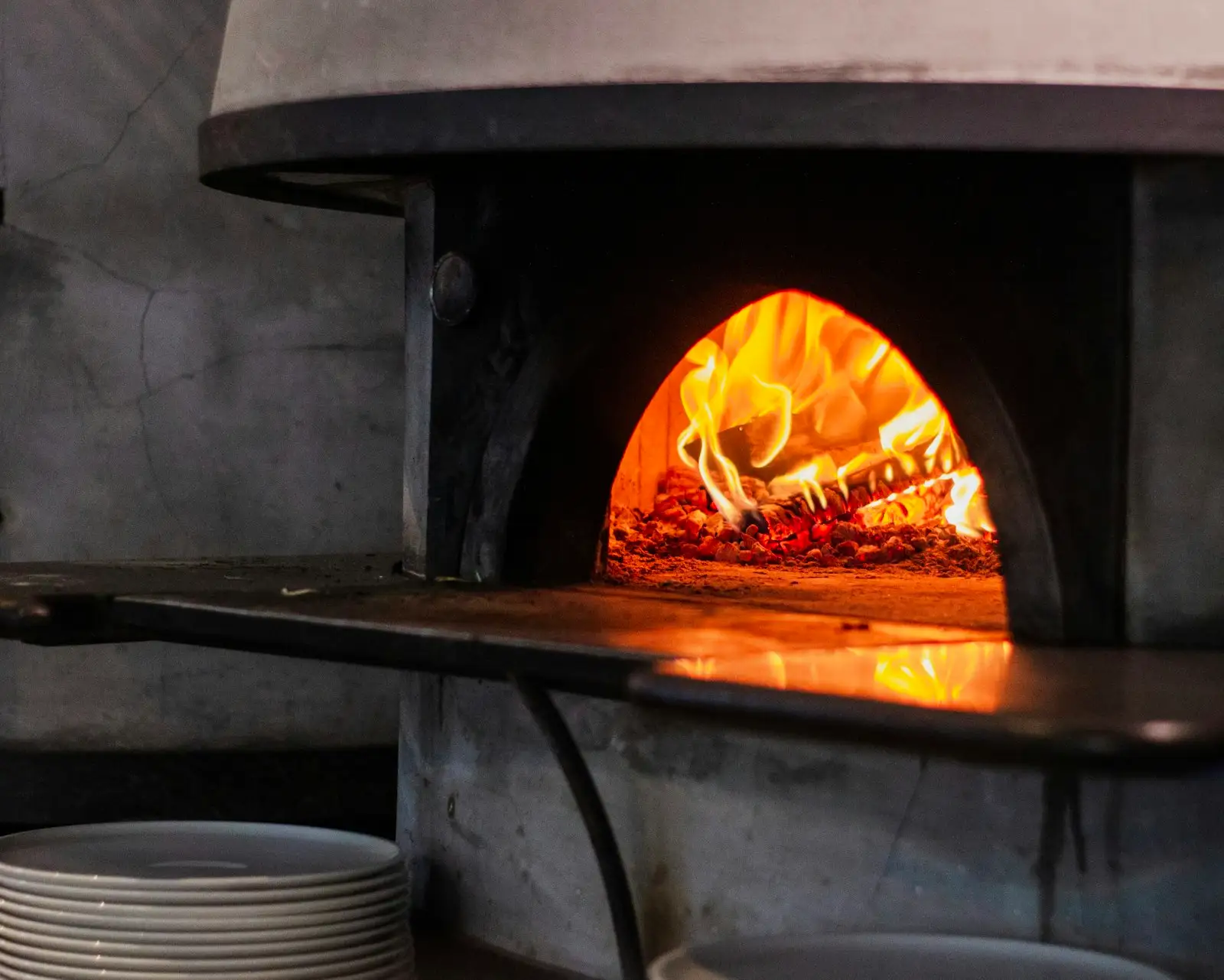
The reason home ovens cap at 500F to 550F is regulatory and insulation-related, not physical. A real pizza oven runs at 700F to 950F. At those temperatures, the stone-vs-steel debate becomes irrelevant because both surfaces are hot enough that the conductivity gap closes.
If your goal is restaurant-quality Neapolitan pizza specifically, no home-oven workaround gets you there. You need a dedicated pizza oven that hits 850F+ on the floor. Our Ooni Koda 16 review covers the gas option ($599) and our best wood-fired pizza oven guide covers the wood-burning alternatives if the ritual matters to you.
The pizza stone or steel inside a 550F home oven is the workaround. It produces good pizza, not Neapolitan-tier pizza. Setting that expectation is most of the battle.
Frequently asked questions
What’s better, a pizza steel or a pizza stone?
A 1/4-inch pizza steel is better for most home cooks who care about crust. It preheats hotter, cooks pizzas in 4 to 6 minutes instead of 7 to 9, browns the bottom more aggressively, and is essentially indestructible. A pizza stone is the right call if you are under $50, baking occasional homemade or frozen pizzas, or you also bake artisan bread loaves where the stone’s gentler heat actually helps the oven spring without burning the bottom.
Do Italians use pizza stones?
Traditional Neapolitan pizza is baked directly on a refractory brick floor in a wood-fired oven (essentially a permanent stone), not on a portable pizza stone. Most modern home Italian cooks who bake pizza at home use a teglia (a steel or aluminum pan) rather than a stone or a steel slab. The marketing copy framing Italian artisans handing down sacred pizza stones is largely invented; the actual tradition is the brick oven floor, which neither product fully replicates in a 550F home oven.
Is a pizza stone really necessary?
Not strictly. A preheated heavy cast-iron skillet, an upside-down sheet pan, or a Lloyd Pans Detroit-style steel pan all produce decent pizza. A stone or steel just delivers measurably better results: more bottom browning, better oven spring, faster cook time. If you are baking pizza more than a few times a year, the upgrade is worth it. If you are baking three pizzas a year, skip both.
What are the most common problems with pizza stones?
Thermal shock (cracking from a temperature change too fast, usually a cold stone going into a hot oven or a cold pizza going onto a hot stone), moisture absorption (a stone that got wet and was not fully dried before heating can crack from steam pressure), soap contamination (porous stones absorb soap, which then off-gasses into pizza), and dropping (any ceramic or cordierite stone will shatter if dropped on a hard floor). All of these are fatal to a stone. None of them affect a steel.
What do Italians use to stop pizza sticking?
Semolina or fine cornmeal dusted on the peel, not flour. Flour burns and tastes bitter at the high temperatures pizza is baked. Semolina has larger granules that act like tiny ball bearings between the dough and the peel, releasing the pizza cleanly. A light dust is all you need; too much will scorch and leave the bottom gritty.
Can a pizza stone go rancid?
Yes. Porous stones (cordierite and ceramic) absorb oils, cheese drippings, and sauce. Without proper care, the absorbed fats oxidize over months and develop an off smell that transfers to future pizzas. The fix is dry-scraping after each bake, baking the stone empty at high heat every few months to burn off residue, and never washing it with soap (which makes the problem worse by adding detergent residue to the absorption mix). Steels do not have this issue.
What this earns you
You now have the decision framework the SERP keeps burying. Stone if you are casual, cheap, or baking bread alongside. Steel if you bake pizza often, want serious crust, and value indestructibility. Buy the right tool, preheat it properly, and the Neapolitan dough or New York-style crust you have been working on will come out the way you imagined when you started reading recipes. The cooking surface is the second-most-important variable in home pizza after the dough. Get it right and the rest of the system pays off.