You either just bought an Ooni Koda 16 pizza oven and are nervous you wasted $649, or you are about to and want a review that cuts past the product page. One honest note upfront: we have not bench-tested this oven ourselves. This Ooni Koda 16 pizza oven review is built from Ooni’s published specs (verified against the live product page), the cross-shop against the Ooni Koda 2 Pro and Karu 2 Pro, the independent testing published by Serious Eats, Wirecutter, and Food & Wine, and the threads every other review glossed over.
TL;DR
- Verdict: 4.4 out of 5. The Koda 16 is the best gas pizza oven under $650 in 2026 for most home cooks, with caveats.
- Price: $649 list, $499 at Ooni’s current sale price. Realistic all-in cost with mandatory accessories: $800 to $950.
- Max temperature: 950°F. Cooks a Neapolitan-style pizza in 60 to 90 seconds.
- Real preheat time: 25 to 40 minutes to a fully saturated stone in independent tests, not the 20 minutes Ooni claims.
- L-shaped burner runs along the back and left side of the oven. Pizza needs a rotation every 20 seconds or one corner burns.
- Weight: 40.1 pounds. The marketing calls it portable. It is not.
- No accessories included. Add a 16-inch wood peel, a metal turning peel, an infrared thermometer, a cover, and a propane tank. Budget $200 to $300.
- Skip the Koda 16 if you want wood-fired flavor (get the Karu 2 Pro), you cook fewer than 10 pizzas a year (just order takeout), or you have no covered outdoor storage. See where it lands against every other option in our best home pizza oven guide.
- Buy the Koda 16 if you want a gas-powered oven, you bake regularly, and the $649 stays in budget after accessories.
Who this oven is for, and who should skip it
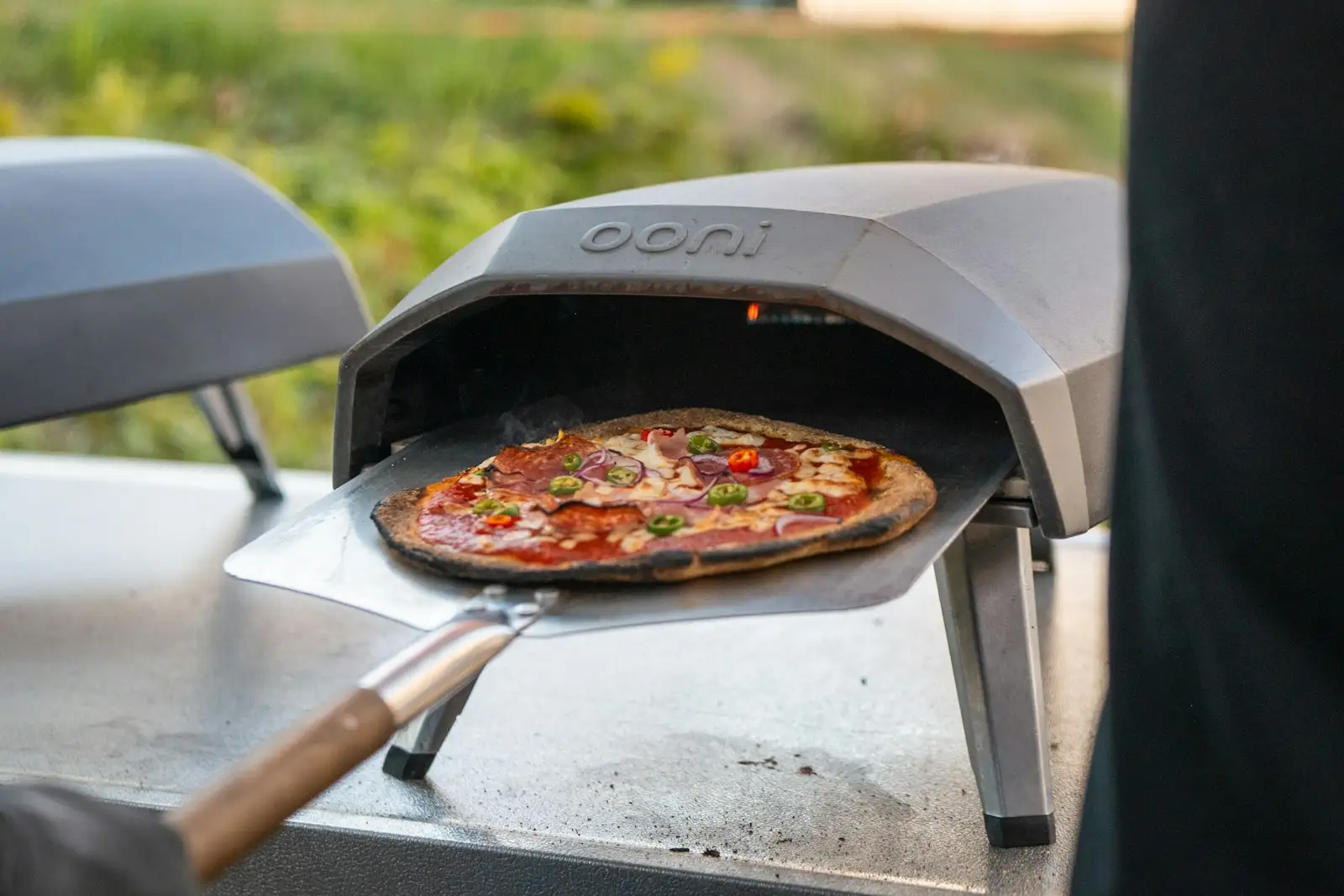
The Koda 16 is for the home cook who wants 950°F pizza in their backyard with the minimum operational fuss. You turn a dial, the propane lights, you wait 30 minutes, you launch a pizza. There is no fire to manage, no ash to clean out, no chimney baffle to adjust mid-cook. For a household that does pizza night every other weekend, the Koda 16 is the simplest path to a 90-second Neapolitan-style bake at home.
Three audiences should skip it. First, anyone who bakes pizza fewer than 10 times a year. At $649 plus accessories, the per-pizza cost beats takeout only above roughly 20 pizzas annually. Below that, just order from the best pizzeria in your town and call it. Second, anyone for whom wood-fired flavor is non-negotiable. The Ooni Karu 2 Pro (our full review) does wood and charcoal natively, at a meaningfully higher price once you add the optional gas burner. Third, anyone without covered outdoor storage. The Koda 16 is 40 pounds of carbon steel; it stays outside year-round, and it needs at least a cover, ideally a stand or dedicated table.
What you actually get in the box
Less than the headline price suggests. The Koda 16 ships with:
- The oven itself (no assembly required, just unfold the legs)
- A cordierite stone baking board (already installed)
- A 28mBar QCC1 propane gas regulator with a 0.9m hose
- The user manual and Ooni’s “Essential Guide” booklet
What it does not include and you will need to buy:
- A propane tank. The standard 20-pound tank from any hardware store works.
- A pizza peel. Ideally two, a wood or bamboo for launching (dough does not stick to wood the way it sticks to metal) and a smaller metal turning peel for rotating mid-bake.
- An infrared thermometer. Not optional. The Koda 16 has no internal temperature gauge. Without an IR thermometer, you are guessing whether the stone is at launch temperature.
- A cover. The Koda 16 is rated outdoor-only and weather-rated, but UV and rain will pit the powder coating in two seasons without one.
- A stand or sturdy table. The fold-out legs are short; the oven is designed to sit on a raised surface, not the ground. Bend over for 60 seconds while you rotate a pizza and your back will tell you why everyone recommends a stand.
Budget another $200 to $300 for the accessories. The realistic all-in cost of owning a Koda 16 is $800 to $950, not the $649 retail price.
Ooni Koda 16 pizza oven specs that matter
Ooni’s published specs (pulled from the live Koda 16 product page) versus what independent testers report:
| Spec | Ooni’s published spec | Independent reviewer consensus |
|---|---|---|
| Max temperature | 950°F | Not disputed; 60 to 90 second Neapolitan bakes |
| Preheat time | 20 minutes | 25 to 40 minutes for full stone saturation |
| Pizza cook time | 60 seconds | 60 to 90 seconds |
| Weight (unboxed) | 40.1 lbs | Not disputed |
| External dimensions | 24.96 x 23.2 x 14.65 inches | Not disputed |
| Cooking stone | Cordierite, sized for 16-inch pizzas | Practical max closer to 14 inches (room to rotate) |
| Fuel | Propane; Ooni sells a natural gas version | Not disputed |
| Temperature range | 310°F to 950°F | Not disputed |
| Warranty | 5 years on registered purchases | Not disputed |
The two specs Ooni is optimistic about: preheat time and pizza diameter. Independent tests put a full-stone preheat closer to 30 minutes, not 20. Pizza diameter is theoretically 16 inches, but you need a few inches of slack to rotate a stretched dough with a peel without flipping it onto the side wall. Reviewers consistently land on 12 to 14 inch pies as the practical size, and nothing about the oven makes you want bigger.
How the L-shaped burner works (and why it matters)
This is the single design detail every Koda 16 review mentions, usually badly. The Koda 16’s flame is shaped like an upside-down L: it runs along the entire left wall of the oven and the entire back wall, and it licks partway up the ceiling. Compare this to a torch burner (Ooni’s older Koda 12 and Fyra designs) which fires a single concentrated flame from one point. The L-burner gives the flame far more contact with the inside of the chamber, which is why the Koda 16 hits 950°F in stride and why the stone heats more evenly than a torch design.
It also creates a hot zone, and every published test flags it. The back-left quadrant of the stone, directly under the burner, runs far hotter than the front-right corner during a steady bake. This is not a defect; it is the design constraint. Every reviewer who has actually cooked on the Koda 16 ends up at the same technique: launch the pizza, rotate it 90 degrees every 20 seconds, four rotations total, pull at 60 to 90 seconds.
If you do not rotate, the back of the crust chars to graphite while the front never browns. If you rotate too late, the leading edge bubbles and burns. If you launch before the stone is fully saturated, the bottom comes out gummy on the front and overdone on the back. The L-burner does not forgive a static pizza; it punishes one.
Preheat reality: 20 minutes versus 40 minutes
This is the spec everyone gets wrong. Ooni’s spec sheet says 20 minutes to launch. The reality, documented across Ooni’s own Insights blog and confirmed by independent testers, is that you should wait until the stone surface reads around 750°F before launching the first pizza, not just the ambient air temperature. The stone temperature, not the air temperature, is what cooks the bottom of the crust.
The independent numbers scatter, and the scatter is the lesson. Serious Eats logged 25 minutes. The Barbecue Lab clocked 20 minutes but did not specify which point on the stone. Palapizza measured closer to a 40-minute window for the whole stone. The quadrant under the L-burner reaches launch temperature well before the front-right corner does, so the preheat number depends entirely on where the thermometer is pointed. The corner farthest from the flame is the one that decides when the oven is ready.
The safe rule: 30 minutes minimum, 40 minutes if it is cold or windy outside. Anything faster and the first pizza is going to look like a science experiment. After the first pizza comes off, reviewers consistently report the stone needs 2 to 3 minutes to recover before the next launch. For a pizza party of 12 pies, plan on roughly 35 minutes of preheat plus 5 minutes per pizza (90 seconds of bake plus recovery), so 95 minutes start to finish.
The infrared thermometer is what makes this knowable. Without one you are guessing. With one you launch when the front of the stone reads 750°F or better. Get the roughly $30 TempPro TP30 IR thermometer (formerly the ThermoPro TP30) or the Ooni-branded version.
Cooking your first pizza on the Koda 16
The technique that works, distilled from Ooni’s own guidance and every credible independent test:
- Preheat 30 minutes, IR thermometer pointed at the front-right corner of the stone. Wait for it to read 750°F.
- Drop the burner to low about 90 seconds before launch. The flame is so aggressive on high that the toppings burn before the crust finishes. Low lets the crust catch up.
- Use a wood peel for launching. Dust the peel with semolina (not flour, semolina rolls under the dough like ball bearings). Build the pizza on the peel, give it a test shake, launch.
- Rotate 90 degrees every 20 seconds. Use a metal turning peel, not the launching peel. The metal slides under the pizza without sticking once the bottom has set.
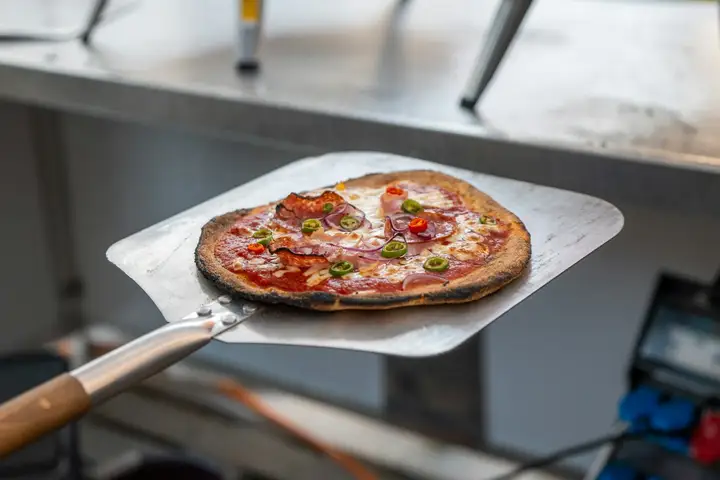
- Pull at 60 to 90 seconds. Look for leoparding (dark brown spots) on the crust rim and a fully melted, slightly bubbly top.
The two failure modes that account for 80 percent of bad Koda 16 first cooks: not waiting long enough for the stone, and not turning the burner down before launch. Both are temperature-management problems, not technique problems.
The third failure mode is the dough. The Koda 16 does not forgive a bad dough. A 75 percent hydration cold-fermented dough designed for a 4-minute home oven bake will tear when you stretch it and stick to the peel when you try to launch. Start with a 60 percent hydration Neapolitan-style dough designed for the 90-second bake. See our Neapolitan pizza dough recipe for the exact ratio and the cold-ferment timeline that works with high-heat ovens.
What the Koda 16 cooks beyond pizza
Pizza is the job, but the 16-inch stone fits two cast iron skillets side by side, which opens up a lot of options. What owners and reviewers consistently report works, in rough order:
- Steaks in cast iron. The 950°F dome heat sears the top while the cast iron sears the bottom, which shortcuts the flip.
- Roasted vegetables. Halved Brussels sprouts, peppers, eggplant, mushrooms: at these temperatures they develop blackened edges in minutes.
- Whole fish. A branzino on cast iron with lemon and herbs comes out fast, with crispy skin.
- Bread directly on the stone. Smaller loaves (focaccia, ciabatta, flatbreads) bake well. Larger boules want a longer, cooler bake than this oven gives.
- Smash burgers. Doable, but messier than you want. The dripping fat hits the stone and smokes aggressively. Use cast iron, not the stone directly.
What it cannot do: anything that wants low, slow, or smoky. Ooni lists the operating range at 310°F to 950°F, and the open mouth cannot hold smoke. Do not try to smoke a brisket in this. Wirecutter’s reviewer cooked oysters Rockefeller in hers, which tells you the versatility ceiling is higher than the words “pizza oven” suggest.
The accessories you actually need (and the ones you can skip)
Ooni sells roughly 40 Koda-compatible accessories. Most you do not need. The ones you do:
Buy:
- Infrared thermometer ($30 to $40). Non-negotiable. A TempPro TP30 is fine. The Ooni-branded version is fine. The cheapest IR thermometer on Amazon is also fine. You just need to read the stone temperature.
- Wood or bamboo pizza peel, 14 inches ($25 to $50). Dough does not stick to wood when properly dusted with semolina. Ooni says 12, 14, and 16-inch peels all work in a 16-inch oven; 14 inches is the easiest size to steer around the flame. Our wood vs metal pizza peel comparison covers the test-kitchen picks and why textured composite peels can grip dough.
- Metal turning peel, 8 to 9 inches ($20 to $40). For rotating mid-bake. A small metal peel slides under the pizza without snagging. Ooni’s perforated turning peel is fine. The holes shed excess semolina so it does not burn on the stone; in America’s Test Kitchen’s testing, perforations did not make metal peels any less sticky.
- Cover ($35 to $50). Ooni sells a branded cover for $50 that fits perfectly. Generic covers in the $35 range work fine if the oven stays under an overhang. If it sits in the open all winter, spring for the Ooni cover.
- A stand or sturdy table ($100 to $250). Ooni’s own modular table is the expensive way to solve this; a stainless steel prep table from a restaurant supply store does the same job for less.
Skip:
- The Ooni dough scraper, Ooni dough trays, Ooni groove board, Ooni branded flour. All work, but they are commodity items where the Ooni-branded version costs 30 to 50 percent more than the equivalent at a restaurant supply store.
- Pizza dough rolling pins of any kind. You should not be rolling Neapolitan-style dough; you stretch it by hand.
- Branded “experience” bundles and gift boxes. Marketing.
Total cost of ownership
The honest math:
| Item | Realistic price |
|---|---|
| Ooni Koda 16 oven | $499 (sale) to $649 |
| 20-pound propane tank (exchange) | $25 first fill, $20 refills |
| IR thermometer | $30 |
| Wood launching peel (14 inch) | $35 |
| Metal turning peel | $25 |
| Cover | $40 |
| Stand or table | $120 to $250 |
| All-in first year | $775 to $1,055 |
After year one, propane refills are the only recurring cost. One 20-pound tank produces roughly 150 pizzas at the Koda 16’s burn rate (per Ooni’s published 10-pizza-per-1.3-lb estimate). At $20 per refill, that is about $0.13 in fuel per pizza. Eventually the cordierite stone wears out and needs a replacement, which Ooni sells direct.
For comparison, price a takeout Neapolitan at the best pizzeria near you and run it against the table above. A household doing regular pizza nights earns the buy-in back inside the first year or two, and the more you bake, the faster the math tilts your way. Below 10 pizzas a year, you are paying a premium for the experience of making pizza.
Koda 16 versus Koda 2 Pro: which Ooni gas oven in 2026
The Koda 2 Pro is the newer, bigger gas oven in Ooni’s lineup, and it has been Serious Eats’ best gas-powered Ooni pick since the 2026 update. Most existing Koda 16 reviews predate the Pro and do not address the obvious cross-shop. The decision:
| Feature | Koda 16 | Koda 2 Pro |
|---|---|---|
| Price | $499 to $649 | $849 list |
| Max temp | 950°F | 950°F |
| Burner | L-shaped (back + left) | Tapered-flame G2 burner (Ooni’s newer design) |
| Pizza size | Up to 16 inches | Up to 18 inches |
| Preheat (Ooni’s claim) | 20 minutes | 30 minutes |
| Door | Open front | Tempered glass visor (heat retention) |
| Display | None | Digital Temperature Hub |
| Weight | 40.1 lbs | 60 lbs |
| Recovery between pizzas | 2 to 3 minutes | Near zero (door + visor) |
The Koda 2 Pro is the better oven on every spec except weight and price. The glass visor is the headline upgrade, because it cuts pizza-to-pizza recovery time to nearly zero, which transforms a pizza party for 12 guests. The digital display is nice but redundant if you already own an IR thermometer.
For most home cooks: the Koda 16 is still the right pick. The Pro’s $200 to $350 premium buys faster throughput, which only matters if you are routinely making 6+ pizzas in a sitting. If you make 2 to 4 pizzas at a time, the recovery-time advantage does not move the needle and the Koda 16 wins on price. Buy the Pro if you regularly host pizza parties; buy the Koda 16 for normal weekly pizza nights.
Koda 16 versus Karu 2 Pro: gas or multi-fuel
The Karu 2 Pro is the second-most-common cross-shop, and the choice is really about flavor preference and patience:
| Feature | Koda 16 | Karu 2 Pro |
|---|---|---|
| Price | $499 to $649 | $849 (oven only), gas burner sold separately |
| Fuel | Gas only | Wood, charcoal, or gas (burner sold separately) |
| Max temp | 950°F | 950°F |
| Door | Open front | Glass door with view-flame |
| Display | None | Digital ambient temp display |
| Weight | 40.1 lbs | 62.6 lbs |
| Ash cleanup | None | Yes, after every wood or charcoal use |
| Recovery between pizzas | 2 to 3 minutes | Near zero (door closed) |
The Karu 2 Pro with the gas burner is the more flexible oven. The Koda 16 is the simpler oven. The trade-off: wood-fired flavor in a 90-second pizza is genuinely subtle. Sit two Neapolitan pizzas side-by-side, one from gas and one from oak, and most tasters cannot reliably tell which is which. The reason is exposure time. A 4-hour brisket smoked over hickory takes on serious wood character. A 90-second pizza barely touches the smoke. If you want the smoky-pizza experience, you want a longer bake at a lower temperature, which is not what these ovens are built for.
Buy the Karu 2 Pro if you specifically want a glass door (legitimately nice for monitoring pizzas), you cook outdoors year-round and want the multi-fuel option, or you plan to roast meats in it at lower temperatures. Buy the Koda 16 if you want the simplest, most consistent gas pizza machine for under $650.
Koda 16 versus Gozney Roccbox: a fair comparison
The Roccbox is what The Barbecue Lab and Serious Eats both compare the Koda 16 to most often. The reality:
| Feature | Koda 16 | Gozney Roccbox |
|---|---|---|
| Price | $499 to $649 | $499 to $599 |
| Max temp | 950°F | 932°F |
| Stone | Sized for 16-inch pizzas | 12.4 x 13.4 inches |
| Pizza diameter | Up to 16 inches | Up to 12 inches |
| Weight | 40.1 lbs | 44 lbs |
| Fuel | Propane (natural gas version available) | Gas (dual-fuel wood add-on) |
| Warranty | 5 years (registered) | 5 years |
| Insulation | Single-layer carbon steel | Silicone outer + insulated wall |
The Roccbox is the more refined oven on insulation and the dual-fuel option. It is smaller, which limits you to 12-inch pizzas. For a single cook making personal-sized Neapolitan pies and the occasional steak, the Roccbox is the more thoughtful machine. For a household that wants 14 to 16 inch pizzas and the option to fit two cast iron skillets, the Koda 16 wins on capacity.
Pick the Roccbox if size is not a priority and you want better-built insulation. Pick the Koda 16 if you want the largest pizzas you can practically launch from a peel.
What never to do with the Koda 16
Anti-recommendations, in rough order of how badly they will go for you:
- Indoor use. The Koda 16 is rated outdoor-only because it produces carbon monoxide and the chamber temperatures will scorch nearby walls. Do not use it in a garage with the door open. Do not use it under an open carport. Outdoor means outdoor.
- High wind. The Koda 16 has a Flame Safety Device that shuts off the gas if the flame blows out, which is good. But the FSD does not prevent the wind from cooking the pizza unevenly. Wind shifts the L-burner flame off the stone surface and your back corner stays cold. Cook in a sheltered area or on a calm day.
- On a glass, ceramic, or wooden table. The base of the oven gets hot enough during a cook to crack glass, craze ceramic, and scorch wood. A stainless steel restaurant prep table or an Ooni-branded stand is the safe answer.
- Launching pizza on a metal peel. Metal peels are for rotating, not launching. Dough sticks to metal in the time it takes you to assemble the toppings. Use wood for the launch, metal for the turn.
- Sliding pizza off a flour-only floured peel. All-purpose flour absorbs moisture from the dough and glues it to the peel. Use semolina or a 50/50 semolina-flour mix instead. The semolina rolls under the dough.
- Leaving it unattended at temperature. A 950°F oven outside is exactly as dangerous as it sounds. Especially around pets and kids.
- Skipping the IR thermometer. Launching before the stone is at temperature is the most common first-cook failure mode. The IR thermometer is the difference between a gummy bottom and a crisp leoparded crust.
FAQ
Is the Ooni Koda 16 worth the price?
Yes for anyone baking 10 or more pizzas a year outdoors with the storage space for a 40-pound oven. The realistic all-in cost (oven plus mandatory accessories) is $800 to $950, and the per-pizza math starts beating takeout somewhere around 20 pizzas a year, depending on what pizza costs where you live. Below 10 pizzas a year, just keep ordering. Above that, the oven pays for itself and you get to eat 950°F pizza at home.
Is the Ooni Karu or Koda better?
For most home cooks, the Koda. Gas is more consistent than wood for 90-second pizza bakes, and the wood flavor is subtle at that exposure time. Pick the Karu only if you specifically want wood-fired flavor as a non-negotiable, you want the option of charcoal, or you want the glass door and digital display.
How long does the Ooni Koda 16 take to preheat?
Plan on 30 minutes minimum for the entire stone to saturate at launch temperature, 40 in cold or windy weather. Ooni’s spec sheet says 20 minutes, and the area under the L-burner does get hot fast, but independent tests from Serious Eats, The Barbecue Lab, and Palapizza put full stone saturation at 25 to 40 minutes. Wait it out or your first pizza will have an uneven bottom.
Can the Koda 16 cook anything besides pizza?
Yes. The 16-inch stone fits two cast iron skillets side by side, and owners and reviewers use it for steaks, roasted vegetables, whole fish, focaccia, and flatbreads. What it cannot do is low and slow: Ooni lists the operating range at 310°F to 950°F, and the open mouth cannot hold smoke.
What is the difference between the Koda 16 and the Koda 2 Pro?
The Koda 2 Pro costs more ($849 list versus $499 to $649 for the Koda 16), and adds a tempered glass visor for heat retention (near-zero recovery between pizzas), an 18-inch cooking area, a digital temperature hub, and Ooni’s newer tapered-flame G2 burner. The Koda 16 is lighter (40.1 versus 60 pounds), cheaper, and simpler. For most home cooks the Koda 16 is still the right pick. The Pro pays off if you regularly bake 6 or more pizzas back-to-back.
How long does the cordierite stone last?
The cordierite stone is the wear part of the oven. Frequent cooks eventually wear one out or crack it, and Ooni sells direct replacements. The powder-coated carbon steel shell holds up outdoors for years with a cover.
The verdict
Buy the Ooni Koda 16 if you want the simplest, most consistent gas pizza oven under $650 and you bake outdoors at least 10 times a year. Skip it if you want wood-fired flavor (Karu 2 Pro), faster pizza-to-pizza throughput (Koda 2 Pro), or you cook fewer than 10 pizzas annually (just order takeout). At $499 to $649, with another $200 to $300 in mandatory accessories, the Koda 16 is the cheapest path to 950°F pizza at home, and it is a real path, not a gimmick. The L-burner has a learning curve, the real-world preheat runs well past the number on the spec sheet, and the oven is not portable. None of that changes the verdict: the Koda 16 is the best gas pizza oven under $650 in 2026 for most home cooks. 4.4 out of 5. One note on where that number comes from: the rating reflects verified Ooni specs, Ooni’s own documentation, and cross-referenced independent tests from Serious Eats, Wirecutter, and Food & Wine, not our own bench testing.
For the dough that actually works in this oven, see our Neapolitan pizza dough recipe. For other regional styles you can bake on the Koda 16, the New York style pizza crust and Detroit style pizza recipe both adapt well, with notes on temperature and bake time in each piece. Browse the full ovens and equipment cluster for head-to-head comparisons.