No yeast pizza dough replaces yeast with baking powder, and it gets you from bowl to baked crust in about 20 minutes instead of a day. That speed is real and worth having on a weeknight. What no recipe blog tells you straight is the trade: you give up the fermented flavor and the open, chewy crumb that make a good pizza crust good. This is the honest version, the recipe, the chemistry that explains why it behaves the way it does, every yeast-free variation worth knowing, and when you should just plan ahead and make the real thing.
TL;DR
- No yeast pizza dough uses baking powder (a chemical leavener) instead of yeast (a biological one). Mix, rest 10 minutes, bake. No rise to wait for.
- The recipe: 2.5 cups (315g) flour, 1 tablespoon baking powder, 1 teaspoon salt, 3/4 cup + 2 tablespoons (200ml) water or milk, 3 tablespoons olive oil. Optional 1 teaspoon sugar for browning.
- What you trade: fermented flavor and chewy, airy crumb. A no-yeast crust is tender and biscuit-like, closer to a flatbread than a pizzeria slice. It is best rolled thin and crisp.
- Roll it thin, dock it, bake it hot (450F). There is no gas network to trap, so thin and crisp is where this dough shines; thick and it goes dense and cakey.
- Yeast-free variants: self-rising flour (it already has the baking powder), 2-ingredient self-rising-flour-plus-Greek-yogurt dough, beer crust, or sourdough starter (no packet yeast).
- It is not Italian. Real Neapolitan dough uses yeast or a natural starter. No-yeast is a weeknight shortcut, and a good one, but call it what it is.
- Eat it fresh. With no fermentation, it stales within hours.
How no yeast pizza dough works (the chemistry)
To understand why this dough behaves differently, you have to understand what yeast actually does, and what baking powder does instead.
Chemical leavening vs biological leavening
Yeast is alive. Given flour, water, and time, it eats the sugars in the dough and exhales carbon dioxide, alcohol, and a range of organic acids. The CO2 inflates the dough, and the acids and alcohol cook off into the flavor we read as “bread.” That process is slow on purpose: a few hours at room temperature, or a day or more in the fridge, which is the whole point of a cold-fermented Neapolitan dough. The time is the flavor.
Baking powder skips all of that. It is a chemical leavener: a dry acid plus baking soda (a base), buffered with a little cornstarch. Add liquid and the acid and base react and release carbon dioxide directly, no living organism, no fermentation, no waiting. As King Arthur’s explainer on baking soda versus baking powder lays out, most modern baking powder is “double-acting”: it releases a little gas when it first hits the liquid, then most of its lift in the oven once the heat kicks in. That oven burst is what puffs the crust during the bake.
What you give up, and what you gain
The CO2 from baking powder inflates the dough, but it does nothing else yeast does. There is no fermented flavor, because nothing fermented. There is no long gluten development, because there was no time for it, so the dough is less stretchy and the baked crumb is denser and more tender than chewy. The texture lands somewhere between a biscuit and a flatbread, not the airy, blistered, elastic crumb of a proper New York or Neapolitan crust.
What you gain is 20 minutes instead of 24 hours. That is the entire deal, and on the right night it is a good one: you are out of yeast, the kids are hungry, you decided on pizza at 6pm. For that, a no-yeast dough is genuinely useful. For a weekend when you have time, make a real dough; the difference is large and it is worth the wait.
The no yeast pizza dough recipe (baking powder method)
This is the standard, reliable baking-powder ratio, the same proportions the better recipe sites converge on. It makes one 12-inch thin crust or two 8-inch crusts.
Ingredients
- 2.5 cups (315g) all-purpose flour, plus more for rolling
- 1 tablespoon (about 14g) baking powder (fresh, not an old tin)
- 1 teaspoon (6g) fine salt
- 1 teaspoon (4g) sugar, optional, for browning
- 3/4 cup plus 2 tablespoons (200ml) warm water or whole milk
- 3 tablespoons (45ml) olive oil
Step by step
- Whisk the dry ingredients. Combine the flour, baking powder, salt, and sugar in a bowl. Whisk well so the baking powder is evenly distributed; clumps of baking powder bake into bitter, soapy spots.
- Add the wet. Make a well, pour in the water (or milk) and olive oil, and stir with a fork or spatula until it comes together into a shaggy dough.
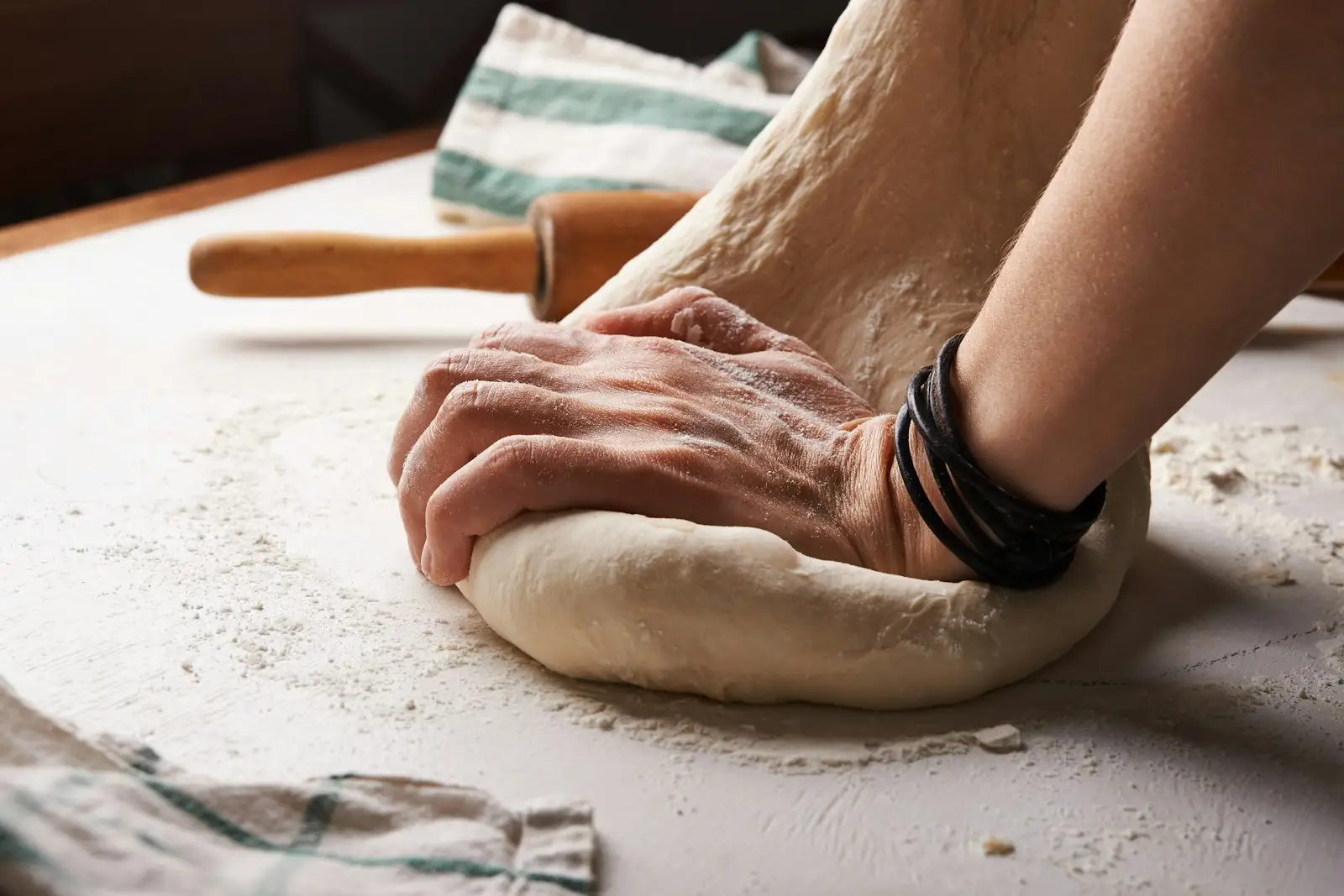
- Knead briefly. Turn it onto a lightly floured counter and knead just 1 to 2 minutes, until smooth. Stop there. Overworking a baking-powder dough makes it tough, and unlike a yeasted dough there is no long rest to relax it again.
- Rest 10 minutes. Cover and let it sit. This is not a rise; it hydrates the flour and relaxes the gluten enough to roll. The dough will not grow.
- Roll thin. Roll or press the dough to about 1/4 inch or thinner. Thin is the goal here (more on why below).
- Dock it. Prick the surface all over with a fork. This stops the baking powder from forming a few big bubbles that balloon and char.
- Top and bake. Top lightly and bake on a preheated stone, steel, or sheet at 450F for 10 to 15 minutes, until the edges are golden and the bottom is crisp. For a crisper base, par-bake the bare crust for 5 minutes before topping.
Milk vs water
Both work, and they do different things. Water gives a leaner, crisper, more neutral crust. Whole milk browns more (the milk sugars and proteins caramelize) and bakes up a touch softer and richer. Use one or the other based on what you want. One thing to skip: fat-free milk, which some recipes call for. With the fat removed it browns and tenderizes no better than water, so it adds nothing; if you want the milk effect, use whole milk.
Shaping, topping, and baking: thin and hot
A no-yeast crust lives or dies on two choices: how thick you roll it and how hot you bake it.
Roll it thin. A yeasted dough has a gluten network full of gas bubbles that gives it structure and chew. This dough does not. Rolled thick, it has nothing to do but bake into a dense, cakey slab. Rolled thin, it crisps and shatters pleasantly, which is what this dough is actually good at. Treat it like a flatbread or a cracker crust, not a pan pizza.
Bake it hot, on a hot surface. Get the oven to 450F with a preheated stone or steel if you have one. The hot surface flashes the bottom crisp before the inside can turn gummy, and the high heat triggers the second, larger release of CO2 from the baking powder right when you want it.
Go light on toppings. With no strong gluten structure, a heavily loaded no-yeast crust sags and steams. Use a thin layer of pizza sauce, a moderate amount of low-moisture cheese, and a restrained hand with wet toppings. Par-baking the crust for 5 minutes first helps it stand up to the load.
Eat it fresh. Fermentation is also what helps a yeasted crust stay good for a day. Without it, a no-yeast crust goes from crisp to leathery within a couple of hours. Make it, eat it, do not plan on leftovers.
Variations without commercial yeast
“No yeast” means different things to different searchers. Here is the full set of yeast-free routes, with an honest note on each.
Self-rising flour version
Self-rising flour already contains baking powder and salt (about 1.5 teaspoons of baking powder and 1/4 teaspoon of salt per cup). So you can skip the separate leavener entirely: 2 cups self-rising flour, 3/4 cup water or milk, and 2 tablespoons olive oil, mixed and kneaded the same way. It is the same dough as the recipe above, just with the baking powder pre-mixed into the flour.
2-ingredient Greek yogurt dough
The viral one. Combine roughly 1 cup self-rising flour with 1/2 to 3/4 cup full-fat Greek yogurt and knead into a soft dough. The self-rising flour leavens it; the yogurt brings moisture and a faint tang. It is genuinely fast and the protein in the yogurt gives it a bit more chew than the plain baking-powder version. Be honest about what it is, though: a tangy, flatbread-style or naan-style crust, not a pizzeria one. Low-fat yogurt makes it sticky and bland; use full-fat.
Beer crust
Beer is carbonated and contains a little residual sugar, so self-rising flour plus beer (roughly 2 to 1 by volume) makes a quick dough with some lift from the bubbles and a yeasty flavor from the beer itself. It is a fun trick more than a serious crust, but the flavor is better than the plain baking-powder version because the beer was, at some earlier point, fermented.
Sourdough starter (no packet yeast)
If “no yeast” means “no store-bought packet yeast,” a sourdough starter is your answer. It leavens with wild yeast and bacteria, so technically it is still yeast, but it is the homemade kind. Note the catch: an active, bubbly starter will leaven a dough over hours, but sourdough discard alone will not give you much rise. Discard is for flavor; active starter is for lift. This is not a fast option, so it belongs in a different category than the others here.
Truly without yeast or baking powder
One of the common related searches is “pizza dough without yeast or baking powder.” With no leavener at all, you are making an unleavened flatbread: flour, water, olive oil, and salt, kneaded and rolled thin, then baked or griddled. It will be flat and cracker-like by definition, closer to a piadina or a tortilla than a pizza. That is fine, just go in knowing there is nothing in it to make it rise.
Is no-yeast dough authentic Italian?
No, and one of the related searches for this recipe is literally “authentic Italian pizza dough recipe without yeast,” which is a contradiction worth clearing up. Traditional Italian pizza dough is a yeasted, fermented dough. The AVPN regulations for true Neapolitan pizza specify the dough be made with fresh brewer’s yeast, a natural mother yeast, or dry yeast, then rested for hours. The long, slow ferment is not optional in that tradition; it is the definition.
So a no-yeast crust is not a Neapolitan, New York, Detroit, or Sicilian pizza, because every one of those styles depends on yeast and time for its crumb. A baking-powder crust is its own thing: a fast, American, weeknight flatbread-style pizza. It is a good thing to know how to make. It is just not the Italian thing, and you will make better pizza long-term by learning the real dough than by perfecting the shortcut.
Troubleshooting
- Soapy, metallic, or bitter taste: too much baking powder, or it was not whisked in evenly. Stick to 1 tablespoon per 2.5 cups of flour and whisk it thoroughly into the dry flour first.
- Dense and cakey: rolled too thick, or overworked. Roll thinner and knead for under 2 minutes.
- Tough and dry: too much flour or over-kneading developed too much gluten with no rest to relax it. Add liquid a tablespoon at a time and handle the dough less.
- Pale, no browning: add the optional sugar, use milk instead of water, and make sure the oven and baking surface are fully preheated to 450F.
- Big bubbles that char: you skipped docking. Prick the rolled-out crust all over with a fork before baking.
- Gummy center: crust too thick, oven not hot enough, or too many wet toppings. Roll thinner, preheat a stone or steel, and par-bake 5 minutes before topping.
What to skip
- Substituting baking soda for baking powder one-for-one. Baking soda is only the base; without an added acid it will not leaven properly and it tastes metallic and soapy. They are not interchangeable.
- Doubling the baking powder for “more rise.” Past about 1 tablespoon per 2.5 cups you get chemical-tasting, chalky dough, not a better crust.
- Fat-free milk. It does not brown or tenderize meaningfully. Use whole milk or just use water.
- Rolling it thick and expecting a fluffy pizzeria crust. Without yeast there is no airy crumb to develop. Thin and crisp is the win.
- Letting it sit for an hour “to rise.” It will not rise on the counter in any meaningful way; the lift is a chemical reaction that happens mostly in the oven. Resting 10 minutes is for hydration, not proofing.
- Skipping the fork-docking. Undocked, the baking powder pools into a few large bubbles that balloon and scorch.
- Calling it Neapolitan or New York. It is neither. Name it for what it is and nobody is disappointed.
- Planning on leftovers. It stales fast. Make what you will eat.
FAQ
What can I use for pizza dough instead of yeast?
Baking powder is the most direct substitute: it releases carbon dioxide to leaven the dough chemically instead of through fermentation. Other yeast-free routes are self-rising flour (which already contains baking powder and salt), a 2-ingredient dough of self-rising flour plus Greek yogurt, a beer crust (the carbonation and the foaming give a little lift), or a sourdough starter (wild yeast, so technically not yeast-free, but no packet yeast). For a true no-leavener option you are making a flatbread: flour, water, oil, and salt, rolled thin.
How do you make pizza dough with 3 ingredients?
The simplest 3-ingredient dough is self-rising flour, Greek yogurt, and a pinch of salt: roughly 1 cup self-rising flour to 1/2 to 3/4 cup full-fat Greek yogurt, kneaded into a soft dough. The self-rising flour brings the baking powder, the yogurt brings moisture and a little acidity. Another 3-ingredient version is self-rising flour, water, and olive oil. Both make a tender, flatbread-style crust, not a chewy pizzeria one.
How do you make pizza dough without yeast?
Mix 2.5 cups (315g) all-purpose flour, 1 tablespoon baking powder, and 1 teaspoon salt. Stir in about 3/4 cup plus 2 tablespoons (200ml) warm water or milk and 3 tablespoons olive oil until it forms a soft dough. Knead 1 to 2 minutes, rest 10 minutes, then roll thin, dock with a fork, and bake at 450F. There is no rise to wait for; the lift happens in the oven.
Do Italians use yeast in their pizza dough?
Yes. The AVPN regulations for true Neapolitan pizza specify fresh brewer’s yeast, a natural mother yeast (starter), or dry yeast, along with a long rest. Traditional Italian pizza dough is a fermented, yeasted dough; a no-yeast baking-powder crust is an American weeknight shortcut, not an Italian tradition. So “authentic Italian no-yeast pizza dough” is a contradiction in terms.
What is a good alternative to pizza dough?
If you have no time to make any dough, store-bought flatbread, naan, pita, a split English muffin, or even a flour tortilla all make a fast pizza base. Each is essentially a pre-baked bread, so you only need to add sauce, cheese, and toppings and bake until melted. They will not taste like a real pizza crust, but they are faster than mixing dough.
When to make this, and when to plan ahead
A no-yeast pizza dough is a genuinely useful weeknight tool: 20 minutes, no special ingredients, no waiting, and a crisp thin crust that beats anything you would have ordered out of impatience. Keep it in your back pocket for the nights you decide on pizza too late to make real dough.
Just know what it is and is not. It is a fast flatbread-style crust. It is not, and cannot be, a fermented Italian dough, and the gap between them is the whole reason we spend a day cold-fermenting a real Neapolitan dough when we have the time. Learn both. Use the shortcut on a Tuesday, and when the weekend comes and you want the chewy, blistered, deeply flavored crust, pick the right flour, mix a yeasted dough, and let time do the work that baking powder cannot.