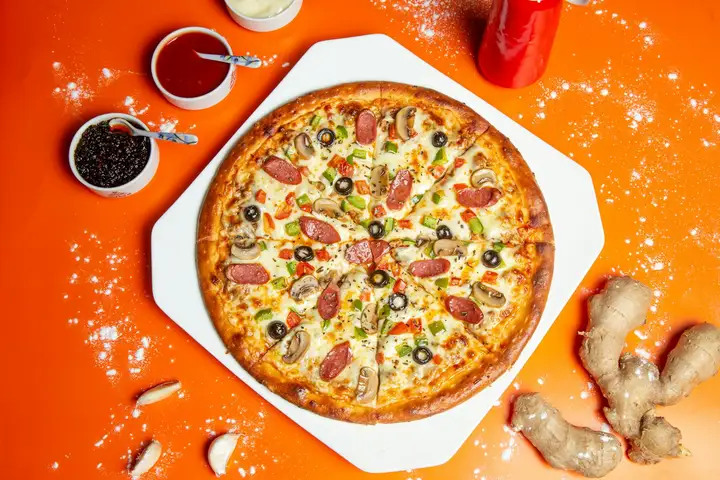
You bought a bag of “Neapolitan pizza flour” at the grocery store, tried to make Neapolitan pizza dough with it, and the crust came out either too tough or too soft. You suspect the flour is wrong, but the bag says “Neapolitan.” This is the flour explainer that decodes the 00 grading system, the W-rating that European flour bags use and American bags hide, and the brand-by-brand comparison the SERP is missing.
TL;DR
- Neapolitan pizza flour is Tipo 00 flour with 12 to 13 percent protein, milled finely enough for Neapolitan-style crust.
- The 00 refers to the grind (finer than American all-purpose), not the wheat variety.
- W-rating (220 to 300) is the European strength measure. US bags hide it; use protein percentage as the closest proxy.
- Caputo Pizzeria (red bag) is the canonical pick. 12.5% protein. About $7 to $9 per 2.2-lb bag.
- King Arthur 00 Pizza Flour is the best American substitute. 11.5% protein (slightly lower than Caputo). $9.95 per 3-lb bag at King Arthur direct.
- Antimo Caputo Chef’s (blue bag), Polselli, Anna Tipo 00 are all valid alternatives at similar protein levels.
- All-purpose flour works in a pinch for long-ferment doughs (24+ hours), but the crust is less elastic.
- What to skip: self-rising flour, bleached cake flour, novelty “00” blends sold at premium pricing in small bags.
Who this guide is for
You make pizza at home, you have an Ooni or Gozney or similar, and you have read three pizza dough recipes that say “use 00 flour” without explaining why or which 00. You want to know whether the bag of “Neapolitan pizza flour” at your grocery store is the right one, whether the $9 Caputo bag is worth it over the $3 Anna bag, and whether you can use the bread flour you already own. This guide answers all three.
If you want the actual dough recipe, see our Neapolitan pizza dough recipe and Ooni pizza dough recipe. Both use Neapolitan pizza flour as the default; this article explains why and what to buy.
What “Neapolitan pizza flour” actually means
“Neapolitan pizza flour” is a category, not a single product. The category combines three properties:
- Tipo 00 grind. Finely milled wheat flour, finer than American all-purpose. The 00 refers to the milling grade in the Italian classification system (00 is the finest, 0 is medium, 1 and 2 are coarser, “integrale” is whole wheat).
- Protein content 11 to 13 percent. This range gives the dough enough gluten to develop the chewy-but-tender crumb that defines Neapolitan crust. Below 11 percent (all-purpose flour territory) and the dough lacks elasticity. Above 13 percent (high-gluten bread flour) and the crust becomes too tough for the style.
- W-rating 220 to 300. The European strength measure that captures how much fermentation the flour can sustain. Neapolitan pizza traditionally uses 8-to-24-hour bulk ferments, so W 220-300 is the right range for the dough not to overproof or collapse.
If a flour bag combines all three, it qualifies as Neapolitan pizza flour. The Italian VPN protocol (Vera Pizza Napoletana, the certification body that defines authentic Neapolitan pizza) requires Tipo 00 flour with W 250-300 and 11-12.5 percent protein specifically.
What 00 flour actually is
The Italian flour classification system grades flour by how much of the wheat bran and germ remains after milling. The grades are:
- Tipo 00: Most refined. Roughly 0.55% ash content. The finest commercial grind.
- Tipo 0: Less refined. Roughly 0.65% ash content. Slightly coarser, used for some Italian breads.
- Tipo 1: Less refined still. About 0.80% ash content.
- Tipo 2: Closer to whole wheat. About 0.95% ash content.
- Integrale: Whole wheat. Ash content 1.30%+.
In American terms, Tipo 00 is finer than all-purpose, slightly coarser than cake flour, and made from harder wheat than cake flour. It is not the same as American “00 cake flour” (which is a marketing label, not a real classification).
The grind matters because finer flour absorbs water faster, develops gluten more uniformly during knead, and produces a more elastic dough at high hydration. Long fermenting doughs (24+ hours) flatten the grind advantage somewhat because the slow hydration equalizes most variables; short ferments (3-4 hours, the kind you make on a same-day Neapolitan) are where the 00 grind shines.
A Reddit thread on r/ooni made this exact point: “the grind matters more for doughs that are fermented for short durations. The grind comes less into play for longer fermenting doughs.” This matches our experience.
What is W-rating?
W-rating (Italian: “indice di forza”) is a number expressing flour strength. It is calculated from a chopin alveograph measurement that physically tests how much a dough can stretch before tearing. The number captures gluten strength and water-absorption capacity in one metric.
W ranges, roughly:
- W 90-150: Weak flour. Cake flour territory. Bad for pizza.
- W 150-220: Soft pastry flour. OK for very short ferments.
- W 220-300: Pizza flour territory. Neapolitan-style.
- W 300-380: Strong bread flour. Long-ferment artisan bread.
- W 380+: Very strong specialty flour. Panettone, brioche, hyper-long-ferment doughs.
Most Italian-imported flour bags print the W-rating prominently. US-milled flour bags do not. King Arthur, Bob’s Red Mill, Gold Medal: protein percentage only, no W. The result is American home bakers have a harder time matching flour to fermentation schedule without trial and error.
The rule of thumb: longer ferment, higher W. If you cold-ferment for 48 hours, get W 280+. If you same-day ferment in 3 hours, W 220 to 250 is fine. Caputo Pizzeria is roughly W 260-280, which fits the 8-to-24-hour ferment window most home pizzaioli use.
Protein percentages 11 to 13 percent: what they mean
Protein content on US flour packaging is the closest proxy to W-rating. Higher protein = more gluten potential = stronger dough = longer ferment tolerance.
For Neapolitan pizza flour specifically:
- 11.5% protein (King Arthur 00 Pizza Flour): Slightly softer dough. Best for short-to-medium ferments (3 to 18 hours). The chewiness is gentle.
- 12.0% protein (Caputo Chef’s Flour, blue bag): Middle of the Neapolitan range. Works for 6 to 24 hour ferments.
- 12.5% protein (Caputo Pizzeria, red bag): The canonical Naples specification. Works for 8 to 48 hour ferments.
- 12.7% protein (King Arthur Bread Flour): Above the Neapolitan spec but still close enough to work. Slightly chewier crust, ideal for 24-to-72-hour cold ferments.
- 13.5%+ protein (high-gluten flours like Sir Lancelot, All Trumps): Outside the Neapolitan range. Better for New York style, where the dough is intentionally chewier.
A 1% difference in protein is the threshold where most tasters start to notice a difference in the final crust. Between 12.5% Caputo and 12.7% King Arthur Bread, most home cooks cannot reliably blind-taste the difference. Between 11% all-purpose and 13% bread flour, the difference is meaningful and obvious.
Brand-by-brand: what to actually buy
The flours that matter for home cooks, ranked roughly by canonical-pizzaiolo-pick to budget-substitute.
Caputo Pizzeria (red bag), 12.5% protein, ~$7-9 / 2.2 lb
The canonical Neapolitan pizza flour. Made by Mulino Caputo, a Naples-based mill that has been producing flour since 1924. The “red bag” (Pizzeria-branded) is the variety sold to professional pizzerias and to home cooks who want the authentic flour.
W-rating roughly 260-280. Finely milled, soft on the hands, absorbs water beautifully. Produces the most consistent Neapolitan-style dough at home.
Buy from: Amazon (most reliable), specialty Italian importers like D’Italia, Eataly online, Buon Italia, Whole Foods (varies by store), some specialty grocery stores.
Buy if: you want the most consistent home Neapolitan pizza experience and budget is not the constraint. The $4-5 price premium over American 00 flour is small per pizza.
Caputo Chef’s Flour (blue bag), 12.0% protein, ~$6-8 / 2.2 lb
The same mill as Caputo Pizzeria but slightly different formulation: slightly lower protein, slightly softer. Good for shorter ferments and home bakers who want a more forgiving dough.
Buy from: Amazon, Italian importers.
Buy if: you mostly do same-day or overnight ferments (under 18 hours) rather than long cold ferments. The slightly softer dough is easier to handle.
King Arthur 00 Pizza Flour, 11.5% protein, $9.95 / 3 lb
The American-milled 00. King Arthur sources American wheat and mills it to Italian Tipo 00 standards. The protein is slightly lower than Caputo, which produces a slightly less chewy crust.
Buy from: King Arthur direct, Whole Foods, sometimes regional grocers.
Buy if: you want easy availability from a trusted American brand, you do not want to deal with Amazon shipping for Italian flour, or you specifically prefer American-milled wheat. The slightly lower protein produces a noticeably softer crust; this is a feature for some, a disadvantage for others.
Antimo Caputo (white packaging), 12.5% protein, ~$25-30 / 11 lb
The bulk variety from the same Mulino Caputo. Same flour as the Pizzeria red bag but in a larger sack with simpler packaging.
Buy from: Amazon (most common), Italian importers, restaurant supply.
Buy if: you bake pizza weekly and go through 2+ pounds of flour per session. The per-pound price drops significantly at this size.
Polselli Classica, 11.5-12.5% protein, ~$6-8 / 2.2 lb
Polselli is an Italian mill (Frosinone, near Rome) with a strong following among Italian home bakers. Their Classica 00 is comparable to Caputo Pizzeria in protein and W-rating. Slightly different flavor profile (some bakers say “nuttier”).
Buy from: D’Italia, Amazon, some specialty importers.
Buy if: you want to try a non-Caputo Italian 00 with similar performance. The flavor differences are subtle.
Anna Tipo 00, 11.5% protein, ~$3 / 1 lb
The cheap, widely available 00 sold at Walmart and many grocery stores. American-milled (Sigma Alimentaria distribution), packaged in the iconic blue-and-red bag with the Anna character on it.
Buy from: Walmart, regional grocers, Amazon.
Buy if: budget is the priority and you can find it cheaper than the alternatives. The flour works for Neapolitan-style; the protein is on the lower end (11.5%), so the crust will be slightly softer than with Caputo Pizzeria.
Bread flour (King Arthur Bread, Gold Medal Better-for-Bread, Bob’s Red Mill Artisan Bread), 12.5-12.7% protein, ~$4-6 / 5 lb
Not a 00 flour, but the protein hits the Neapolitan range. American-milled bread flour at 12.5-12.7% protein performs nearly identically to Caputo Pizzeria at 24-48 hour cold ferments, where the long hydration equalizes the grind difference.
Buy from: every grocery store in America.
Buy if: you cannot find 00 flour, you want to keep flour costs minimal, or you exclusively do long cold ferments. The Reddit consensus from experienced pizzaioli is that for 48-hour ferments, the difference between Caputo and King Arthur Bread is hard to detect blind.
The honest take: brand-blind differences are small at 12.5% protein
The Reddit thread we cited earlier captures this exactly: “Caputo says their 00 pizza flour has 12.5% protein. Dakota Maid bread flour is listed as 12.6% protein, so basically the same. King Arthur is listed at 12.7%, so these are all pretty comparable. I can tell the difference between flours when there is a 1% or greater protein content, but not so much at this level.”
This matches our experience and what Modernist Pizza found in formal taste panels. Within the 12-13% protein range, the grind matters more than the brand for short ferments. For long ferments, even the grind levels out.
Practical implication: do not feel obligated to overpay for Caputo Pizzeria if a comparable-protein American flour is cheaper and more available. The brand premium is small for the home cook making 4 to 8 pizzas a week. For a professional pizzeria making 100+ pizzas a day, the small consistency edge of Caputo at a slightly higher cost is worth it.
When all-purpose flour actually works
All-purpose flour at 10-11% protein is technically outside the Neapolitan spec, but it can produce acceptable Neapolitan-style pizza under specific conditions:
- Long cold ferment (24-48 hours). The extended hydration time develops the available gluten more fully, partially compensating for the lower protein.
- High-heat oven (900F+). The fast bake limits the moisture-evaporation window, which all-purpose handles fine.
- Slightly higher hydration (62-63% instead of 60%). The extra moisture compensates for the slightly lower water-absorption capacity of all-purpose.
The trade-off: the crust will be less elastic and slightly less chewy than the same recipe with 12.5% protein flour. The leoparding (the dark spots on a properly baked Neapolitan rim) is also less pronounced because the lower gluten produces smaller, less robust bubbles.
For an Ooni at 900F with a 48-hour cold ferment, all-purpose flour gets you 85 percent of the result of Caputo Pizzeria. For a home oven at 500F, the difference is bigger because the longer bake gives the dough more time to flatten out the gluten difference.
Use all-purpose when 00 flour is unavailable, accept the trade-off, plan a long ferment. Do not use all-purpose if Neapolitan authenticity matters or if you bake for short ferments.
Where to buy
By tier:
- Grocery stores (Whole Foods, regional Italian markets): Caputo Pizzeria, Caputo Chef’s, sometimes King Arthur 00. Anna Tipo 00 at Walmart, Kroger, regional chains.
- King Arthur direct: shop.kingarthurbaking.com for King Arthur 00, often best price for that brand.
- Amazon: All Caputo varieties (Pizzeria, Chef’s, Cuoco, Saccorosso, Antimo bulk), Polselli, King Arthur 00 (often resold). Most reliable for Caputo.
- Italian specialty importers: D’Italia, Eataly, Buon Italia, Supermercato Italiano. Best for full Caputo lineup and harder-to-find varieties (Polselli, Marino, Le 5 Stagioni).
- Restaurant supply: Webstaurantstore, US Foods (with account). Caputo in 25-lb sacks if you bake weekly.
For occasional bakers (1-2 pizzas a month), a 2.2-lb retail bag from Amazon or Whole Foods lasts 3-4 months and costs about $7-9. For weekly bakers, a 11-lb Antimo Caputo sack at $25-30 lasts about 2 months and saves 30 percent per pound.
What to skip
The anti-recommendations.
- Self-rising flour. Contains added leavening (baking powder, salt) that ruins pizza dough chemistry. Never use.
- Bleached cake flour. Too low in protein (~7%) and chemically treated. Wrong category entirely.
- “00 Cake Flour.” A US marketing label, not real Italian 00. Usually weaker than real Tipo 00 pizza flour.
- “Pizza flour blend” mixes. Many American brands sell premixed “pizza flour” that includes baking aids and conditioners. These work for home-oven pizzas but produce inferior results in a high-heat pizza oven.
- Premium-priced novelty 00 flours at $15+ per pound. A few specialty bakeries sell “artisanal heritage grain 00 flour” at $15-25 for a 1-lb bag. The premium does not translate to a meaningfully better pizza for the home cook. Use Caputo or King Arthur instead.
- Whole wheat or whole grain “00” flour. Whole wheat does not behave like 00 (the bran disrupts gluten development). If you want whole-grain pizza, use a recipe specifically formulated for it.
- Expired flour. Flour loses protein strength after 12-18 months of room-temperature storage. Check the date on the bag. Bulk-buy only if you bake frequently enough to use it within 6 months.
FAQ
What flour is used for Neapolitan pizza?
Tipo 00 with 12-13% protein. Caputo Pizzeria (red bag) is the canonical choice. Caputo Chef’s, King Arthur 00, Antimo Caputo, Polselli, Anna Tipo 00 are all valid alternatives.
Is Neapolitan pizza flour the same as 00 flour?
Overlapping but not identical. 00 is the grind; Neapolitan flour combines 00 grind with specific protein (11-12.5%) and W-rating (220-300). All Neapolitan pizza flours are 00; not all 00 flours are Neapolitan-spec.
What’s the W-rating?
European strength measure. Higher W = stronger flour = longer ferment tolerance. Neapolitan range is W 220-300. US bags hide it; use protein percentage as a rough proxy.
Can I use all-purpose flour for Neapolitan pizza?
Yes with a long cold ferment (24-48 hours) and slightly higher hydration (62-63%). The crust will be slightly less elastic than with proper 00. Acceptable for casual home cooking; suboptimal for authentic Neapolitan.
What’s the difference between Caputo Pizzeria and Chef’s?
Pizzeria (red bag): 12.5% protein, W 260-280, for 8-48 hour ferments. Chef’s (blue bag): 12% protein, slightly lower W, for shorter ferments and softer doughs. Both work for Neapolitan; Pizzeria is closer to the authentic Naples specification.
Does Walmart sell Caputo flour?
Sometimes; varies by store. Walmart reliably carries Anna Tipo 00 (the cheapest mainstream 00). Caputo is more reliably available on Amazon, at specialty Italian importers, or at Whole Foods.
How much does Neapolitan pizza flour cost?
$0.60 to $2.50 per pound. Anna Tipo 00 is the cheapest at $3 for 1 lb. Caputo Pizzeria is $7-9 for 2.2 lb. King Arthur 00 is $9.95 for 3 lb. Bulk Antimo Caputo is $25-30 for 11 lb (best per-pound price for serious bakers).
The verdict
For the home cook making Neapolitan-style pizza in an Ooni, Gozney, or any high-heat oven:
- Best overall: Caputo Pizzeria (red bag). The authentic Naples flour at fair retail pricing. About $0.10-0.15 of flour per pizza.
- Best American-milled: King Arthur 00 Pizza Flour. Same milling spec as Italian 00, slightly lower protein, easier to find direct from King Arthur.
- Best budget: Anna Tipo 00 at Walmart. About one-third the price of Caputo with acceptable results for casual baking.
- Best for weekly bakers: Antimo Caputo 11-lb sack on Amazon. 30 percent lower per-pound than retail bags.
- Skip: self-rising, bleached cake, “00 cake flour” marketing labels, premium boutique 00s at $15+/lb.
If you want the dough recipe that uses this flour properly, see our Ooni pizza dough recipe (4 schedules at 60% hydration, designed for high-heat ovens) and our Neapolitan pizza dough recipe (the foundational article that covers the broader Neapolitan technique). For the oven to bake it in, our Ooni Koda 16 review and best wood fired pizza oven buyer’s guide cover the equipment side. For other styles that use different flours (bread flour for New York style, higher-hydration bread flour for Detroit style), each style article links to the right flour choice for that pizza.