You had one at a street stall in Bari, at Luini in Milan, or on a pizzeria menu that listed panzerotti next to the calzones, and you want to make them at home without the filling blowing out into a pot of hot oil. That last part is where most panzerotti recipes fail you. They give you a dough and a filling and say “fry until golden,” and skip the two details that decide whether you get a puffed, sealed pocket of molten mozzarella or a greasy, burst mess: how dry the filling is, and how hot the oil is.
Panzerotti (singular panzerotto) are small half-moons of yeasted pizza dough filled with tomato and mozzarella, sealed tight, and deep-fried until puffed and golden. They come from Puglia, the heel of Italy, where Bari treats them as its signature street food. The name means “little bellies,” for the way they swell in the oil.
Who this is for: anyone who wants to know what panzerotti actually are, how they differ from a calzone, and how to fry a batch at home that stays sealed.
TL;DR
- Panzerotti are fried, not baked. Folded like a calzone, but smaller, rolled thin, and deep-fried. Wikipedia’s definition is blunt: the term applies only to a fried product.
- They are Puglian. Bari calls them panzerotti; Salento calls the same thing a calzone; Campania calls it pizza fritta.
- The dough is pizza dough, slightly firmer. GialloZafferano’s formula runs 57% hydration with 2% salt, 2% olive oil, and 1% sugar for color. That is the recipe below, in grams.
- Fry at 330°F (165°C), not 375°F. A sealed pocket needs time for the cheese to melt before the shell browns. Hotter oil gives you a dark outside and a cold middle.
- A dry filling is the whole game. Cook the passata down, drain the mozzarella, and keep the edges clean. Water in the filling becomes steam, and steam is what bursts the seam.
- Use a rolling pin. The one time this site will tell you to. You want an even 2 mm sheet with no puffy rim.
What is a panzerotti?
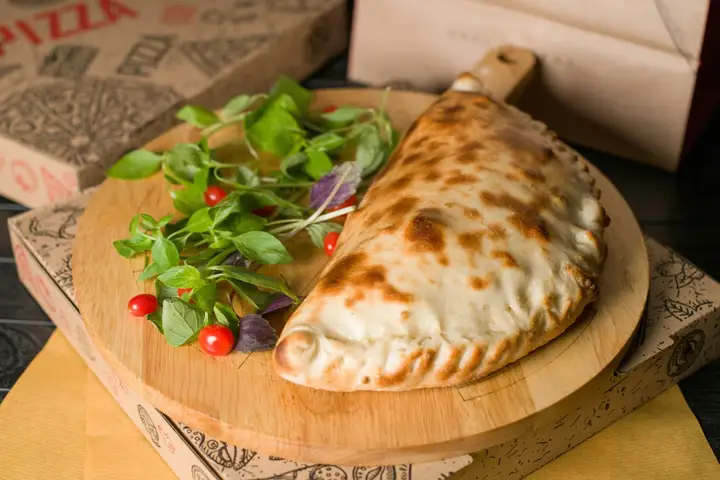
A panzerotto is a round of yeasted dough, rolled thin, filled with tomato and mozzarella, folded into a half-moon, sealed, and deep-fried. Done right, it puffs in the oil like a small balloon, the shell turns blistered and golden, and the inside is a pocket of melted cheese and hot tomato. You eat it out of hand, carefully.
The classic filling is just tomato and mozzarella. Wikipedia’s panzerotti entry also lists onions cooked in olive oil with salted anchovies and capers (the same briny pairing that makes anchovies on pizza work), and mortadella with provolone. Bari’s versions add capers, ricotta, or bacon.
A note on the word. Panzerotti is plural; one is a panzerotto. American menus use “panzerotti” for both, and you will also see panzarotti and panzarotto, a spelling variant common enough that it has its own search volume. The root is panza, the southern Italian form of pancia, belly. A panzerotto is a little belly, named for the way it bloats in the fryer.
Where panzerotti come from
Panzerotti come from Puglia, and specifically from Bari. La Cucina Italiana’s history of the panzerotto barese places its birth “among the alleys” of Bari’s old town sometime between the 16th and 17th centuries, while allowing that it may be older and shares its history with pizza. No individual inventor is documented, and you should be skeptical of any article that names one.
The name changes as you move around southern Italy, which is the root of most of the confusion online:
- Bari: panzerotto.
- Salento (the far south of Puglia): calzone, per La Cucina Italiana.
- Campania: pizza fritta, or calzone fritto (fried calzone).
- Molfetta and other towns near Bari: frittelle, especially at Christmas, New Year’s Eve, and the San Martino feast.
- Brindisi: fritte.
One trap: Salento also makes panzerotti di patate, which are mashed-potato croquettes, not dough pockets at all.
Panzerotti in Milan: the Luini story
If you have searched “panzerotti Luini,” this is why. According to Luini’s own history, Giuseppina Luini moved from Puglia to Milan with her family in 1949 and opened a bakery at Via Santa Radegonda 16. For its first years the shop made bread for restaurants and hotels. Then, going through recipes handed down from her grandfather, she found the family panzerotti recipe and started frying a few.
The Milanese were not used to them at first. Within a few years they were a city staple, and Luini still makes every panzerotto to order. The dough recipe is a family secret, and the shop sells both fried and baked versions. Luini did not invent the panzerotto; it is the reason Milan, at the other end of the country, treats it as its own.
Panzerotti vs calzone
A panzerotto is a small, thin, fried pocket from Puglia; a calzone is a larger, baked pocket from Naples. They share a shape and a dough family, which is why Wikipedia notes the two are often mistaken for each other. The differences:
| Panzerotti | Calzone | |
|---|---|---|
| Region | Puglia (Bari) | Naples and Campania |
| Cooking | Deep-fried | Baked |
| Size | Small: about 100 g of dough per pocket | A full pizza round, folded |
| Dough handling | Rolled thin with a pin, about 2 mm | Hand-stretched |
| Classic filling | Tomato and mozzarella, together inside | Ricotta, mozzarella, cured meat; tomato sauce usually on the side |
The naming map above complicates the clean version. In Salento, a “calzone” is a panzerotto, and in Campania the fried pocket is literally called a fried calzone. So the honest rule is that frying is the line: fried and Puglian is a panzerotto, baked and Neapolitan is a calzone. For how the calzone stacks up against the Italian-American stromboli (and where panzerotti fit in that three-way confusion), see our calzone vs stromboli breakdown.
Why panzerotti dough is built differently from pizza dough
Panzerotti dough is pizza dough adjusted for a sealed pocket in hot oil. La Cucina Italiana says it plainly: a true panzerotto alla barese is pizza dough stuffed with mozzarella and tomato. But three adjustments matter, and each one follows from what happens inside a closed pocket in a fryer.
1. It runs slightly firmer. Compare hydrations (water as a percentage of flour weight):
| Dough | Hydration | Shaping |
|---|---|---|
| GialloZafferano panzerotti | 57% | Rolled to 2 mm with a pin |
| Our Neapolitan pizza dough | 60% | Hand-stretched, never rolled |
| Our New York style crust | 63% | Hand-stretched, never rolled |
The difference looks small, and it is. But a firmer dough rolls to an even 2 mm sheet without sticking to the pin, holds its shape when you fold it over a filling, and gives you dry, flat edges that bond when you press them. A slack, sticky dough smears instead of sealing.
2. It gets rolled, not stretched. Our guide to stretching pizza dough bans the rolling pin, because a pin presses out the gas that makes a pizza rim puff. For panzerotti, that is exactly what you want. There is no rim. You need an even sheet, so the pocket cooks evenly and the seam is the same thickness as the rest.
3. It carries a little sugar. GialloZafferano adds 1% sugar and tells you not to skip it, because it gives the fried shell its golden color. That matters more than it sounds, because of the next point.
The physics of a sealed pocket in hot oil
Once a panzerotto is sealed, it is a closed system. The oil browns the outside on contact, but heat reaches the cheese only by conduction through the dough. Two things follow.
First, the oil has to be cooler than you think. GialloZafferano’s panzerotti recipe fries at a constant 165°C (329°F) and warns that if the oil goes higher, the panzerotti burn outside and do not melt inside. Typical American recipes call for the standard deep-fry range of 350 to 375°F. That range suits a doughnut, which is dough all the way through. It is wrong for a pocket of cold cheese.
Second, every gram of water in the filling becomes steam. Steam needs somewhere to go, and in a sealed pocket the only exit is the seam. Wikipedia’s entry notes that the tomatoes in a traditional filling are drained and dried, because wet tomatoes make the dough rip. That is the blowout, explained. Dry filling, sealed edges, and the puff you want stays inside the pocket.
Panzerotti recipe
This is the formula from the Italian recipe site GialloZafferano, laid out in grams and baker’s percentages with US flour substitutions. It makes 8 panzerotti.
Ingredients
| Ingredient | Grams | Baker’s % |
|---|---|---|
| 00 flour (or all-purpose) | 250 g | 50% |
| Manitoba flour (or bread flour) | 250 g | 50% |
| Warm water | 285 g | 57% |
| Fine salt | 10 g | 2% |
| Extra-virgin olive oil | 10 g | 2% |
| Sugar | 5 g | 1% |
| Fresh yeast (or 3 g instant or active dry) | 8 g | 1.6% |
Filling: 250 g mozzarella, 200 g tomato passata, 1 tablespoon olive oil, 1 teaspoon salt, 1 teaspoon dried oregano.
For frying: peanut or vegetable oil, enough for the panzerotti to float freely.
On the flour: 00 is a finely milled Italian flour (our Neapolitan pizza flour guide explains what the rating means), and Manitoba is Italy’s name for strong, high-protein flour, the job bread flour does in a US kitchen. The 50/50 blend gives a dough with enough strength to roll thin and hold a seal without fighting back. On the yeast: GialloZafferano’s editors convert 1 g of dry yeast to 3 g of fresh, so 8 g fresh becomes about 3 g instant or active dry.
Make the dough
Mix both flours with the yeast and sugar. Add half the water and stir until it is absorbed, then add the salt, then the rest of the water a little at a time. Work in the olive oil last.
Knead on the counter for 5 to 10 minutes, until the dough is smooth and no longer sticks to your hands. Divide it into 8 pieces of about 100 g, round each into a tight ball, and set them in a covered container or under plastic, away from drafts. Let them rise about 2 hours, until doubled.
Make a dry filling
While the dough rises, simmer the passata with the olive oil and salt for 15 minutes to drive off water, stir in the oregano, and let it cool completely before it goes anywhere near the dough.
Dice the mozzarella and drain it in a fine-mesh sieve for the full rise. Fresh mozzarella (fior di latte) is the Italian choice and the wettest; drain it hard. Low-moisture mozzarella is drier and more forgiving, and our guide to the best cheese for pizza explains the moisture difference. If you make your own sauce, a smooth, cooked-down version of our pizza sauce recipe works in place of the passata.
Roll, fill, and seal
On a lightly floured board, roll each ball with a rolling pin into a disc about 2 mm thick (a little under 1/8 inch). A 100 g ball at that thickness comes out roughly 9 inches across.
Spoon about 2 tablespoons of sauce into the center and add a few cubes of mozzarella. Keep the outer inch of dough completely clean. GialloZafferano’s editors, answering a reader whose panzerotti kept opening, give exactly this advice: press harder, keep filling off the edges, and always drain the mozzarella.
Fold the dough over into a half-moon, press out any trapped air, and press the edges together firmly. Trim the edge with a pastry wheel or knife for a clean seam, then fold the edge over itself and press it down with the tines of a fork.
Fry at 330°F, not 375°F
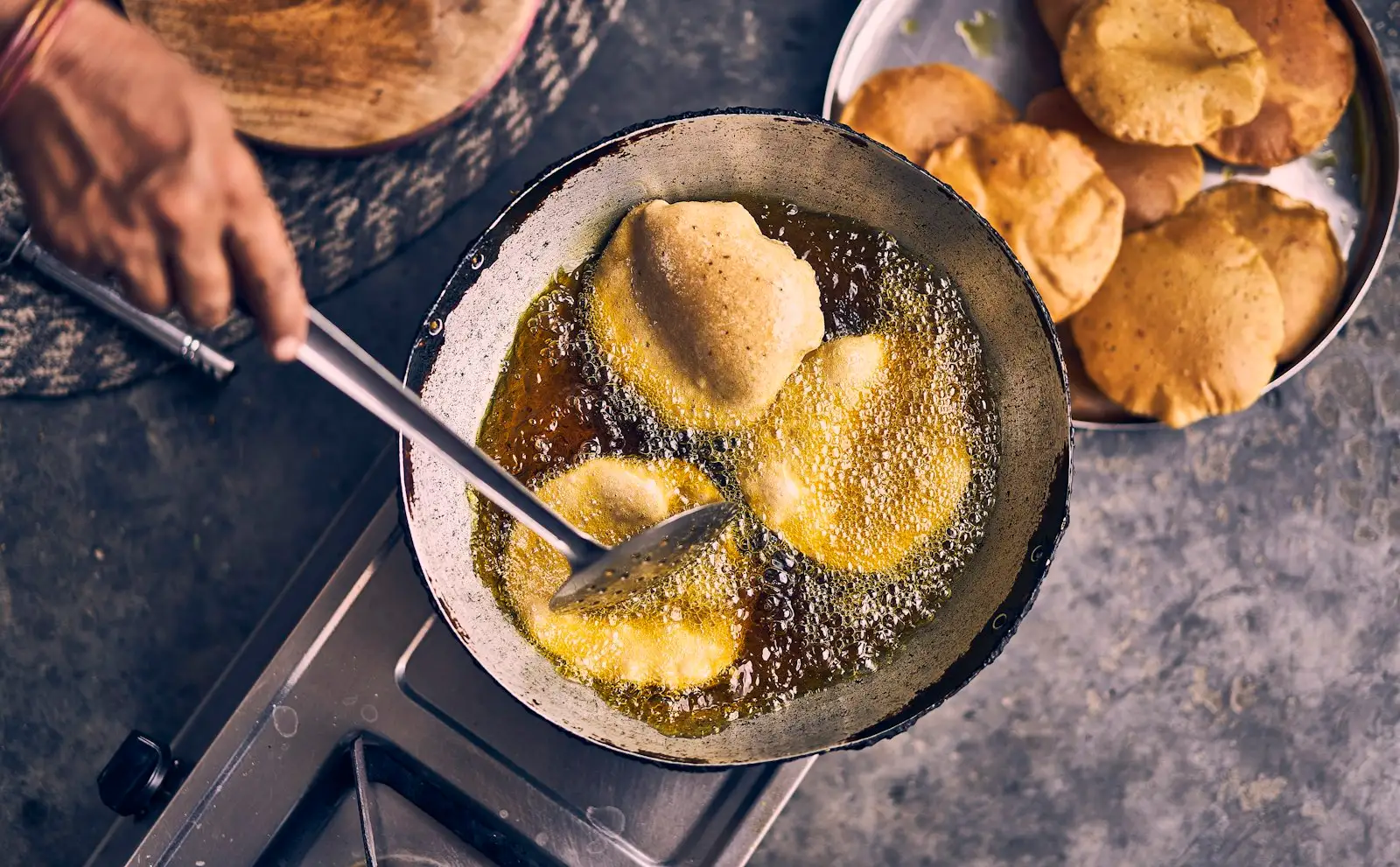
Heat the oil in a heavy pot to 330°F (165°C), with a clip-on thermometer in the oil, and hold it there. Fill the pot no more than halfway, so the oil has room to rise when the panzerotti go in, and keep a lid nearby. Never put water on an oil fire.
Fry 1 or 2 at a time; more drops the oil temperature. Each panzerotto sinks, then floats. When it floats, flip it and spoon hot oil over the top, which is GialloZafferano’s method and the reason the shell puffs evenly instead of browning in patches. Fry until deep golden on both sides, judging by color rather than the clock. Drain on paper towels, let the oil come back to 330°F, and repeat.
Serve them hot, and warn people. The inside is molten.
Make-ahead: GialloZafferano notes you can freeze raw, filled panzerotti and fry them straight from frozen. Fried leftovers keep a day in the fridge; reheat them in the oven, or in an air fryer the way you would reheat pizza in an air fryer. Never the microwave, which steams the shell soft.
Baked or fried panzerotti?
Fried is the panzerotto; baked is a perfectly good small calzone. La Cucina Italiana says a baked panzerotto tastes just as good but that skipping the fryer would be “an abomination for panzerotto purists,” and Wikipedia reserves the word for the fried version. Luini, for the record, sells both.
The difference is texture. Frying puffs the pocket and gives a blistered, crisp-chewy shell. Baking gives a drier, breadier crust that does not puff as much. If you want to bake, GialloZafferano’s method for small baked calzoni is to brush them lightly with olive oil and bake at 230°C (446°F) with the fan on for 10 to 15 minutes. Cut a small steam vent in the top, which you never do for frying (it lets oil in).
Why panzerotti burst, and other problems
Panzerotti burst because water in the filling turns to steam and forces open the weakest point, the seam. Here is that and every other common failure:
| Problem | Cause | Fix |
|---|---|---|
| Burst in the oil | Wet filling, filling on the edges, or overfilling | Cook the passata down, drain the mozzarella, keep the edges clean, press the seal hard |
| Dark outside, cheese not melted | Oil too hot | Hold 330°F (165°C); GialloZafferano caps it at 165°C for exactly this reason |
| Greasy and heavy | Oil too cool, usually from crowding the pot | Fry 1 or 2 at a time and let the oil recover between batches |
| Pale shell | Oil too cool, or the sugar left out | Keep the 1% sugar; check the thermometer |
| Dough tears when you fold it | Rolled thinner than 2 mm, or dough under-rested and tight | Give the balls the full rise; see our pizza dough troubleshooting guide for dough that fights back |
| Soggy the next day | Steam from the filling softens the shell | Reheat in the oven or air fryer, never the microwave |
What to skip
- Frying at 375°F. The standard deep-fry number is wrong for a sealed pocket of cheese. Hold 330°F.
- Stirring the sauce into the cheese. Some recipes mix sauce, cheese, and toppings into one wet filling. Keep them separate and keep the sauce cooked down.
- Raw passata or watery canned tomatoes. Uncooked tomato is mostly water, and water is steam.
- Fresh mozzarella straight from the brine. Drain it for the full 2 hours, or use low-moisture.
- Hand-stretching. Our usual rule flips here. Stretching leaves thick and thin spots; a pin gives the even 2 mm sheet a seal needs.
- Overfilling. Two tablespoons of sauce and a few cubes of cheese. A fat panzerotto is a burst panzerotto.
- The microwave for leftovers. It turns the shell to sponge.
FAQ
Is panzerotti dough the same as pizza dough?
Essentially, yes. La Cucina Italiana describes a true panzerotto alla barese as pizza dough stuffed with mozzarella and tomato, folded into a half-moon, and fried. Italian home formulas tend to run a little firmer than pizza dough (GialloZafferano’s is 57% hydration, against 60 to 63% for typical Neapolitan and New York doughs) and add about 1% sugar for a golden fry. Any pizza dough works; a firmer one is easier to roll thin and seal.
What is panzerotti in English?
There is no exact English word. Panzerotto is a diminutive of panza, the southern Italian form of pancia, meaning belly, so the name translates loosely as “little belly,” for the way the pocket swells in the fryer. English menus usually describe panzerotti as fried calzones or fried pizza pockets. Panzerotti is the plural; one is a panzerotto.
What is another name for panzerotti?
It depends where you are. Panzarotti (and panzarotto) is a common spelling variant. In Campania the same fried pocket is called pizza fritta or calzone fritto, in Salento it is simply called a calzone, in Molfetta and other towns around Bari it can be a frittella, and in Brindisi a fritta. In Bari itself, it is a panzerotto.
Who made the original panzerotti?
No single inventor is documented. Panzerotti come from Puglia, and La Cucina Italiana places their birth in the old-town alleys of Bari sometime between the 16th and 17th centuries, while noting they may be older. The most famous name attached to them is Giuseppina Luini, who brought her family’s recipe from Puglia to Milan in 1949 and made panzerotti a Milanese staple, but she popularized them; she did not invent them.
How long do you bake panzerotti?
About 10 to 15 minutes at 446°F (230°C) with the oven fan on, brushed lightly with olive oil first, per GialloZafferano’s method for small baked calzoni. Bake them until the shell is deep golden. Expect a breadier, drier pocket than the fried version; strictly speaking, a baked panzerotto is a small calzone.
The one rule to remember
Every panzerotti failure comes back to water and heat. Keep the water out of the filling and the oil at 330°F, and the rest (a firm dough, a 2 mm sheet, a hard-pressed seam) is just the technique that lets those two rules work. Make one batch with the GialloZafferano formula and a thermometer clipped to the pot, and you will have the thing Bari has been frying for centuries: a sealed, puffed, golden pocket with a molten center that did not end up in the oil.