Pinsa is everywhere right now: pinserie in Rome, frozen bases in supermarkets, menus from San Francisco to Tokyo, and a thousand articles telling you it is the ancient flatbread Roman legionaries ate before pizza existed. That story is false, and not in a fuzzy lost-to-history way. The man who created pinsa has said, on the record, that he invented it.
Pinsa is an oval Roman-style flatbread made from a high-hydration blend of wheat, rice, and soy flours plus dried sourdough, mixed with cold water, cold-fermented for one to five days, and baked until crisp outside and airy inside. Despite the marketing, it is not ancient: it was created and trademarked in 2001.
This guide covers what pinsa actually is, where it really came from, why the dough is a genuinely clever piece of modern engineering, and how it compares to the pizza you already make.
Who this is for: anyone who has seen pinsa on a menu or in a freezer case and wants the real answer, and any home baker curious whether the rice-and-soy flour blend is worth trying.
TL;DR
- Pinsa is a modern invention. Corrado Di Marco’s Rome-area company registered the “pinsa romana” trademark in 2001. The “ancient Rome” backstory was invented as marketing, and Di Marco has publicly admitted it.
- The dough is the real story: wheat flour cut with rice and soy flours plus dried sourdough, very little yeast, cold water, and a 24 to 120 hour cold ferment.
- The result: an oval flatbread that is crackly-crisp outside and open and airy inside, sturdier than Neapolitan, lighter than focaccia.
- “Healthier than pizza” is mostly marketing. The long ferment may aid digestibility; the calories are pizza calories.
- Pressed, never rolled. The name evokes the Latin pinsere, to press or pound, and gentle fingertip pressing is also just correct dough handling.
What is pinsa?
Pinsa (often “pinsa romana”) is an oval flatbread that sits somewhere between pizza and focaccia. The base is the whole point: a wet dough built from wheat flour blended with rice flour and soy flour plus a dried sourdough component, fermented cold and slow, then hand-pressed into an oblong and baked hot. Done right, the crust shatters lightly when you bite it and opens into an airy, almost lacy crumb, with a character distinct from any round pizza.
According to the official Pinsa Romana specification, the defining features are the oval shape, the proprietary three-flour blend with dried mother dough, cold water in the mix, a small yeast dose, and a slow refrigerated fermentation that can run from 24 hours to as long as 120. The company calls the signature texture “friability”: crunchy outside, soft inside.
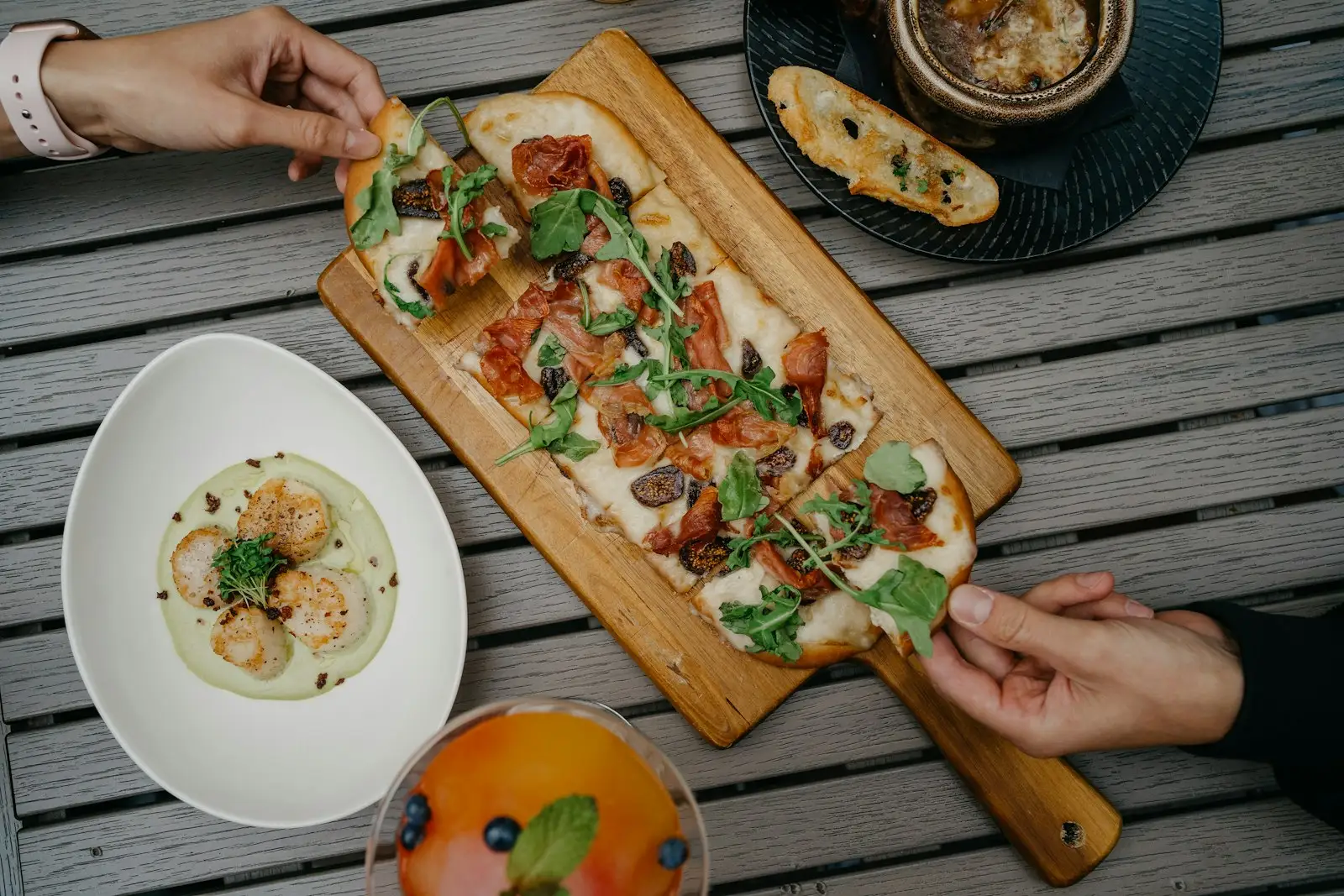
Toppings are pizza toppings. Tomato and mozzarella is the staple, and the sturdy crisp base also carries post-bake toppings (prosciutto, arugula, stracciatella) unusually well, which is why so many pinserie lean into white, deli-style versions.
The “ancient Roman” story, and what actually happened
Almost every article about pinsa, including the one currently ranking first on Google, tells you pinsa is an ancient Roman flatbread, a rustic ancestor of pizza eaten two thousand years ago. Here is what actually happened, and it is better than the myth.
Pinsa was created by Corrado Di Marco, an Italian entrepreneur whose family baking company near Rome had been producing a tray-baked dough since 1981. In 2001 the company registered the “pinsa romana” trademark, named the product to evoke the Latin verb pinsere (to pound or press) while deliberately echoing “pizza” and “pita”, and launched it with a backstory connecting it to ancient Rome.
The backstory was fiction, and not speculatively so. As documented on Wikipedia’s well-sourced pinsa entry, Di Marco admitted in a 2020 Italian interview that there is no historical trace of pinsa and that he invented the story to promote the product. The invented history worked spectacularly: media repeated it uncritically, and it is now embedded in restaurant menus, packaging, and most of the articles outranking the truth. Even the official Pinsa Romana site still describes a recipe “revisited several times over the centuries.”
Rome-based food writer Katie Parla, whose pinsa romana recipe is one of the few honest treatments in English, puts it plainly: the story is fun but “lacks any historical backing.” Pinsa is not part of a pizza continuum stretching back two millennia. It is a product of Italy’s contemporary pizza culture, where new flatbread formats built on engineered flour blends and long fermentation have been emerging for a couple of decades.
None of this makes pinsa bad. It makes pinsa a well-designed modern dough wearing a costume it never needed. Judge it on the texture, which is real, not the history, which is not.
Pinsa vs pizza: the real differences
| Pinsa | Pizza | |
|---|---|---|
| Shape | Oval / oblong | Round (style-dependent) |
| Flour | Wheat + rice + soy blend, plus dried sourdough | Wheat flour (00 or bread flour) |
| Water | High hydration, always cold | Style-dependent, usually 55-70%, temperature varies |
| Yeast | Very small dose | Small to moderate dose |
| Fermentation | Cold, slow: 24 to 120 hours | Style-dependent: same-day to 72 hours |
| Shaping | Gently pressed by hand, never rolled | Stretched (Neapolitan/NY) or pan-pressed |
| Texture | Crackly-crisp outside, open airy interior | Varies: soft-pliable (Neapolitan) to crisp-thin (tavern) |
| Age of the style | Trademarked 2001 | Naples lineage, 1800s onward |
The toppings overlap almost completely; the base is the difference. If you want the deeper context on what the classic doughs do differently, our Neapolitan pizza dough guide covers the strict traditional end, and our Sicilian dough recipe covers the other famous oblong pan format that pinsa is most often confused with.
Pinsa vs focaccia vs Sicilian: the three oblong breads people confuse
Put a pinsa, a focaccia, and a Sicilian square side by side and plenty of menus would happily swap the labels. They are three different things, and the differences are structural, not cosmetic.
Focaccia is an olive-oil bread first. The dough is enriched with oil, baked thick in an oiled pan, and the crumb is uniformly soft and plush from edge to edge. It is a bread you might top, not a base engineered for toppings. Pinsa’s standard formula keeps oil optional and minimal, and its crumb is built for contrast: a brittle shell over an open interior, sturdy enough to act as a platform.
Sicilian (and its American square-slice descendant) is a pan pizza: a high-hydration wheat dough proofed and baked in an olive-oiled rectangular pan, golden-fried on the bottom, open-crumbed and tall. It is the closest cousin of the three, but it is still all wheat, baked in its pan, with the fried-bottom character as the signature. Our Sicilian dough guide covers it properly.
Pinsa is the outlier on flour and on shaping. The rice-and-soy blend exists in neither of the others, the dough is pressed free-form into an oval rather than proofed into a pan’s corners, and the bake chases crispness over fried richness. If focaccia is bread and Sicilian is pan pizza, pinsa is closer to a long-fermented flatbread cracker that kept an airy heart.
The one-line test when a menu is vague: pan-cornered and oily-bottomed is Sicilian, plush and dimpled is focaccia, free-form oval with a crackle is pinsa.
The dough science: why the weird flour blend works
Strip away the marketing and pinsa’s formula makes real sense. Each component does a job.
Rice flour brings crispness and water capacity. Rice flour has no gluten and gelatinizes differently than wheat starch. In a blend, it drinks up water and bakes into a thinner, crisper, more brittle shell than wheat alone, which is where pinsa’s shattering exterior comes from.
Soy flour brings tenderness and color. A small soy fraction softens the crumb and aids browning, keeping the interior from reading as bready even with a crisp shell around it.
The dried sourdough (mother dough) brings flavor and the digestibility pitch. Pinsa formulas include dried lievito madre alongside a tiny commercial-yeast dose. The long acidification is the basis of the easier-to-digest claim. That mechanism is real as far as it goes: long fermentation does break down some starches and proteins in any dough, which is the same reason a properly fermented sourdough pizza dough eats lighter than a same-day emergency dough. What it does not do is turn flatbread into a health product.
Cold water plus a long cold ferment keeps it controllable. With high hydration and a multi-day timeline, warmth is the enemy. The cold mix and refrigerated 24-to-120-hour fermentation keep the small yeast dose crawling along slowly, developing flavor without overproofing. (If your own wet doughs run away from you, that failure mode and its fixes are in our pizza dough troubleshooting guide.)
A note on exact numbers: the precise blend ratios in the trademark “Pinsa Romana” flour are proprietary to Di Marco’s company, which sells the mix and runs an association certifying pinserie. Published home formulas approximate it; Katie Parla’s, for example, uses 500 grams of bread flour to 50 grams of rice flour, about a 9 percent rice fraction, with an overnight refrigerator ferment. Anyone selling you “the exact ancient formula” is selling you the 2001 story again. For how flour protein and blends change crust behavior generally, see our pizza flour guide.
Is pinsa healthier than pizza?
Honest answer: not meaningfully, and the claim deserves the same skepticism as the origin story.
What is supportable: the long cold fermentation and sourdough component are intended to improve digestibility, and long-fermented doughs in general are easier on many stomachs than fast doughs. The airy, low-density base can also mean a typical portion carries slightly less dough by weight than a dense slab.
What is not supportable: pinsa as a health food. It is white-flour flatbread with cheese on it. The producer’s marketing claims fewer carbohydrates and fats than pizza dough; treat that as a company claim about its own product, not independent nutrition science. If “healthier” drives the choice between pinsa and pizza, the differences are rounding errors. Choose pinsa for the texture.
How to make pinsa at home
You can make a credible pinsa without the trademarked flour. The method below follows the published approach Rome-based writer Katie Parla documented, generalized to what each step is doing.
- Build the blend. Bread flour cut with roughly 10 percent rice flour gets you most of the texture effect. Add soy flour only if you can find it fresh; a blend without it still works.
- Mix wet, with cold water, and expect a sticky dough. Pinsa dough is far wetter than a classic 60 to 65 percent pizza dough. Resist the urge to flour it into submission; wet hands and a bench scraper are the tools, exactly as with any high-hydration dough.
- Develop with folds, not kneading. A stretch-and-fold every 30 minutes through the first hours builds strength gently. The dough should turn shiny and elastic.
- Cold-ferment at least overnight. The refrigerator does the flavor work. One night is the floor; pinsa’s spec runs as long as five days, and the dough improves over the first 48 to 72 hours.
- Divide and ball. Parla’s formula cuts the batch into roughly 165 gram pieces for individual oval pinse.
- Press, never roll. Dimple and press each piece outward with fingertips into an oblong, preserving the gas. This is the same discipline as any good pizza shaping, just in an oval; the full hand-positioning logic is in our how to stretch pizza dough guide, and a rolling pin undoes everything the five-day ferment built.
- Bake hot, on a preheated surface. A steel or stone preheated at your oven’s maximum gives the crisp base; the principles by oven and style are in our pizza oven temperature guide. For a white pinsa finished with cold toppings after the bake, the logic in our white pizza guide applies directly.
Reading the menu: what “pinsa romana” legally means
One more thing the marketing makes confusing: “Pinsa Romana” is not a protected regional designation like Neapolitan pizza’s STG status or a DOP cheese. It is a registered trademark owned by Di Marco’s company, which also sells the official flour blend and, per its own materials and Katie Parla’s reporting, oversees an association that certifies pinserie to keep the product consistent worldwide.
That has two practical consequences when you are deciding what to order or buy:
- A “certified” pinseria is certified by the brand owner, not by an independent tradition body. The certification is a real consistency signal (the shop is using the official blend and method), but it is a franchise-style quality mark, not a heritage credential.
- Plenty of excellent oval flatbreads are sold as pinsa without certification, made with house blends like the bread-plus-rice-flour approach in published home recipes. They cannot legally be “Pinsa Romana” product, and they can still be terrific. Judge the crumb, not the trademark.
The parallel with Neapolitan pizza is instructive. The AVPN protects a century-old public tradition anyone can learn; the pinsa trademark protects a 2001 product one company invented. Neither model is wrong, but only one of them is “authentic Italian heritage”, and it is not the one whose marketing leans hardest on the word.
What to skip
- The ancient-grains marketing. Any product or menu invoking Roman legions, “millennia-old recipes”, or ancient tradition is repeating a story the inventor has disavowed. Skip the premium that story is charging.
- The rolling pin. Pressing is the technique and half the branding (pinsere). Rolling flattens the open crumb into cardboard.
- Skipping the cold ferment. A same-day “pinsa” is just an oval white bread. The texture and flavor live in the multi-day refrigerator ferment.
- Treating it like Neapolitan. Different flour, far wetter dough, different shape, longer bake. The skills transfer; the recipe does not.
- Paying health-halo prices. It is excellent flatbread, not a supplement.
FAQ
What is the difference between pizza and pinsa?
Four real differences. Shape: pinsa is oval, pizza is round. Flour: pinsa uses a wheat, rice, and soy blend plus dried sourdough; pizza uses wheat alone. Dough: pinsa runs wetter, is mixed with cold water, and cold-ferments 24 to 120 hours. Texture: pinsa bakes crisp and crackly outside with an open, airy interior. The toppings overlap almost completely; the base is the difference.
Is pinsa healthier than pizza?
Mostly no. The long cold ferment and sourdough component may aid digestibility, and the airy base can mean a lighter portion, but it is still white-flour flatbread with cheese. The lower-carbohydrate claims come from the producer’s own marketing, not independent nutrition science. Choose pinsa for the texture.
What is the real history of pinsa?
Corrado Di Marco’s Rome-area company registered the “pinsa romana” trademark in 2001, building on a tray-baked dough it had produced since 1981. The ancient-Rome backstory was invented marketing; Di Marco admitted in a 2020 interview that there is no historical trace of pinsa and that he made the story up. The name evokes the Latin pinsere (to pound or press) while echoing “pizza” and “pita.”
How is pinsa traditionally made?
The tradition dates to 2001, but the method is consistent: wheat flour blended with rice and soy flours plus dried sourdough, a small yeast dose, salt, and cold water, fermented in the refrigerator for one to five days, then gently pressed by hand into an oval (never rolled) and baked until crisp outside and airy inside.
What are the best toppings for pinsa?
Anything that works on pizza works on pinsa; tomato and mozzarella is the staple. The crisp, sturdy base makes it especially good for white versions finished after baking with prosciutto, arugula, stracciatella, or mortadella, since the crust stays crackly under toppings that would weigh down a softer crust.
The honest verdict
Pinsa is a 2001 invention with a fake history and a genuinely good dough. Strip the myth and what remains is worth your oven time: a flour blend engineered for crispness, a fermentation schedule that does real flavor work, and an oval format that carries toppings a soft round crust cannot. Make it once with the rice-flour blend and a 48-hour cold ferment and you will understand why it conquered Rome’s menus in two decades, no legionaries required.