You already make decent pizza dough, and you want more flavor and a dough that stretches without a fight, but you don’t want to wait three days for a cold ferment or keep a sourdough starter alive. Poolish pizza dough is the shortcut that isn’t a cheat. You mix a third of the flour and water with a pinch of yeast the night before, let it ferment on the counter, and bake the next afternoon. Below: the recipe by weight, how much yeast to use for your schedule, how to tell when the poolish is ready, and what four published recipes have in common once you do the math.
TL;DR
- Poolish is equal weights of flour and water plus a pinch of instant yeast, with no salt. It ferments 12 to 16 hours, then becomes part of the dough.
- The recipe, by weight (four ~247 g balls): poolish of 200 g flour, 200 g water, 0.3 g instant yeast. Final dough of 400 g flour, 172 g water (190 g for a home oven), 15 g salt, 0.9 g instant yeast. That works out to 62% hydration (65% for a home oven), 2.5% salt, 0.2% yeast.
- The number that matters is total yeast. Recipes from Ooni, Caputo, Pala Pizza, and Fontana Forni look nothing alike, but all four land at 0.19 to 0.20% instant yeast on total flour.
- Yeast is a timer. Use 0.1 to 0.2% of the poolish flour for an overnight poolish at 65 to 72°F, and closer to 0.5% for one you need in 6 to 8 hours.
- A ripe poolish is risen, covered in small bubbles, smells pleasantly tangy, and is just starting to sink in the center. Fully collapsed means you’re late.
- Put 30 to 50% of the flour in the poolish. The “never more than 50%” rule you’ll see online isn’t one; Caputo’s own recipe uses 60%.
- Biga vs poolish: stiff (about 50 to 70% water) vs liquid (100%). In Italy, “biga” is the generic word for any preferment.
- Skip: salt or honey in the poolish, teaspoon-measured yeast, and stacking a poolish on top of a 72-hour cold ferment.
What is poolish?
Poolish is a liquid preferment: equal weights of flour and water (100% hydration), a small amount of commercial yeast, and no salt, fermented for roughly 6 to 16 hours before it’s mixed into the final dough. In pizza dough, it adds a buttery, nutty flavor, makes the dough easier to stretch, and cuts the next day’s fermentation time.
A ripe poolish looks like a thick, bubbly pancake batter. King Arthur’s professional reference on preferments gives poolish Polish origins, notes it was first used in pastry before spreading through European bread baking, and defines it strictly: 100% hydration, a small portion of yeast, no salt. A preferment is the umbrella term. Biga, sponge, pâte fermentée, and sourdough levain are all preferments too; they differ in hydration, in what leavens them, and in whether they carry salt.
Poolish is more of a North American pizza technique than an Italian one. Modernist Pizza, as quoted in Ooni’s biga vs poolish explainer, calls it “widely used by professional pizza makers in North America (though rarely by Italian pizzaioli, who generally prefer to make direct doughs).” The same passage notes that because poolish runs on commercial yeast, it “does not have the tangy flavor of a levain.”
Why poolish changes pizza dough
A poolish gives you the effects of a long fermentation in a single overnight step on the counter. There are three effects, and each one shows up in the finished crust.
Flavor. Organic acids and esters build up during a slow ferment, and King Arthur’s reference credits them for the “subtle wheaty aroma” and “pleasing aromatic tang” of preferment breads. Ken Forkish, quoted in the same Ooni piece, describes poolish specifically as adding “buttery and nutty notes.” Because the poolish carries a large share of the dough’s flour, that flavor runs through every bite.
Extensibility. King Arthur’s Martin Philip writes in Baking with preferments that poolish “boosts extensibility (the ability for dough to stretch).” Francisco Migoya of Modernist Cuisine adds that a poolish means a shorter mix time and less dough development in the final dough, according to Ooni’s summary. In practice, your dough ball opens into a disc without springing back, which is the problem most home pizza makers fight hardest. King Arthur also notes that a preferment’s acidity strengthens the gluten structure, so extensible doesn’t mean weak.
Time. The poolish arrives at the mixing bowl already fermenting. King Arthur’s reference notes that a preferment “immediately incorporates acidity and organic acids into the dough, serving to reduce required floor time after mixing.” That’s why a poolish dough can go from mixing bowl to oven in about 3 to 5 hours and still taste like it took two days.
This is the honest trade-off against a straight cold ferment. Our Neapolitan pizza dough gets its flavor from 24 to 72 hours in the fridge with no preferment at all. A poolish gets you to a similar place on a tighter schedule. Pick the method that fits your calendar, not the one that sounds more serious.
Poolish pizza dough recipe (by weight)
This formula puts a third of the flour in the poolish, runs 62% total hydration for an outdoor pizza oven (65% for a home oven), uses 2.5% salt, and totals 0.2% instant yeast. We built it from the published ranges in the sections below rather than from a side-by-side test of our own. Every number sits inside those ranges.
| Ingredient | Poolish | Final dough | Total | Baker’s % |
|---|---|---|---|---|
| Tipo 00 or bread flour | 200 g | 400 g | 600 g | 100% |
| Water | 200 g | 172 g (home oven: 190 g) | 372 g (390 g) | 62% (65%) |
| Fine sea salt | none | 15 g | 15 g | 2.5% |
| Instant yeast | 0.3 g | 0.9 g | 1.2 g | 0.2% |
Yield: about 988 g of dough (1,005 g for the home-oven version), four balls of roughly 247 g, one 11 to 12 inch pizza each.
Flour. For an outdoor oven at 850°F and up, use a Neapolitan 00 such as Caputo Pizzeria (12.5% protein, W 260/280 per Caputo’s spec sheet). For a home oven, bread flour browns better over a longer bake. Our guide to Neapolitan pizza flour breaks down the options brand by brand.
Weighing 0.3 g of yeast. A kitchen scale with 1-gram steps can’t do it, and a teaspoon can’t either: by King Arthur’s ingredient weight chart, 2 teaspoons of instant yeast weigh 6 g, so 1/16 teaspoon is only about 0.19 g. Two fixes:
- A 0.01 g pocket scale. They’re cheap and widely sold (search results on Amazon). This is the clean answer if you bake often.
- The dilution trick. Stir 2 g of instant yeast into 200 g of water. Every 10 g of that water now carries 0.1 g of yeast. Use 30 g of it in the poolish (with 170 g of plain water). Mix a fresh batch the next day and use 90 g in the final dough (with 82 g of plain water, or 100 g for the home-oven version). Throw out the rest.
Schedule
| When | Step | Time |
|---|---|---|
| Night before, 8 to 10 pm | Mix the poolish | 5 minutes |
| Overnight | Poolish ferments at 65 to 72°F | 12 to 16 hours |
| Next day, late morning | Mix the final dough | 20 minutes |
| Bulk rest | 30 to 60 minutes | |
| Ball and proof | 2 to 4 hours | |
| Afternoon or evening | Bake | 1 to 8 minutes per pizza |
Make the poolish (the night before)
Stir 200 g flour, 200 g water, and 0.3 g instant yeast in a container with room to triple, until no dry flour remains. It’ll look like thick batter. Room-temperature water is fine. Cover it and leave it on the counter, ideally somewhere that stays between 65 and 72°F.
No salt goes in. King Arthur is explicit that a poolish contains none, and salt would slow the yeast you’re counting on.
Mix the final dough
When the poolish is ripe (see the next section), pour the 172 g of final-dough water around the edge of the container. Fontana Forni’s tip: the water releases the sticky poolish from the walls so it slides out instead of clinging. Tip everything into your mixing bowl and stir to a loose slurry.
Whisk 400 g flour, 15 g salt, and 0.9 g instant yeast together, add them to the bowl, and mix until no dry flour remains. The dough will be shaggy. Knead it a few minutes, cover, rest 10 to 15 minutes, and repeat once or twice until it’s smooth and elastic. That rest-and-knead rhythm comes from Fontana’s poolish method. In a stand mixer, about 4 minutes on medium-low gets the dough together, per Ooni’s poolish recipe.
Poolish dough is sticky by nature. Ooni’s fix: dip your hands in ice water before handling it. Don’t add flour to the bowl to fix stickiness, or you’ll drift off the hydration you planned.
Proof: same day or overnight
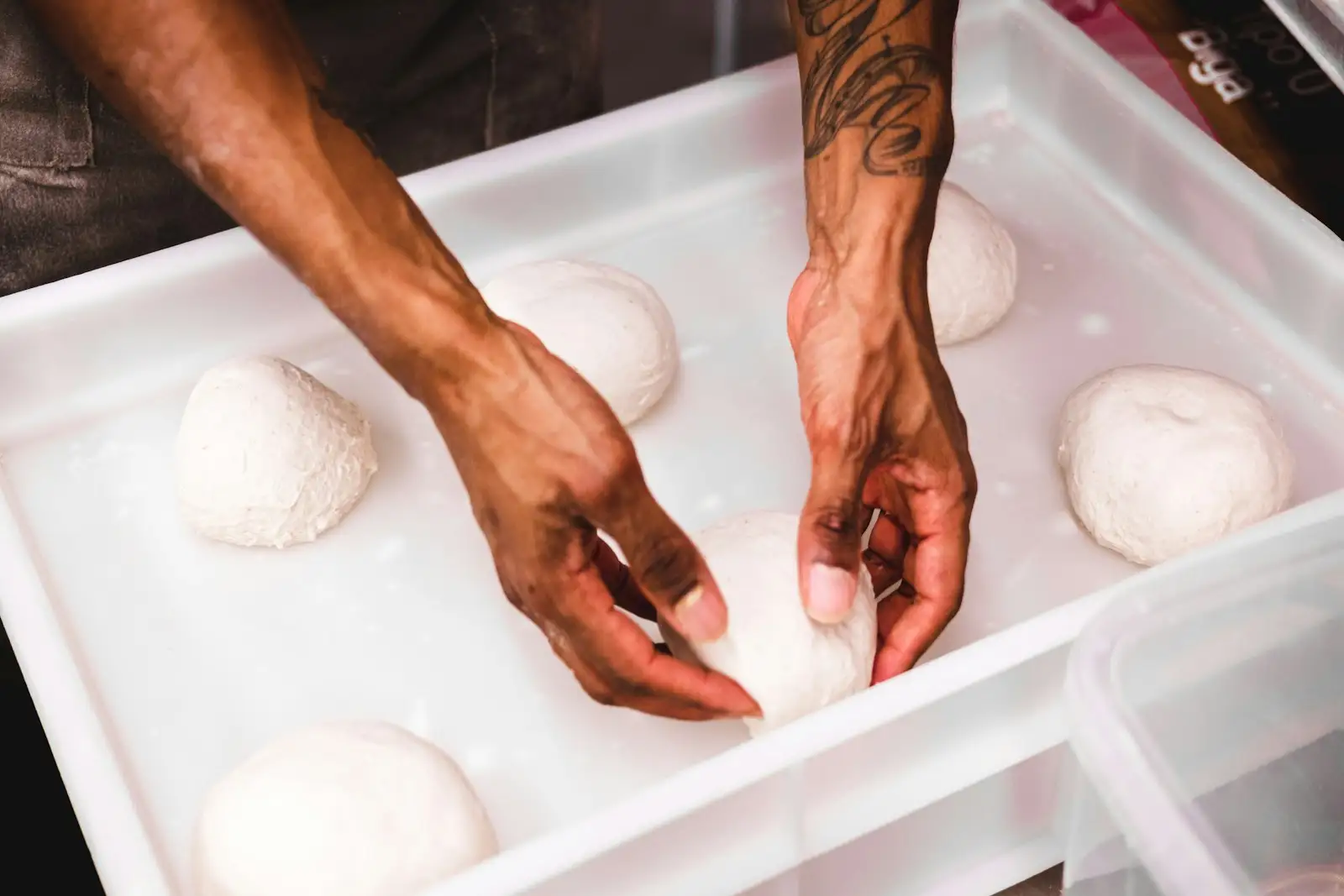
Cover the dough and give it a 30 to 60 minute bulk rest. Then divide it into four pieces of about 247 g, round each into a tight ball, and set them in a covered dough tray or lidded containers.
- Same day: proof 2 to 4 hours at room temperature until the balls have roughly doubled and a fingertip dent springs back slowly. Caputo’s recipe proofs its balls 2 to 3 hours; Ooni’s, which adds no yeast to the final dough, gives 4 to 6.
- Next day: put the balls straight into the fridge overnight, then give them 2 to 3 hours at room temperature before stretching. Ooni stores its poolish dough balls overnight in the fridge the same way.
Stretch by hand from the center out; our guide on how to stretch pizza dough covers the technique. A well-made poolish dough should open with very little spring-back.
Bake: outdoor oven or home oven
- Outdoor pizza oven: Ooni’s target for this style is 850 to 950°F on the stone, measured with an infrared thermometer. At that heat a Neapolitan-style pie is done in about 60 to 90 seconds, turned as the edge facing the flame colors.
- Home oven: Caputo designed its poolish recipe for 500 to 550°F home ovens. Once the oven reaches temperature, give the stone or steel another 45 to 60 minutes, bake 5 to 6 minutes, then switch to the broiler for 1 to 2 minutes to finish the rim.
For why the stone temperature matters more than the dial, see our pizza oven temperature guide.
How to tell when poolish is ready
A poolish is ready when it has risen, its surface is covered in small bubbles with some breaking through, it smells pleasant with a slight tang, and the center is just starting to sink. That last cue is the most useful one. King Arthur’s reference describes a ripe preferment as “fully risen and just beginning to recede in the center,” and notes that with a loose preferment like poolish, the bubbles and aroma are the easier signals to read.
| Stage | What you see | What to do |
|---|---|---|
| Under-ripe | Barely risen, few bubbles, dense, smells mostly of flour | Move it somewhere warmer (70 to 75°F) and check every hour |
| Ripe | Roughly doubled, domed or just dipping in the center, surface covered in bubbles, pleasant mildly tangy smell | Mix the final dough now |
| Past peak | Sunken and slack, risen high on the container walls then fallen back | Use it right away; keep the final proof on the short side |
A poolish that has collapsed hasn’t gone bad, but it has spent some of its strength. Fontana warns that once a poolish collapses, “its leavening power will have definitely decreased.” King Arthur adds that a preferment that is either sluggish or past ripeness produces bread lacking volume and flavor. If you keep overshooting, the fix is in the next section: less yeast, a cooler spot, or a shorter window.
How much yeast in a poolish
The right amount of yeast depends on how long the poolish will sit and how warm the room is. King Arthur’s reference puts it plainly: a bakery that gives its poolish 8 hours uses “a slightly higher percentage of yeast” than one giving it 14 to 16 hours, and a poolish ripening in a 65°F room needs more yeast than one in a 75°F room.
Here’s how the published recipes dose their poolish, as a percentage of the poolish flour:
| Poolish yeast | Schedule | Source |
|---|---|---|
| 0.1% | 14 to 18 hours, room temperature | Our Ooni pizza dough (Schedule 4); King Arthur’s French bread example |
| 0.12% | Overnight on the counter | Fontana Forni |
| 0.17% | 12 to 16 hours in a cool spot | Caputo |
| 0.2% | About 10 hours, room temperature | My Pizza Corner’s rule of thumb |
| 0.57% | 12 hours (its text says 6 to 12) | Ooni |
| 0.57% | 2 hours at room temperature, then 18 to 24 hours in the fridge | Pala Pizza |
The pattern is consistent. Overnight poolishes at room temperature sit between 0.1 and 0.2%. The two that use 0.57% either expect to be ready sooner (Ooni’s 6 to 12 hours) or slow down in the fridge (Pala). So:
- 12 to 16 hours at 65 to 72°F: 0.1 to 0.2% of the poolish flour. This recipe’s 0.15% sits in the middle.
- Need it in 6 to 8 hours: closer to 0.5%.
- Warm kitchen (75°F and up): stay at the low end or shorten the window.
- Cold kitchen (below 65°F): go to the high end, or find a warmer spot.
Using a different yeast? Ooni’s recipe lists 2 g instant yeast as interchangeable with 3 g active dry or 5 g fresh.
What four published poolish recipes have in common
Brand poolish recipes look wildly different on the page. Converted to overall baker’s percent, they turn out to agree on the one number that matters most. The conversion follows King Arthur’s baker’s percentage method: split the poolish back into its flour, water, and yeast, add them to the final dough, and divide everything by the total flour. (Fontana measures yeast by the teaspoon; we converted at King Arthur’s 3 g per teaspoon.)
| Recipe | Flour in poolish | Poolish yeast | Yeast added to final dough | Total hydration | Salt | Total yeast |
|---|---|---|---|---|---|---|
| Ooni, Our Best Poolish Dough | 33% | 0.57% | none | 60% | 2.9% | 0.19% |
| Caputo, Pizza Dough with a Poolish | 60% | 0.17% | 1 g | 65% | 2.5% | 0.20% |
| Pala Pizza, Easy Poolish Pizza Dough | 35% | 0.57% | none | 60% | 2.4% | 0.20% |
| Fontana Forni, Pizza Dough with Poolish | 30% | 0.12% | 1.5 g | 63% | 1.8% | 0.19% |
| This recipe | 33% | 0.15% | 0.9 g | 62 to 65% | 2.5% | 0.20% |
Three things stand out.
Total yeast converges at about 0.2%. The poolish share runs from 30 to 60% and the poolish yeast from 0.12 to 0.57%, yet the total lands at 0.19 to 0.20% in all four. Recipes with a lean poolish add yeast to the final dough; recipes with a heavily yeasted poolish add none. If you remember one number for a same-day poolish pizza dough, make it 0.2% total.
The poolish share is a range, not a ceiling. Pala Pizza tells readers a poolish “should make up roughly ⅓ of your total dough and never exceed 50%.” Caputo, the flour mill whose 00 most of these recipes call for, puts 60% of its flour in the poolish. Ken Forkish’s guidance, quoted by Ooni, is that a poolish “often contains 30 to 50 percent of the total flour,” and “often” is the right word. Ooni even publishes a dough made with 100% biga.
Hydration includes the poolish water. A recipe that lists 125 g of water against 325 g of flour in the final dough looks like 38% hydration. Count the poolish and it’s 60%. This trips people up when they compare recipes or try to make a dough wetter: King Arthur’s own worked example reads as “48% water” and “3% salt” until you fold the poolish back in, at which point it’s 65% and 2%.
How to convert any pizza dough recipe to poolish
Any direct pizza dough converts to poolish in four steps. Here’s the method, worked through on a typical 1,000 g batch at 65% hydration and 2.5% salt.
- Write the recipe in baker’s percent. Flour is 100%, everything else is a share of it. Example: 1,000 g flour, 650 g water (65%), 25 g salt (2.5%).
- Pick the poolish share. 30 to 50% of the flour is the normal band. At 30%, the poolish takes 300 g of flour.
- Build the poolish. Match the flour with an equal weight of water (300 g) and dose the yeast for your schedule from the table above. For an overnight poolish, 0.5 g of instant yeast is 0.17%.
- Build the final dough from what’s left. Remaining flour: 700 g. Remaining water: 650 minus 300, so 350 g. All the salt: 25 g. Then add enough yeast to bring the total to 0.2% of the total flour: 2.0 g minus the 0.5 g already in the poolish leaves 1.5 g.
Any oil, sugar, or diastatic malt in the original recipe goes into the final dough, never the poolish. The finished dough has exactly the same hydration and salt as the original. It just ferments differently.
One caveat. If your original recipe is a long cold ferment with a tiny dose of yeast (our Neapolitan dough uses about 0.06%), the poolish version is a different schedule, not a drop-in swap. Plan for a same-day or overnight proof after mixing, not another three days in the fridge.
Poolish vs biga (and what “biga” means in Italy)
Poolish and biga are both yeasted, salt-free preferments. The difference is water: poolish is liquid at 100% hydration, while biga is a stiff dough at roughly 50 to 70% hydration. Tony Gemignani, quoted by Ooni in its biga explainer, puts a classic biga “usually between 50 and 60 percent water” (his own “Tiga” runs 70%). Forkish says 60 to 70%.
| Poolish | Biga | |
|---|---|---|
| Hydration | 100% (equal weights flour and water) | About 50 to 70% |
| Texture | Thick, bubbly batter | Stiff, shaggy dough |
| Typical ferment | 6 to 16 hours | 6 to 16 hours |
| Salt | None | None |
| Flavor (per King Arthur and Forkish) | Buttery, nutty | Floral, aromatic |
| Mixing into the final dough | Easy, it disperses in the water | Harder, it has to be broken up |
| Good fit | Hand-mixed round pizzas | Pan pizzas such as Sicilian |
Migoya’s point, via Ooni, is the practical one: because it’s so wet, poolish “is much easier to incorporate into the final dough than a biga.” If you mix by hand, that matters more than any flavor difference.
Here’s the correction most English-language recipes miss. In Italian, biga isn’t a specific stiff preferment. King Arthur’s reference: “Biga is an Italian term that generically means preferment. It can be quite stiff in texture, or it can be of loose consistency (100% hydration).” The neat stiff-biga vs wet-poolish split is how bakers outside Italy use the words. When an Italian recipe says biga, check the hydration before you assume.
Poolish vs sourdough starter
A poolish is made fresh for each batch with commercial yeast and used the next day. A sourdough starter is a permanent culture of wild yeast and bacteria that you feed and keep going. King Arthur’s reference notes that a levain can be perpetuated “for months, years, decades, and even centuries,” while a commercial-yeast preferment is baked off the next day and made again from scratch.
The flavor difference follows from that. Modernist Pizza says poolish lacks the tang of a levain, and Martin Philip describes yeasted preferment flavors as “gentler” and less complex than starter-based ones. If you want tang, use a starter: our sourdough pizza dough recipe covers it. If you want flavor without the upkeep, poolish is the better tool.
Poolish pizza dough troubleshooting
Most poolish problems come down to timing. The yeast dose was wrong for the room, or the poolish sat too long.
| Problem | Likely cause | Fix |
|---|---|---|
| Poolish barely moved after 12 hours | Room too cold, or too little yeast | Move it to 70 to 75°F and give it 2 to 4 more hours; next time dose toward 0.2% |
| Poolish collapsed before morning | Room too warm, or too much yeast for the window | Use it now and shorten the final proof; next time cut the yeast or the time |
| Final dough is a sticky mess | Normal for poolish dough, made worse by under-kneading | Wet hands, rest-and-knead cycles; check your total hydration includes the poolish water |
| Balls spread flat and won’t hold shape | Overproofed | Shorter proof, or into the fridge sooner; see overproofed pizza dough |
| Dough springs back when stretching | Gluten still tight | Rest the ball 15 to 30 minutes covered, then try again |
| Crust pale and bland | Underproofed final dough, or oven not hot enough | Proof until a fingertip dent springs back slowly; preheat the stone longer |
For anything not on this list, our pizza dough troubleshooting guide works through tearing, gumminess, and burnt bottoms symptom by symptom.
What to skip
- Salt in the poolish. By definition there’s none, and it would slow the ferment you’re relying on.
- Honey or sugar in the poolish. Pala Pizza adds honey to its poolish and Caputo adds it to the final dough. King Arthur’s, Ooni’s, and Fontana’s poolishes are flour, water, and yeast only. Your flour already feeds the yeast.
- Measuring 0.3 g of yeast with a teaspoon. A 1/16 teaspoon measure holds about 0.19 g, roughly two-thirds of what you need. Use a 0.01 g scale or the dilution trick.
- “Never more than 50% poolish.” It’s a preference, not a rule. Caputo uses 60%.
- Stacking every fermentation trick at once. A heavily yeasted poolish, plus extra yeast in the final dough, plus a 72-hour cold ferment, is a recipe for slack, overproofed dough. A poolish is the flavor step. Let it be the main one.
- The digestibility pitch. Fontana’s recipe says poolish lets you halve the yeast, “thus making it more digestible.” We haven’t seen evidence presented for that, so we don’t claim it.
- A poolish when a cold ferment fits your week better. If you can mix on Wednesday and bake on Saturday, a straight 48 to 72 hour cold ferment gets you comparable flavor with fewer steps.
FAQ
What is poolish pizza dough?
Poolish pizza dough is pizza dough in which part of the flour, usually 30 to 50 percent, is first fermented overnight as a poolish: equal weights of flour and water with a pinch of instant yeast and no salt. The next day the poolish is mixed with the rest of the flour, water, and salt. The result has more flavor and stretches more easily than a same-day dough.
What does poolish do to pizza?
Three things. It adds flavor, because the organic acids and esters that build up during a slow ferment carry into the dough; Ken Forkish describes the notes as buttery and nutty. It makes the dough more extensible, so it stretches without fighting back. And it shortens the next day’s work, because the dough starts half-fermented. It does not make pizza sour; a poolish uses commercial yeast, not a sourdough culture.
What is the recommended ratio of poolish to pizza dough?
Put 30 to 50 percent of the total flour into the poolish, the range Ken Forkish gives. This recipe uses 33 percent. The poolish itself is always 1:1 flour to water by weight. Going above 50 percent is fine: Caputo’s own poolish pizza dough puts 60 percent of its flour in the poolish.
Do you add more yeast when using poolish?
Sometimes, and only a little. Ooni and Pala Pizza add no yeast to the final dough; Caputo and Fontana Forni add a small amount. Converted to baker’s percent, all four recipes land at 0.19 to 0.20 percent total instant yeast on total flour. If your poolish carries less than that, add the difference to the final dough.
Which is better for pizza dough, poolish or biga?
Neither wins outright. Poolish (100 percent hydration) is easier to mix into the final dough by hand and is known for buttery, nutty flavor and extensibility. Biga (roughly 50 to 70 percent hydration) is stiffer and harder to incorporate; King Arthur describes its flavor as floral and aromatic. For hand-mixed round pizza, start with poolish. For a pan pizza like Sicilian, biga is the traditional choice.
Do Italians use poolish?
Rarely. Modernist Pizza, as quoted by Ooni, says poolish is widely used by professional pizza makers in North America but rarely by Italian pizzaioli, who generally prefer direct doughs. In Italian baking, the word biga means any preferment, and King Arthur notes it can be stiff or as loose as 100 percent hydration, so some Italian bigas are close cousins of a poolish.
One overnight step, a better crust
You now have a poolish pizza dough you can start after dinner and bake the next day. More useful, you have the logic behind it: 1:1 flour and water, no salt, yeast dosed to the clock and the thermometer, a ripe poolish read by its bubbles rather than the hour, and 0.2% total yeast as the number that ties the final dough together. With those in hand you can turn any recipe into a poolish dough. For a schedule tuned to an Ooni, the poolish variant in our Ooni pizza dough recipe runs a smaller, slower preferment on the same principles.