Your bread machine is a better pizza tool than most recipes give it credit for, and a worse one than most recipes assume. It kneads dough well, hands-free, in under two hours. What it can’t do is the slow, cold fermentation that gives a pizzeria crust its flavor. This bread machine pizza dough recipe uses the machine for what it does well and your fridge for the rest. It’s for anyone with a Zojirushi, Cuisinart, Oster, or any machine with a Dough setting who wants pizza that tastes like more than warm bread.
How do you make pizza dough in a bread machine? Add cold water and olive oil to the pan, then bread flour, sugar, and salt, with instant yeast in a well on top. Run the Dough cycle (90 minutes to 2 hours, depending on the machine), divide the dough into balls, and refrigerate them 24 to 72 hours. Bake on a preheated steel at your oven’s top temperature.
TL;DR
- The machine is a mixer, not a flavor engine. Its Dough cycle kneads and then gives one warm rise. Flavor comes from a 24 to 72 hour cold ferment in the fridge.
- The recipe, by weight: 500 g bread flour, 315 g cold water (63%), 10 g salt (2%), 10 g olive oil (2%), 8 g sugar (1.6%), 2 g instant yeast (0.4%). Three 280 g balls, one 16-inch pizza each.
- Use cold tap water. Kneading friction warms the dough on its own. The 105 to 110F water some recipes call for only rushes a rise you want slow.
- Weigh, don’t scoop. A “cup” of bread flour is 120 g by King Arthur’s chart and about 130 g by Zojirushi’s own manual.
- Bread machine yeast is instant yeast. Use either.
- Need pizza tonight? Raise the yeast to 8 g, run the cycle, rest the balls 30 to 60 minutes, bake. It works. It just tastes flatter.
- Bake hot: steel on the top rack, preheated 45 to 60 minutes at 525 to 550F, 6 to 10 minutes per pie.
- Skip: warm water, cup measures, dessert-level sugar, and leaving the dough in the machine after the cycle ends.
What a bread machine actually does to pizza dough
On its Dough setting, a bread machine does two jobs. It kneads, and then it holds the dough somewhere warm while the yeast works. It does the first job well. The second is the one that costs a pizza crust its flavor.
Inside the dough cycle
Here is what two machines actually run, straight from their manuals:
| Machine | Program | Total time | What happens |
|---|---|---|---|
| Zojirushi Virtuoso Plus (BB-PDC20) | Dough | 1 hr 50 min (1 hr 27 min with Rest off) | Rest to even out ingredient temperature, knead, then one rise with a punch-down |
| Cuisinart Compact (CBK-110, now discontinued) | Dough | 1 hr 30 min | Mix, knead, two rises |
| Cuisinart Compact (CBK-110) | Artisan Dough | 5 hr 5 min | ”Several long, slow, cool rises,” dough only |
Sources: Zojirushi’s BB-PDC20 operating instructions and Cuisinart’s CBK-110 instruction booklet.
Cuisinart calls its Dough program “ideal for pizza dough,” and for the kneading, it is. But look at how both programs end: with a rise in a warm pan. That step is built for bread you shape and bake the same afternoon. Whatever brand you own, find the Dough setting (or a dedicated Pizza Dough setting) in your manual’s program chart. Either one works for this recipe, because the fridge is going to do the real fermenting.
Why same-day machine dough tastes flat
Warm yeast makes gas fast and flavor slowly. Kenji López-Alt’s testing at Serious Eats found that fast, warm fermentation leaves bread with “the one-dimensional flat flavor of the flour,” while dough retarded in the fridge produces more of the desirable flavor compounds, fewer sour ones, and better structure. His cold-ferment tests put the ideal window at three to five days. The day-one pie browned to one flat, uniform shade with a tight, small-holed crumb.
This formula carries 1.6% sugar, the same as our New York style pizza crust, so we cap the cold ferment at 72 hours. Sugar gives the yeast easy fuel, and a sugared dough pushed past three days can over-proof.
What the top-ranking bread machine recipes actually contain
We took the five bread machine pizza dough recipes ranking at the top of Google in October 2026 and converted each into baker’s percentages (every ingredient as a percent of the flour’s weight), using King Arthur’s ingredient weight chart for the cup-to-gram math.
| Range across the 5 recipes | This recipe | |
|---|---|---|
| Hydration | 63% to 71% | 63% |
| Salt | 1.25% to 3.3% | 2% |
| Sugar | 0% to 10.3% | 1.6% |
| Fat (oil or butter) | 3.5% to 10.4% | 2% |
| Yeast | 1.1% to 1.9% | 0.4% cold ferment, 1.6% same-day |
| Cold ferment | None of the five | 24 to 72 hours |
Three things stand out. Salt varies by a factor of almost three, so somebody’s crust is bland and somebody’s is briny. The sweetest recipe, at about 10% sugar and 10% oil, is richer than Zojirushi’s own sandwich loaf (8.7% sugar, 6.3% butter): that’s dinner-roll dough. And not one of the five uses the fridge. Two of them also call for 100 to 110F water.
Hydration looks steady at 63% in four of the five, but that number rests on cups. Zojirushi’s manual counts 4 1/4 cups of bread flour as 553 g, about 130 g a cup. King Arthur says 120 g. Measure the same recipe both ways and you get 63% hydration or 58%. A kitchen scale ends the argument.
The bread machine pizza dough recipe (by weight)
This is our New York style formula, sized for a 2-pound machine. Bread flour gives the chew and structure for a crust that folds; the small amounts of oil and sugar help it brown and stay tender through a home oven’s 6 to 10 minute bake.
Ingredients
| Ingredient | Baker’s % | Grams | Volume (approx.) |
|---|---|---|---|
| Bread flour (King Arthur or similar) | 100% | 500 g | about 4 1/4 cups |
| Cold water | 63% | 315 g | 1 1/3 cups + 1 tablespoon |
| Olive oil | 2% | 10 g | 2 1/2 teaspoons |
| Granulated sugar | 1.6% | 8 g | 2 teaspoons |
| Fine sea salt or table salt | 2% | 10 g | 1 2/3 teaspoons |
| Instant or bread machine yeast | 0.4% | 2 g | 2/3 teaspoon |
For same-day pizza, use 8 g of yeast (about 2 3/4 teaspoons) instead of 2 g.
The batch weighs about 845 g: three 280 g balls, each one 16-inch pizza. For 14-inch pizzas, make 240 g balls and you’ll have a little left over. Diamond Crystal kosher salt is lighter by volume, so 10 g is about 1 1/4 tablespoons.
Scaling for a 1.5-pound machine
500 g of flour sits comfortably in a 2-pound machine; Zojirushi’s own 2-pound loaf uses 553 g. For a 1.5-pound machine, make two-thirds: 333 g flour, 210 g water, 7 g salt, 7 g oil, 5 g sugar, and 1.3 g yeast (a scant 1/2 teaspoon). That gives two 280 g balls. Don’t push a smaller machine past its rated size. Zojirushi warns that adding flour beyond the recipe can overload the motor.
How to make pizza dough in a bread machine, step by step
1. Load the pan in your manufacturer’s order
Both manuals we checked use the same order: liquids first, then flour, then the rest, with the yeast last. Zojirushi says to make a depression in the flour and put the yeast in it “so that the yeast does not come into contact with water,” and Cuisinart adds that salt “should be as far away from the yeast as possible.”
So: cold water and olive oil into the pan. Flour on top, piled in the center. Sugar and salt in opposite corners. A shallow well in the middle of the flour for the yeast. If your manual specifies a different order, follow your manual.
Use cold tap water. Many manuals suggest warming ingredients first, but King Arthur’s bread machine guide notes that you can use cold tap water and even refrigerated ingredients, because “the heat generated by the vigorous kneading raises the temperature of the dough sufficiently.” For a dough headed to the fridge, cooler is exactly what you want.
2. Run the dough cycle and check the dough early
Select Dough (or Pizza Dough) and press start. Then open the lid 5 to 10 minutes into the kneading and look. King Arthur encourages exactly this: poke the dough while it kneads, but leave the lid closed once it starts to rise.
You’re after “a smooth, soft ball,” in King Arthur’s words: one mass that rides around the pan, tacky but not gluey. If dry flour is still clinging to the corners or the dough is thumping around in stiff pieces, add water 1 teaspoon at a time. If it’s spreading across the bottom like thick batter, add flour 1 teaspoon at a time. Higher-protein flour absorbs more water, so if you switch from bread flour to a high-gluten flour, expect to need a little more.
On a Zojirushi Virtuoso Plus, the Dough course’s Add Beep sounds about 38 minutes in, near the end of kneading. That’s your last good chance to adjust.
Optional: knead only, for the longest cold ferment
At 0.4% yeast, the Dough cycle’s warm rise does no harm. Think of it as the couple of hours a hand-mixed dough would spend on the counter before going into the fridge. If you’d rather skip it anyway:
- Any machine: watch the display or the window, and cancel the cycle once the paddle stops and the rise begins.
- Zojirushi Homemade course: program Rest and Knead (the manual allows 5 to 30 minutes of kneading) and switch every Rise and Bake step off. Zojirushi warns that running knead-only cycles back to back trips the motor’s safety cutoff, so give the machine about an hour between batches.
Cuisinart CBK-110 owners have a third route: the 5-hour Artisan Dough program and its “long, slow, cool rises.” It’s a reasonable middle ground on a day you can’t wait for the fridge.
3. Divide, ball, and refrigerate 24 to 72 hours
Pull the dough as soon as the cycle ends; dough left in a warm pan keeps fermenting. Turn it out onto a lightly floured counter, and if the kneading paddle comes out with it (Zojirushi’s manual flags this), pull the paddle out.
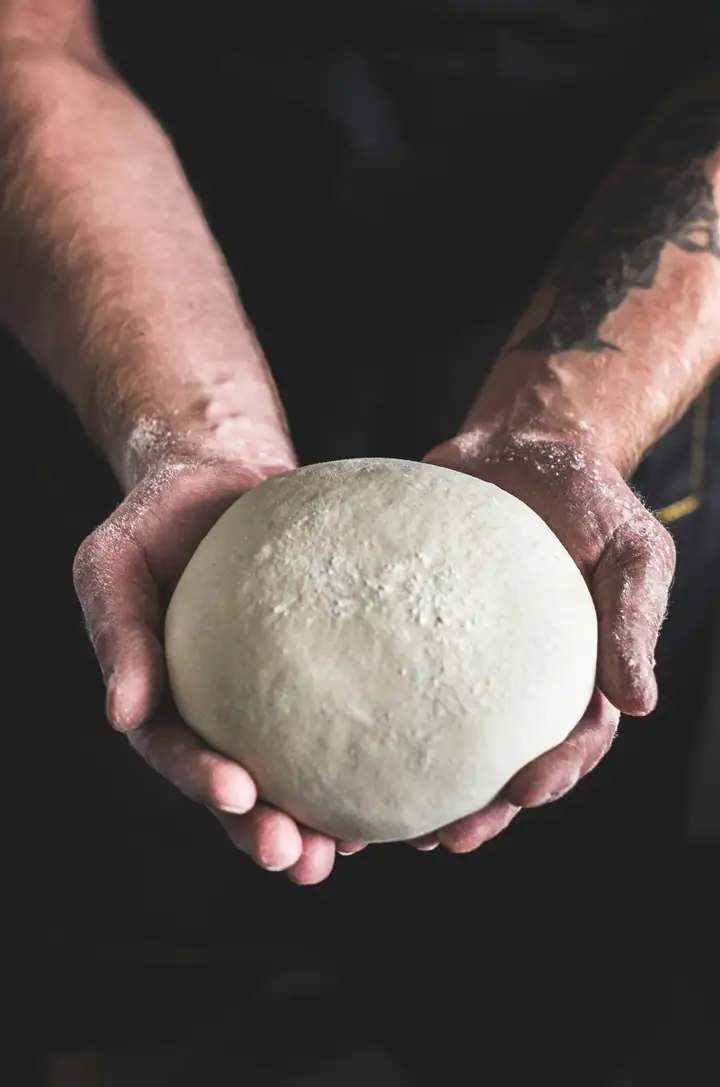
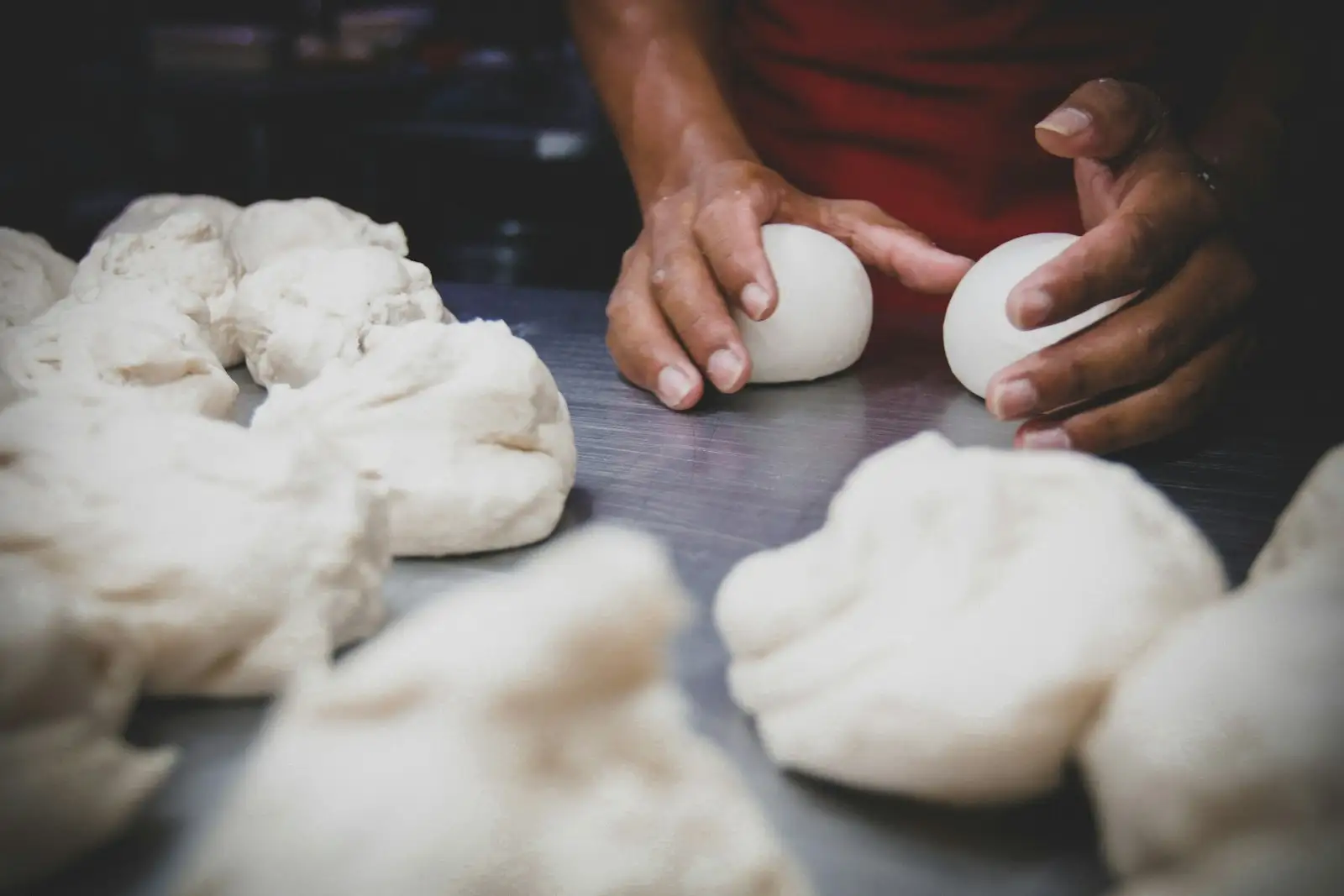
Divide the dough into three 280 g pieces on a scale. Round each into a tight ball: tuck the edges underneath, then drag the ball toward you across the counter until the top is smooth and taut. Put each ball in a lightly oiled, lidded container (a 1-quart deli container works) and refrigerate.
- 24 hours: clearly better than same-day.
- 48 hours: the sweet spot for flavor and stretch.
- 72 hours: the most extensible, and the upper limit for a dough with sugar in it.
On pizza day, take the balls out 2 to 4 hours before you bake and leave them covered at room temperature. Cold dough fights the stretch. The dough is ready when a fingertip pressed into the side leaves a dent that springs back slowly.
Same-day bread machine pizza dough
When you need pizza tonight, use 8 g of yeast (about 2 3/4 teaspoons) instead of 2 g, run the full Dough cycle, then divide and ball as above. Rest the balls, covered, for 30 to 60 minutes so the gluten relaxes enough to stretch, then bake.
At 1.6% of the flour, 8 g sits inside the 1.1% to 1.9% range the ranking recipes use, so this version behaves like theirs. It makes good pizza. It won’t make the pizza the cold-fermented version makes, and Kenji’s day-one test pie shows why.
Shaping and baking
Stretch by hand. Press from the center out with your fingertips, leaving a border for the rim, then drape the dough over your knuckles and let gravity widen it to 16 inches. Our guide to how to stretch pizza dough walks through it. A rolling pin presses out the gas the cold ferment built, so save it for a tavern-style thin crust, where a flat, cracker-like crust is the point.
Bake on a pizza steel:
- Set the steel on the top rack, about 6 inches below the broiler.
- Preheat at your oven’s maximum (525 to 550F) for 45 to 60 minutes.
- Switch to the broiler 5 minutes before you launch.
- Launch the pizza, bake 4 minutes under the broiler, then switch back to bake for 2 to 5 minutes, until the rim is deep golden and the cheese bubbles.
With a stone instead of a steel, follow our how to use a pizza stone guide, which runs the stone lower in the oven and preheats it longer. For target temperatures by style, see our pizza oven temperature guide. No steel or stone at all? One of these dough balls also makes a good cast iron skillet pizza.
Common bread machine pizza dough problems
Most bread machine pizza dough problems come down to three things: water you didn’t adjust during kneading, dough left too long in a warm pan, or a recipe with no cold ferment.
The dough is a sticky puddle or a dry knot. Fix it in the first 10 minutes of kneading, 1 teaspoon of water or flour at a time. Once the rise starts, leave the lid shut.
It springs back when you stretch it. It’s still cold or hasn’t relaxed. Give it another 30 minutes, covered, at room temperature. Our pizza dough troubleshooting guide covers the rest of the usual suspects.
The crust tastes like plain bread. That’s a same-day dough. The fix is time in the fridge, not a different recipe.
The rim browns before the center cooks. Usually too much sugar. Zojirushi’s manual says it plainly: “Using a lot of sugar will darken the crust color.” At 1.6%, this dough browns on a 6 to 10 minute schedule; a 10% sugar dough darkens far faster under a broiler.
The dough overflowed or collapsed in the pan. It sat in the warm machine after the cycle ended, or the yeast was too high for the timeline. Pull it promptly, and use 2 g of yeast for anything going in the fridge.
What to skip
- Warm water. The kneading heats the dough by itself. Warm water just rushes a rise you want slow.
- Cup measures. The same “cup” of flour is 120 g or 130 g depending on whose chart you trust. Weigh it.
- Dessert-level sugar and oil. 10% of each is roll dough. New York style pizza dough runs 1 to 2% sugar and 2 to 3% oil.
- Leaving the dough in the machine. Pull it the moment the cycle ends.
- A rolling pin for New York style pies. It flattens the bubbles that make the rim.
- Gluten-free flour on the Dough cycle. Cuisinart’s manual says its Dough program suits “almost any dough recipe (except gluten free),” and Zojirushi gives gluten-free bread its own course. Gluten-free pizza dough needs its own recipe, not a flour swap in this one.
- Calling same-day dough “New York style.” The cold ferment is part of what makes New York dough what it is.
FAQ
How long should pizza dough rise in a bread machine?
Only as long as the Dough cycle runs, because the rise is built into the cycle. Zojirushi’s Virtuoso Plus (BB-PDC20) Dough course takes 1 hour 50 minutes including one rise, and Cuisinart’s CBK-110 Dough program takes 1 hour 30 minutes including two rises. Do not add extra time in the warm machine. If you want more flavor, the next rise belongs in the refrigerator for 24 to 72 hours.
What is the difference between bread machine yeast and active dry yeast?
Bread machine yeast is instant yeast; King Arthur calls them the same yeast. Instant yeast has a smaller granule than active dry, so it dissolves and gets going faster, which is why bread machine recipes use it. Both work for pizza dough. If you substitute instant yeast for active dry in a bread machine recipe, King Arthur recommends using 25% less, because bread machines raise dough at a higher temperature and a 1:1 swap can over-rise.
Can you use bread dough for pizza?
You can, but most bread machine loaf doughs are richer than pizza dough. Zojirushi’s Basic White Bread works out to 8.7% sugar and 6.3% butter plus dry milk, at 58% hydration. A New York style pizza dough runs about 1.6% sugar and 2% olive oil with no milk, at 63% hydration. The leaner dough stretches thinner and browns more slowly, so it can take a hotter oven without scorching; Zojirushi’s own manual notes that extra sugar and milk both darken the crust.
What is the main drawback of using a bread machine for pizza dough?
The warm rise. A Dough cycle ends by fermenting the dough in a heated pan, which suits bread you bake the same day but leaves a pizza crust with flat, one-dimensional flavor. The fix is to move the dough to the refrigerator right after the cycle and cold ferment it 24 to 72 hours. The other limit is capacity: a 2-pound machine handles roughly 500 to 550g of flour, enough for three 16-inch pizzas but not a crowd.
Let the machine knead, let the fridge do the rest
A bread machine takes the one tedious part of pizza dough, the kneading, off your hands. Pair it with a scale, cold water, and two days in the fridge, and what comes out is the same dough you’d get mixing by hand, minus the work. When you want to go further, the same cold-ferment logic drives our Neapolitan pizza dough. And on the nights there’s no time for any of it, our no yeast pizza dough gets a crust on the table in 20 minutes.