Most pepperoni pizza recipes give you the same template: dough, sauce, mozzarella, pepperoni, bake at 500°F. What they don’t tell you is that the type of pepperoni you buy is the single biggest variable separating a great pepperoni pizza from a mediocre one. Cup-and-char pepperoni (natural-casing pepperoni that curls into bowls during the bake and chars at the edges) is the upgrade most home cooks miss. This is the recipe with the science of cup-and-char built in.
TL;DR
- Use cup-and-char pepperoni. Margherita Brand, Hormel Rosa Grande, Vermont Smoke and Cure. These have natural casings that shrink during the bake, curling each slice into a tiny bowl that traps rendered fat and chars at the edges.
- Hand-grate block low-moisture mozzarella. Pre-shredded with anti-caking starch melts wrong (grainy, oily separation).
- The right ratios for a 12-inch pizza: 1/3 cup sauce, 4 oz cheese, 8 to 12 slices pepperoni (~75 g). 20+ slices = grease overload + soggy crust.
- Bake at 500°F on a preheated stone or steel, 5 to 7 minutes. Open the oven door as little as possible.
- Pepperoni placement is style-dependent. Detroit goes under the cheese (cheese-up architecture). NY goes on top or under (pizzeria preference). Sicilian goes on top. Neapolitan traditionally skips pepperoni entirely.
- Skip: pre-shredded mozzarella, plastic-bag deli pepperoni, baking on a cold pan, opening the oven mid-bake.
The pepperoni problem most home cooks miss
There are two kinds of pepperoni in American supermarkets, and the recipe blogs treat them as interchangeable. They aren’t.
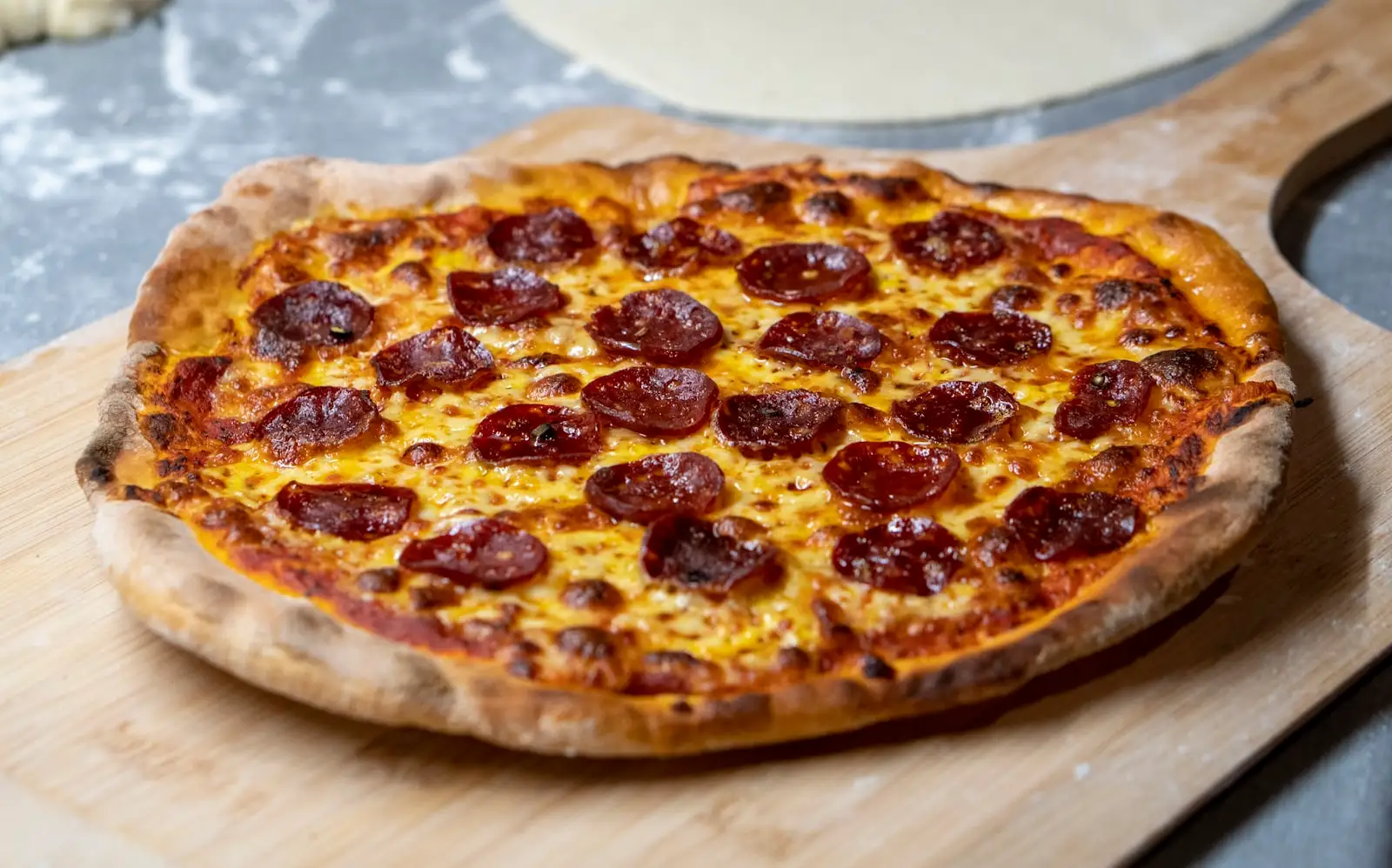
Cup-and-char pepperoni (sometimes called “natural casing pepperoni” or “old-world pepperoni”) is cured in a real edible casing. During the bake, the casing causes the bottom of each slice to shrink faster than the top, curling the slice up into a tiny bowl. The cup traps the rendered fat instead of flooding the pizza. The edges crisp into char. Each slice is an individual flavor pocket.
Casingless deli pepperoni is pressed and reformed into a continuous log without a real casing. It stays flat during the bake. The fat renders out and pools across the pizza surface, soaking the crust below. No cups, no char, just greasy flat circles.
Kenji López-Alt’s experiment at Serious Eats breaks down the physics: pepperoni curls because the bottom contracts faster than the top under heat, and the shape of the slice combined with the casing’s contraction creates the cup. Cup-and-char is not just an aesthetic choice. It’s a fundamentally different ratio of rendered fat to charred surface area.
If you remember nothing else from this article, remember: buy cup-and-char pepperoni, not deli pepperoni. Everything else in your recipe could be average and your pizza will still beat 90% of home pepperoni pizzas.
The brand hierarchy
After cooking pepperoni pizzas with most national brands, here’s how they actually rank for home cooking:
Tier 1 (the cup-and-char winners):
- Margherita Brand Pepperoni, the gold standard. Made by Margherita Meats (Smithfield-owned). Natural casing, cups dramatically, balanced spice. The pepperoni most upscale pizzerias use. Available at most large grocery stores in the specialty meat section, not the deli case.
- Hormel Rosa Grande Pepperoni, slightly larger slice diameter, deep cup, well-spiced. A favorite among home pizza obsessives. Sold in 1-pound packages, lasts 30+ days refrigerated.
- Vermont Smoke and Cure Pepperoni, smaller slice, intense smoke flavor, cups well. The artisan choice. More expensive but worth it for special pizzas.
Tier 2 (acceptable, won’t quite cup as dramatically):
- Boar’s Head Bianco D’Oro Pepperoni, Italian-American style, mild spice, casing varies by batch. Good when Margherita or Hormel aren’t available.
- Volpi Pepperoni, artisan, dry-cured, very mild. Less cup but excellent flavor.
Tier 3 (skip these for the headline topping):
- Mass-market deli pepperoni (the slices behind glass at most supermarket delis). Casingless, won’t cup. Use these for non-cup applications like stuffed crust or pepperoni rolls, but not as the star of a pepperoni pizza.
- Pre-packaged pepperoni rounds (Hormel Pillow Pack, etc.). These are aimed at children’s pizza kits. They’ve been processed for shelf life over flavor.
Adam Kuban at Serious Eats has called hot soppressata “the new pepperoni”, Calabrian-style spicy salami that cups even more dramatically than pepperoni and has a more complex spice profile. For an upgraded “pepperoni” pizza, hot soppressata is worth seeking out. Most Italian markets carry it.
The recipe (12-inch pizza, 1 serving for 2)
Ingredients
- 1 ball pizza dough (245 to 280 g), see our Neapolitan dough recipe for the cold-fermented version or our Ooni pizza dough recipe for the same-day version
- 1/3 cup tomato sauce (no-cook), see our pizza sauce recipe
- 4 oz (115 g) low-moisture mozzarella, hand-grated from a block
- 8 to 12 slices cup-and-char pepperoni (~75 g / 2.6 oz)
- 1 tablespoon extra virgin olive oil
- Pinch of flaky sea salt
- Fresh basil leaves for finishing (optional)
The bake setup
- Place a pizza stone or steel on the middle or lower rack of the oven. See our pizza stone vs steel guide for which surface to buy. A steel produces a crispier bottom and faster cook time; a stone is gentler and cheaper.
- Preheat the oven to 500°F (or the maximum your oven hits) for at least 45 minutes. The metal/stone needs to be genuinely at temperature, not just the air around it. See our pizza oven temperature guide for the full temperature breakdown by style.
- Turn the broiler on for the last 5 minutes of the preheat. This adds radiant heat from above, which helps brown the cheese and curl the pepperoni.
Step-by-step
- Stretch the dough on a floured peel to about 12 inches diameter. See our how to stretch pizza dough for the technique if dough handling is new. Leave a half-inch border for the cornicione (rim).
- Spread the sauce in a thin layer with the back of a spoon, in a spiral from center to within 1 inch of the edge. About 1/3 cup. More sauce makes the crust soggy.
- Scatter the grated cheese evenly over the sauce. 4 oz / 115 g for a 12-inch pizza. Don’t pack it; let it lay loose.
- Lay the pepperoni slices evenly, slightly overlapping if needed. 8 to 12 slices total. Place them tip-up so they cup during the bake.
- Drizzle 1 teaspoon of olive oil over the top in a spiral. Sprinkle a pinch of salt.
- Slide the pizza onto the preheated stone/steel. Use a confident slide-and-jerk motion; hesitation is what causes pizzas to land askew.
- Bake 5 to 7 minutes at 500°F with the broiler on. Watch the pepperoni: the cups will form in the first 60 seconds, edges will char in the last 90 seconds.
- Remove with the peel when the cheese is sizzling, the pepperoni is crisp at the edges, and the crust is golden brown underneath.
- Rest 30 to 60 seconds before slicing. Top with fresh basil if using.
The whole bake is 5 to 7 minutes. If yours takes longer, your stone isn’t hot enough; preheat longer next time.
How to bake it (the oven section)
The oven temperature math:
- 500°F + preheated stone/steel + broiler on: 5 to 7 minutes. Best home-oven result.
- 500°F + preheated stone/steel, no broiler: 7 to 9 minutes. Cheese melts but won’t brown as well.
- 475°F + sheet pan (no stone/steel): 12 to 15 minutes. Acceptable for budget setup; the bottom won’t crisp as well.
- In an Ooni Koda 16 or similar (850°F+): 90 seconds. See our Ooni Koda 16 review and pizza oven temperature guide for outdoor-oven specifics. At 850°F the pepperoni still cups but the bake is so fast that you need to make sure your pepperoni is at room temperature when it goes on, or the centers will be cold.
Don’t open the oven door mid-bake. Each opening drops the oven by 50°F and you lose 30+ seconds of preheat. Watch through the window.
Style-by-style pepperoni placement
Pepperoni placement matters more than most recipes suggest. The placement depends on the pizza style.
New York-style pepperoni pizza
Pepperoni-on-top is the canonical NY-pizzeria style. The slice gets the visual hit, the cups form for the photogenic finish, and the rendered fat trickles down through the cheese to season everything below.
A growing number of upscale NY-style pizzerias put pepperoni UNDER the cheese: the steam-cook produces a softer slice with less char but more even distribution of pepperoni flavor through the cheese. Either approach works for NY-style. See our New York-style pizza crust recipe for the dough.
Detroit-style pepperoni pizza
Pepperoni goes UNDER the cheese in Detroit-style. This is part of the cheese-up architecture: cheese to the edges (for frico), then toppings on the cheese, then sauce in racing stripes on top. The pepperoni under the cheese stays softer (no char) but the cheese-up bake develops more deeply browned cheese, which is the Detroit signature. See our Detroit-style pizza recipe.
Sicilian / Grandma-style pepperoni pizza
Pepperoni on top. The long bake (18 to 22 minutes at 475-500°F) gives plenty of time for the pepperoni to render and curl. The thick crust holds the rendered fat without going soggy. See our Sicilian pizza dough recipe.
Neapolitan pepperoni pizza (or rather, not)
Pepperoni isn’t a traditional Neapolitan topping. The AVPN (Associazione Verace Pizza Napoletana) protocol doesn’t include pepperoni. If you make a “Neapolitan pepperoni pizza”, what you’re actually making is a NY-style pepperoni on Neapolitan dough, which is fine, but call it what it is. See our pizza toppings ideas guide for the full style-purist breakdown.
The grease problem (and the blot fix)
Pepperoni renders fat. A LOT of fat. On a 12-inch pizza with 10 slices of cup-and-char pepperoni, you’re looking at 1 to 2 tablespoons of rendered fat by the end of the bake. Cup-and-char pepperoni manages this by cupping the fat into the bowl. Casingless deli pepperoni doesn’t, and the fat pools across the pizza surface, soaking into the cheese and crust.
If you’re using anything other than tier-1 cup-and-char pepperoni, here’s the fix:
- Lay pepperoni slices on a paper towel before topping the pizza
- Cover with a second paper towel and press lightly
- Wait 60 seconds. Some fat will absorb into the towels.
- Remove and top the pizza as normal
This pre-blot doesn’t change the flavor (the pepperoni hasn’t lost spices, just surface fat) but it cuts the post-bake greasy puddle by about 30%. Not as good as cup-and-char (which manages the fat by structure, not subtraction), but the closest workaround when good pepperoni isn’t available.
The post-bake fix: a 60-second rest after pulling the pizza, with the pizza on a wire rack instead of a flat board, lets the residual surface fat drip off the bottom. Skip this step and the bottom of your slice will be greasy by the time you eat it.
How much pepperoni per pizza
The right amount is more constrained than most recipes admit.
| Pizza size | Slice count | Pepperoni count | Total weight |
|---|---|---|---|
| 10-inch | 6 | 6 to 8 slices | 50 to 60 g |
| 12-inch | 8 | 8 to 12 slices | 60 to 90 g |
| 14-inch | 10 | 12 to 16 slices | 90 to 120 g |
| 16-inch NY | 12 | 14 to 20 slices | 105 to 150 g |
| Detroit 10x14 | 8 | 14 to 18 slices | 105 to 135 g |
| Sicilian half-sheet | 12 | 24 to 32 slices | 180 to 240 g |
The standard placement is “barely overlapping”, slices not touching but with very little gap between them. Stacking pepperoni doesn’t add flavor; it adds grease and prevents the bottom slice from cupping (the slice underneath stays flat because it can’t curl without breaking the slice above it).
More than the recommended count = grease pooling, cheese can’t show through, dough underneath stays raw. Less than the recommended count = the pepperoni gets lost in the cheese.
What to skip / never do
- Pre-shredded mozzarella with anti-caking starch. The cellulose powder dusted on pre-shredded bags is engineered to prevent clumping; it also prevents the cheese from melting smoothly. The result is a grainy melt with oily separation. Buy a block, grate it yourself. See our deeper discussion in the pizza toppings ideas and Wisconsin brick cheese articles.
- Plastic-bag deli pepperoni. The cheap fold-over packs at the deli counter are casingless and won’t cup. If a recipe says “use pepperoni” without specifying, this is what most home cooks default to. Don’t.
- Baking on a cold pan. The bottom won’t crisp. Always preheat the stone or steel for at least 45 minutes at 500°F before launching the pizza.
- Opening the oven mid-bake. Each opening costs 50°F and 30 seconds of effective bake time.
- Layering pepperoni 2 or 3 high. Top layer cups; bottom layer stays flat. You wanted cups; now you have grease.
- Microwaving leftover pepperoni pizza. See our reheat pizza in oven guide for why this fails. The pepperoni gets rubbery and the crust gets wet.
- Adding pepperoni to a pizza that’s already in the oven. The fat won’t render evenly; some slices will burn while others stay raw.
- Skipping the rest. 30 to 60 seconds of rest before slicing lets the cheese set slightly. Cutting a too-hot pizza pulls the cheese off in strings.
- Pepperoni on Neapolitan with the AVPN label. It’s not traditional. Call it NY-style on Neapolitan dough.
FAQ
What are the ingredients for pepperoni pizza?
Pizza dough, tomato sauce (no-cook San Marzano or a quick-cooked variant), low-moisture mozzarella you grate yourself from a block, cup-and-char pepperoni (Margherita Brand or Hormel Rosa Grande), olive oil, salt. Fresh basil after the bake is the optional upgrade. Six ingredients (counting dough as one), no shortcuts.
What are the toppings for pepperoni pizza?
Pepperoni is the headline. Common pairings: mushrooms (dry-sautéed first), red onions (sliced thin), green bell peppers, black olives, fresh basil added after the bake, hot honey drizzle. Skip pre-shredded mozzarella with anti-caking starch (the cellulose ruins the melt). For a step-up, hot honey + cup-and-char pepperoni is the pairing every upscale pizzeria has copied.
How to make a pizza with pepperoni?
Stretch a 12-inch dough round, spread 1/3 cup tomato sauce to within 1 inch of the edge, scatter 4 oz hand-grated low-moisture mozzarella, lay 8-12 slices cup-and-char pepperoni evenly. Bake on a preheated stone or steel at 500°F for 5-7 minutes until the cheese sizzles and the pepperoni edges curl into cups. Rest 30 seconds before slicing.
Why does my pepperoni curl up into cups?
Natural-casing pepperoni shrinks faster on the bottom (against the heat) than the top during baking, causing it to curl up into bowls. This is the desired behavior, not a problem. The cups trap rendered fat instead of flooding the pizza with grease, AND the edges crisp into char. Mass-market casingless pepperoni (the kind in grocery deli cases) stays flat because it’s been pressed and reformed.
How much pepperoni should I put on a pizza?
8 to 12 slices on a 12-inch pizza, or about 75 grams (2.6 oz) total. The standard quantity is to barely overlap slices, not stack them. 20+ slices is grease overload AND the dough underneath won’t bake through. If you want more pepperoni flavor without more slices, use 1-inch quarters of pepperoni dispersed across the pizza.
What this earns you
A pepperoni pizza with the upgrade most home cooks miss. The cup-and-char distinction alone separates a great home pizza from a mediocre one, and it’s the single change with the highest leverage. The brand hierarchy is the second-highest leverage. The right ratios (75 grams of pepperoni on a 12-inch pizza, 4 oz of cheese, 1/3 cup of sauce) is the third.
If you only remember three things: buy cup-and-char (Margherita Brand or Hormel Rosa Grande), grate your own mozzarella from a block, preheat the stone for 45 minutes at 500°F. The rest is execution. Once you’ve got pepperoni dialed, the next move is to learn how to reheat the leftover slices properly, or the faster air fryer reheat that re-crisps cup-and-char pepperoni beautifully, because the leftovers of a well-made pepperoni pizza are almost as good as fresh.